
Pico pi rel

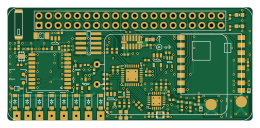
About the Pico pi rel PCB
Pico pi rel is an open source Microchip SAM PCB design by bristol-seds, published on GitHub under the MIT license. It is a 4-layer board measuring 65 × 30 mm, with 96 components from 46 distinct parts.
Its main chip is the ATSAMD20E17A-MU, from the Microchip SAM family. Other key parts include the ADM6823T, TPS73633, 74LVC1G32, RFM95_96_97_98W and TG-5006CJ. By type, the board carries 30 capacitors, 15 diodes, 15 resistors, 12 ICs, 10 connectors and 7 inductors.
It belongs with the rf & radio and power & battery designs in this gallery.
From the project
The folder contains the schematic files for the pico-pi header board. This provides us with the all the additional hardware functionality we need for a balloon tracker.
The folder contains the schematic files for the pico-pi header board. This provides us with the all the additional hardware functionality we need for a balloon tracker.
868MHz RFM96W LoRa Radio u-Blox MAX-M8Q GPS 144MHz and 434MHz Radios Microcontroller to act as watchdog Input diodes for solar panels optional ADXL345 accelerometer
We include a GPS Front End and a Chip Antenna. This choice of antenna trades off sensitivity for low mass, while the Front End mantains sufficient sensitivity and noise rejection.
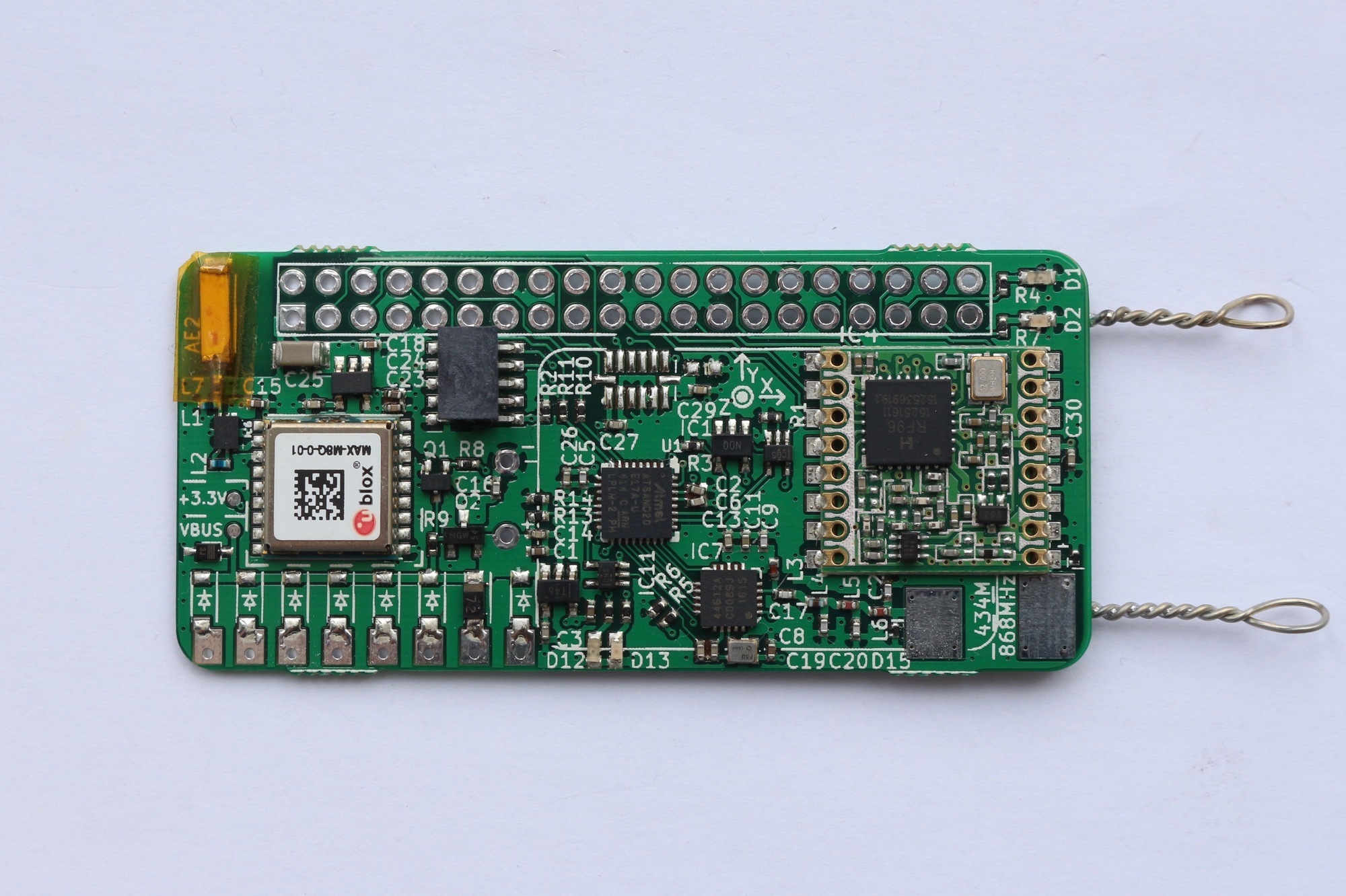
Main components on the Pico pi rel
Pico pi rel bill of materials (BOM)
96 components, 46 distinct parts.
| Qty | Part | Footprint | Refs |
|---|---|---|---|
| 1 | ADM6823T | SOT-23-5 | IC1 |
| 2 | TPS73633 | SOT-23-5 | IC2, IC9 |
| 1 | 74LVC1G32 | SC-70-5 | IC3 |
| 1 | RFM95_96_97_98W | RFM95_96_97_98W | IC4 |
| 1 | TG-5006CJ | TG-5006CJ | IC5 |
| 1 | BGM1034N7 | TSNP-7-10 | IC6 |
| 1 | Si4460 | QFN-20-EP-SI | IC7 |
| 1 | MAX-7Q | MAX-7Q | IC8 |
| 1 | ADXL345 | ADXL3x5 | IC10 |
| 1 | 74LVC1G126 | SC-70-5 | IC11 |
| 1 | ATSAMD20E17A-MU | QFN50P500X500X80-33 | U1 |
| 1 | BC847CW | SOT-323 | Q1 |
| 1 | NX2301P | SOT-23 | Q2 |
| 1 | SWD | FTSH-105-01-L-DV-K | P1 |
| 1 | Raspberry_Pi_+_Conn | Rasberry_Pi_Zero | P2 |
| 8 | PAD | 2mm_solder_pad | P3, P4, P5, P6, P7, P8, P9, P10 |
| 2 | ANT | WIREPAD | AE1, AE3 |
| 1 | ANT | 1575AT43A0040 | AE2 |
| 2 | TESTPAD | TESTPAD | TP1, TP2 |
| 1 | LED-WARN | 0603-LED | D1 |
Show 26 more
| Qty | Part | Footprint | Refs |
|---|---|---|---|
| 1 | LED-OK | 0603-LED | D2 |
| 8 | RB161M | SOD-123 | D3, D4, D5, D6, D7, D8, D9, D10 |
| 1 | 5.1V | SOD-323 | D11 |
| 1 | LED-1 | 0603-LED | D12 |
| 1 | LED-2 | 0603-LED | D13 |
| 2 | TVS_DIODE | TSLP-2-17 | D14, D15 |
| 2 | 8.2nH | 0402 | L1, L2 |
| 1 | 470nH | 0402 | L3 |
| 1 | 56nH | 0402 | L4 |
| 2 | 18nH | 0402 | L5, L6 |
| 1 | NOSTUFF | 0402 | L7 |
| 6 | 1µF | 0402 | C1, C4, C8, C15, C18, C24 |
| 12 | 100nF | 0402 | C2, C3, C6, C7, C11, C12, C14, C22 +4 |
| 3 | 100pF | 0402 | C5, C13, C16 |
| 1 | 2.2µF | 0402 | C9 |
| 1 | 5F,5.4V | PHV-5R4H505-R | C10 |
| 2 | 15pF | 0402 | C17, C20 |
| 2 | 8.2pF | 0402 | C19, C21 |
| 1 | 10nF | 0402 | C23 |
| 1 | 100µF | 1206 | C25 |
| 1 | 10µF | 0603 | C28 |
| 2 | 1MΩ | 0402 | R1, R3 |
| 3 | 10kΩ | 0402 | R2, R8, R14 |
| 6 | 330Ω | 0402 | R4, R7, R10, R11, R12, R15 |
| 3 | 100kΩ | 0402 | R5, R6, R9 |
| 1 | 33kΩ | 0402 | R13 |
Pico pi rel design files
The KiCad project lives in the bristol-seds/pico-pi-rel repository on GitHub; these links point at the commit this page was built from.
- Layouthw/pico-pi.kicad_pcb
Pico pi rel: common questions
What microcontroller does the Pico pi rel use?
The Pico pi rel is built around the ATSAMD20E17A-MU, from the Microchip SAM family.
How big is the Pico pi rel PCB?
The Pico pi rel measures 65 × 30 mm, has 4 copper layers and is 0.8 mm thick.
How many components are on the Pico pi rel?
96 components, from 46 distinct parts. The full bill of materials is listed on this page.
Where can I download the Pico pi rel design files?
From the bristol-seds/pico-pi-rel repository on GitHub, which has the KiCad layout; the links under Design files point to each one.
Can I use the Pico pi rel design in my own project?
Yes, under the terms of its MIT license, which bristol-seds chose for the repository.
Can I test firmware for the Pico pi rel without the hardware?
Yes. HardLabs builds a simulation of the board from its netlist and BOM, so you can run and debug Microchip SAM firmware against it before you order a PCB.
Similar boards
 Microchip SAM
Fpgaboy
Wren6991
50 × 50 mm89 parts4LNo license508 Microchip SAM
Kira
kiibohd
366.9 × 114.3 mm400 partsCERN-OHL-1.2415 Microchip SAM
DSKY driver
benkrasnow
43 × 92.3 mm44 partsMIT258 Microchip SAM
Duet 2 Maestro
Duet3D
100 × 123 mm336 partsCERN-OHL-1.2257 Microchip SAM
Makennbot
idlehandsdev
60 × 75 mm53 parts2LNo license175 Microchip SAM
Oxidized flash
blakesmith
61 × 21.6 mm19 parts2LNo license167