
TinyLlama

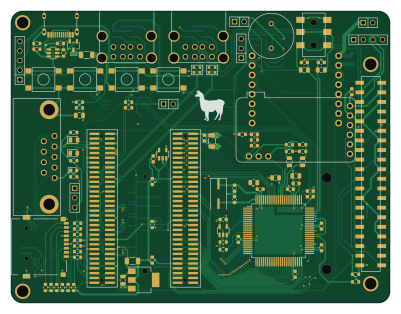
About the TinyLlama PCB
TinyLlama is an open source ESP8266 PCB design by eivindbohler, published on GitHub under the GPL-3.0 license. It is a 4-layer board measuring 100 × 77 mm, with 138 components from 65 distinct parts.
Its main chip is the D1_MINI, from the ESP8266 family. Other key parts include the U_MAX16054, U_AMS1117-3.3, U_CS4237B-KQ, U_74LVC1G04 and U_K24C08. By type, the board carries 46 capacitors, 38 resistors, 14 connectors, 8 ICs, 6 switches and 6 inductors.
It belongs with the audio, iot & wireless and displays & leds designs in this gallery.
From the project
A tiny x86 retro computer
- A fully-fledged 486/Pentium-class PC in a tiny form factor - Integrated Sound Blaster Pro-compatible audio - Add a Raspberry Pi Zero 2 for Roland MT‑32 and General MIDI music - Open-source hardware schematics, board layout and BIOS - build your own! - Perfect for playing DOS games!
The two main new features in version 2 are: Built-in hardware USB HID (keyboard+mouse) to PS/2 emulation using [rasteri's HIDman firmware][hidman] running on a CH559 microcontroller On-board Wemos D1 Mini ESP8266 for providing either a Hayes-compatible modem-over-WiFi or ethernet-over-WiFi (SLIP)…
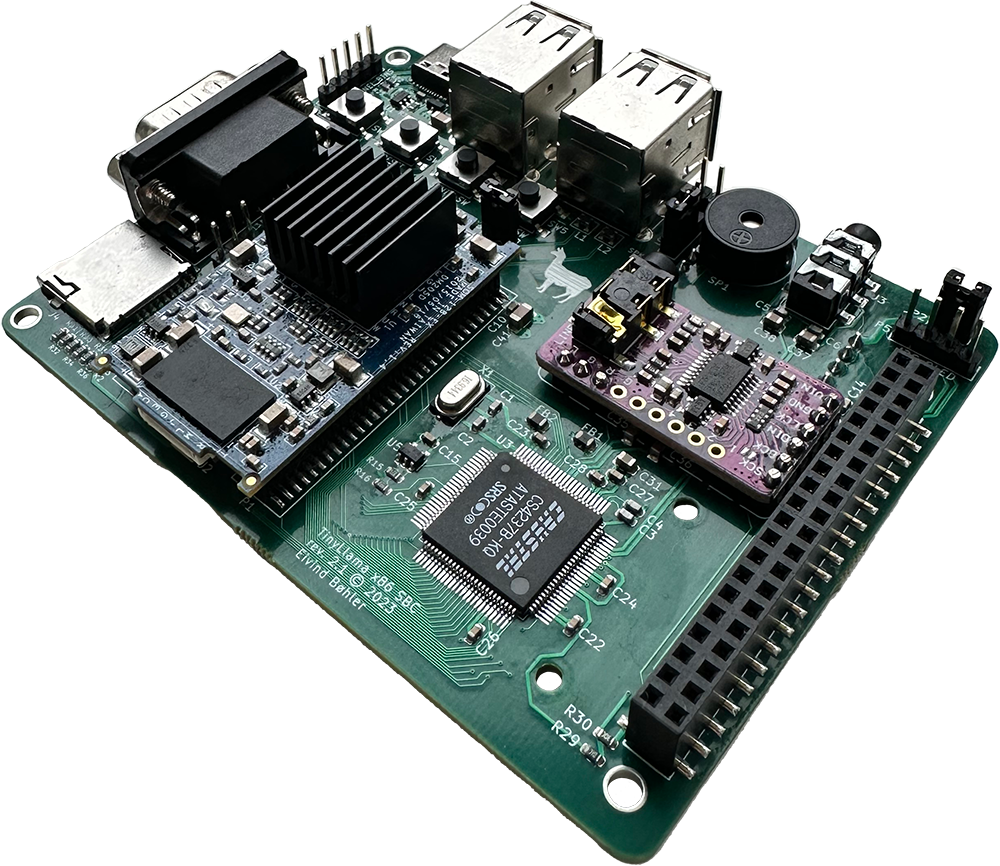
Main components on the TinyLlama
TinyLlama bill of materials (BOM)
138 components, 65 distinct parts.
| Qty | Part | Footprint | Refs |
|---|---|---|---|
| 1 | U_MAX16054 | U_TSOT-23-6 | U1 |
| 1 | U_AMS1117-3.3 | U_SOT-223-3_NOTAB | U2 |
| 1 | U_CS4237B-KQ | U_TQFP-100_14x14mm_P0.5mm_HandSoldering | U3 |
| 1 | U_74LVC1G04 | U_SOT-23-5 | U4 |
| 1 | U_K24C08 | U_SOT-23-5 | U5 |
| 1 | U_MAX3243 | U_SSOP-28_5.3x10.2mm_P0.65mm | U6 |
| 1 | GY-PCM5102 | U_GY-PCM5102 | U7 |
| 1 | U_CH559L | U_QFP-12x12_14x14_Pitch0.5mm | U8 |
| 1 | Q_PMOS_GDS | Q_PFET_ENH_SOT-23-3 | Q1 |
| 1 | NPN | Q_BJT_SOT-23-3 | Q2 |
| 1 | 16.9344MHz | X_Crystal_SMD_HC49S-MINI | X1 |
| 1 | J_USB_C | J_USB_TYPE-C-31-M-12 | J1 |
| 1 | J_MINI_PCIE | J_MINI_PCIE | J2 |
| 1 | AudioJack3 | J_AUDIO35_C95463 | J3 |
| 1 | MICRO_SD | J_MicroSD_TF01A | J4 |
| 1 | USB_NATIVE | J_USB_A_C12049 | J5 |
| 1 | USB_HID | J_USB_A_C12049 | J6 |
| 1 | J_PI_ZERO | J_CONN_RPI_SMD | J7 |
| 1 | D1_MINI | J_WEMOS_D1_MINI | J8 |
| 1 | P_SOM-128-EX | P_CONN_SOM-128-EX | P1 |
Show 45 more
| Qty | Part | Footprint | Refs |
|---|---|---|---|
| 1 | FAN_PWR | P_CONN_01X03_SQUARE | P2 |
| 1 | P_DE9M | P_DE9M | P3 |
| 1 | ESP_DEBUG | P_CONN_01X02_SQUARE | P4 |
| 1 | I2C_OLED | P_CONN_01X04_SQUARE | P5 |
| 1 | PANEL_BTNS | P_CONN_01X05_SQUARE | P6 |
| 1 | CR1220 | BT_MY-1220-03 | BT1 |
| 4 | F | Fuse_0603_1608Metric | F1, F2, F3, F4 |
| 4 | H_HOLE | H_440_HOLE | H1, H2, H3, H4 |
| 1 | SPKR_VOL | P_CONN_01X03_SQUARE | JP1 |
| 1 | ESP_POWER | P_CONN_01X02_SQUARE | JP2 |
| 1 | HID_POWER | P_CONN_01X02_SQUARE | JP3 |
| 1 | SPEAKER | SP | SP1 |
| 1 | POWER | SW_B3FS-1010 | SW1 |
| 1 | RESET | SW_B3FS-1010 | SW2 |
| 1 | FLASH | SW_B3FS-1010 | SW3 |
| 1 | SYNTH_SW | SW_B3FS-1010 | SW4 |
| 1 | ROM_SW | SW_B3FS-1010 | SW5 |
| 1 | PRG | SW_B3FS-1010 | SW6 |
| 1 | 1N4148 | D_SOD-323F | D1 |
| 1 | CONN | D_0603_1608Metric | D2 |
| 1 | TX | D_0805_2012Metric | D3 |
| 1 | RX | D_0805_2012Metric | D4 |
| 2 | FB | R_0805_2012Metric | FB1, FB2 |
| 4 | L_EMI_FILTER | L_EMI_FILTER_MCM2012B900GBE | L1, L2, L3, L4 |
| 2 | 22pF | C_0603_1608Metric | C1, C2 |
| 4 | 1nF | C_0603_1608Metric | C3, C4, C5, C6 |
| 1 | 2.7nF | C_0603_1608Metric | C7 |
| 1 | 10nF | C_0603_1608Metric | C8 |
| 22 | 0.1uF | C_0603_1608Metric | C9, C10, C11, C12, C13, C14, C15, C16 +14 |
| 1 | 1uF | C_0805_2012Metric | C31 |
| 1 | 3.3uF | C_0603_1608Metric | C32 |
| 6 | 10uF | C_0805_2012Metric | C33, C34, C35, C36, C37, C38 |
| 8 | 47uF | C_1206_3216Metric | C39, C40, C41, C42, C43, C44, C45, C46 |
| 1 | 0 | R_0603_1608Metric | R1 |
| 6 | 33 | R_0603_1608Metric | R2, R3, R4, R5, R6, R7 |
| 1 | 200 | R_0603_1608Metric | R8 |
| 1 | 470 | R_0603_1608Metric | R9 |
| 3 | 1k | R_0603_1608Metric | R10, R11, R12 |
| 1 | 1.5k | R_0603_1608Metric | R13 |
| 8 | 4.7k | R_0603_1608Metric | R14, R15, R16, R17, R18, R19, R20, R21 |
| 2 | 5.1k | R_0603_1608Metric | R22, R23 |
| 4 | 6.8k | R_0603_1608Metric | R24, R25, R26, R27 |
| 2 | 10k | R_0603_1608Metric | R28, R29 |
| 1 | 20k | R_0603_1608Metric | R30 |
| 8 | 47k | R_0603_1608Metric | R31, R32, R33, R34, R35, R36, R37, R38 |
TinyLlama design files
The KiCad project lives in the eivindbohler/tinyllama2 repository on GitHub; these links point at the commit this page was built from.
- Layoutkicad/TinyLlama.kicad_pcb
- Schematickicad/TinyLlama.kicad_sch
TinyLlama: common questions
What microcontroller does the TinyLlama use?
The TinyLlama is built around the D1_MINI, from the ESP8266 family.
How big is the TinyLlama PCB?
The TinyLlama measures 100 × 77 mm, has 4 copper layers and is 1.59 mm thick.
How many components are on the TinyLlama?
138 components, from 65 distinct parts. The full bill of materials is listed on this page.
Where can I download the TinyLlama design files?
From the eivindbohler/tinyllama2 repository on GitHub, which has the KiCad layout and the schematic; the links under Design files point to each one.
Can I use the TinyLlama design in my own project?
Yes, under the terms of its GPL-3.0 license, which eivindbohler chose for the repository.
Can I test firmware for the TinyLlama without the hardware?
Yes. HardLabs builds a simulation of the board from its netlist and BOM, so you can run and debug ESP8266 firmware against it before you order a PCB.
More boards in tinyllama2
Similar boards
 ESP8266
ESP8266ControllerCircuit
stuartpittaway
75 × 30 mm20 parts2LCC-BY-NC-4.01.1k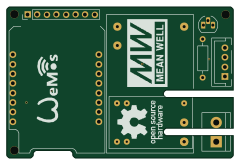 ESP8266
HASwitchPlate
aderusha
60 × 40 mm8 parts2LMIT738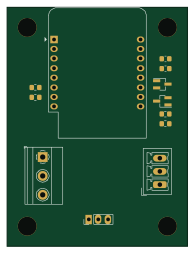 ESP8266
RatGDO-OpenSource-D1Mini-ESP8266
Kaldek
47.8 × 63.3 mm12 parts2LMIT506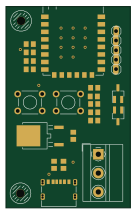 ESP8266
Goatgdo
32.9 × 53.3 mm23 parts2LMIT506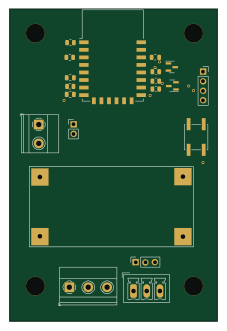 ESP8266
RatGDO-OpenSource-Bare-ESP8266
55 × 82.7 mm20 parts2LMIT506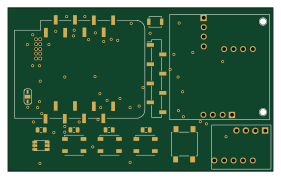 ESP8266
Iaq board
nkitanov
70.1 × 43.2 mm17 parts2LNo license398