
Tesseract

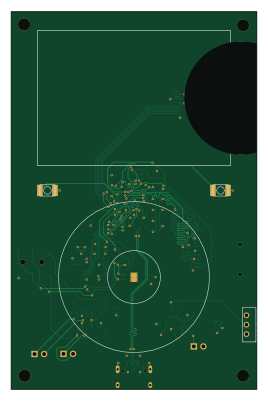
About the Tesseract PCB
Tesseract is an open source Raspberry Pi PCB design by hridcode, published on GitHub. It is a 4-layer board measuring 65 × 100 mm, with 82 components from 37 distinct parts.
Its main chip is the RP2354A, from the Raspberry Pi family. Other key parts include the C107671, C181692, C5446 and PAM8403D. By type, the board carries 43 capacitors, 18 resistors, 6 ICs, 5 connectors, 5 switches and 2 speakers.
It belongs with the audio, displays & leds and power & battery designs in this gallery.
From the project
Tesseract is a retro-style MP3 player with 32-bit stereo output to speakers and headphones, an LCD display, and battery charging for on-the-go listening.
Tesseract is a retro-style MP3 player with audio output to speakers and headphones, an LCD display, and battery charging for on-the-go listening. I made this because I wanted to have a dedicated device to run a library of my favorite music in a simplistic way, as a sort of action against streaming services.
- 32-bit 48kHz stereo output to speakers and headphones - microSD card file loading (up to 32GB) - 2.0" LCD display (ST7789) - Battery charging with power path - Album and artist shuffling modes - Genre tags
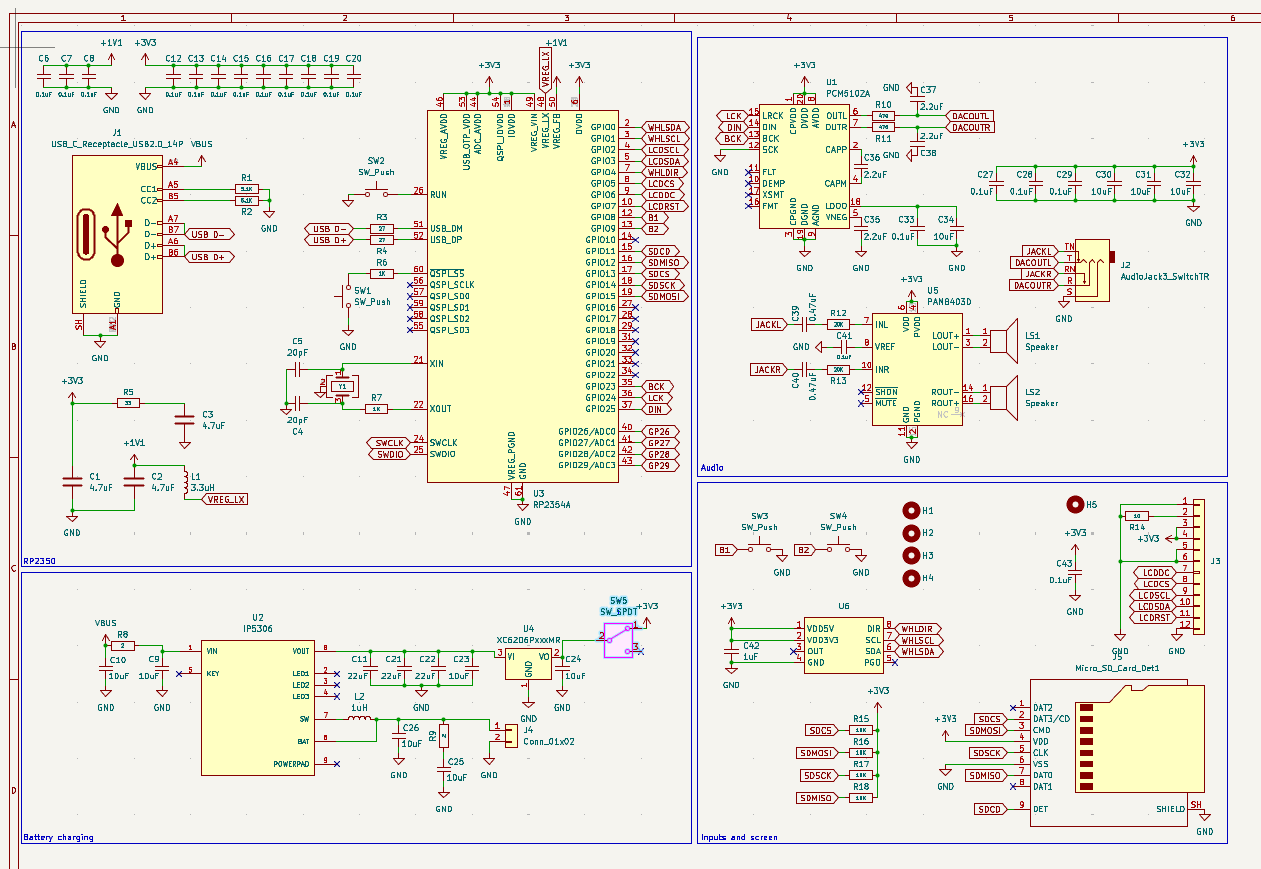
Main components on the Tesseract
Tesseract bill of materials (BOM)
82 components, 37 distinct parts — part numbers from the project's BOM.
| Qty | Part | Footprint | Refs |
|---|---|---|---|
| 1 | C107671 PCM5102A | TSSOP-20_4.4x6.5mm_P0.65mm | U1 |
| 1 | C181692 IP5306 | eSOP-8 | U2 |
| 1 | RP2354A | QFN-60-1EP_7x7mm_P0.4mm_EP3.4x3.4mm | U3 |
| 1 | C5446 XC6206PxxxMR | SOT-23-3 | U4 |
| 1 | PAM8403D | SOIC-16_3.9x9.9mm_P1.27mm | U5 |
| 1 | ~ | SOIC-8-1EP_3.9x4.9mm_P1.27mm_EP2.29x3mm_ThermalVias | U6 |
| 1 | C9002 Crystal_GND24 | Crystal_SMD_3225-4Pin_3.2x2.5mm | Y1 |
| 1 | C165948 USB_C_Receptacle_USB2.0_14P | USB_C_Receptacle_HRO_TYPE-C-31-M-12 | J1 |
| 1 | AudioJack3_SwitchTR | AUDIO-SMD_PJ-242_1 | J2 |
| 1 | Conn_01x12 | Hirose_FH12-12S-0.5SH_1x12-1MP_P0.50mm_Horizontal | J3 |
| 1 | Conn_01x02 | PinHeader_1x02_P2.54mm_Vertical | J4 |
| 1 | Micro_SD_Card_Det1 | TF-SMD_TF-CARD-H1.8 | J5 |
| 2 | Speaker | PinHeader_1x02_P2.54mm_Vertical | LS1, LS2 |
| 2 | SW_Push | L_Taiyo-Yuden_NR-40xx | SW1, SW2 |
| 2 | SW_Push | button_342 | SW3, SW4 |
| 1 | SW_SPDT | SW-TH_MSK12D18G2 | SW5 |
| 1 | C84474 3.3uH | L_0402_1005Metric | L1 |
| 1 | C84468 1uH | L_0402_1005Metric | L2 |
| 3 | C23733 4.7uF | C_0402_1005Metric | C1, C2, C3 |
| 2 | C1554 20pF | C_0402_1005Metric | C4, C5 |
Show 17 more
| Qty | Part | Footprint | Refs |
|---|---|---|---|
| 16 | C1525 0.1uF | C_0402_1005Metric | C6, C7, C8, C12, C13, C14, C15, C16 +8 |
| 10 | C15525 10uF | C_0402_1005Metric | C9, C10, C23, C24, C25, C26, C30, C31 +2 |
| 3 | C59461 22uF | C_0603_1608Metric | C11, C21, C22 |
| 4 | C12530 2.2uF | C_0402_1005Metric | C35, C36, C37, C38 |
| 2 | C1525 0.47uF | C_0402_1005Metric | C39, C40 |
| 1 | 0.1uF | C_0402_1005Metric | C41 |
| 1 | 1uF | C_0402_1005Metric | C42 |
| 1 | C15525 0.1uF | C_0402_1005Metric | C43 |
| 2 | C25905 5.1K | R_0402_1005Metric | R1, R2 |
| 2 | C25190 27 | R_0603_1608Metric | R3, R4 |
| 1 | C25105 33 | R_0402_1005Metric | R5 |
| 2 | C11702 1K | R_0402_1005Metric | R6, R7 |
| 2 | C22977 2 | R_0603_1608Metric | R8, R9 |
| 2 | C25117 470 | R_0402_1005Metric | R10, R11 |
| 2 | C25190 20K | R_0603_1608Metric | R12, R13 |
| 1 | C11702 10 | R_0402_1005Metric | R14 |
| 4 | C11702 10K | R_0402_1005Metric | R15, R16, R17, R18 |
Tesseract design files
The KiCad project lives in the hridcode/tesseract repository on GitHub; these links point at the commit this page was built from.
- Layoutsource/pcb/tesseract.kicad_pcb
- Schematicsource/pcb/tesseract.kicad_sch
- BOMBOM.csv
Tesseract: common questions
What microcontroller does the Tesseract use?
The Tesseract is built around the RP2354A, from the Raspberry Pi family.
How big is the Tesseract PCB?
The Tesseract measures 65 × 100 mm, has 4 copper layers and is 1.6 mm thick.
How many components are on the Tesseract?
82 components, from 37 distinct parts, with part numbers taken from the project's own BOM. The full bill of materials is listed on this page.
Where can I download the Tesseract design files?
From the hridcode/tesseract repository on GitHub, which has the KiCad layout, the schematic and the BOM; the links under Design files point to each one.
Can I use the Tesseract design in my own project?
The repository has no license, so all rights stay with hridcode. Use it as a reference, and ask the author before reusing the design.
Can I test firmware for the Tesseract without the hardware?
Yes. HardLabs builds a simulation of the board from its netlist and BOM, so you can run and debug Raspberry Pi firmware against it before you order a PCB.
Similar boards
 Raspberry Pi
Open source rover
nasa-jpl
220 × 178 mm144 parts2LApache-2.09.7k Raspberry Pi
SPIRIT
SPIRIT-org
82 × 155 mm130 parts6LCERN-OHL-S-2.01.3k Raspberry Pi
CM5RevEng
schlae
55 × 40 mm417 parts10LNo license1.0k Raspberry Pi
Haxo hw
cardonabits
102.4 × 211.3 mm38 parts2LCustom license672 Raspberry Pi
PowerBook
BlueSCSI
74.5 × 56.3 mm78 parts2LGPL-3.0449 Raspberry Pi
Desktop 50 Pin TopConn
89.2 × 82.6 mm103 parts2LGPL-3.0449