
Mouse lick detection

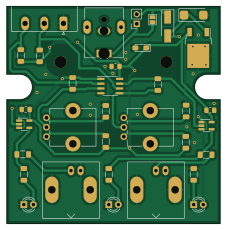
About the Mouse lick detection PCB
Mouse lick detection is an open source PCB design by iBehave-eLab, published on GitHub under the MIT license. It is a 2-layer board measuring 56.5 × 57.5 mm, with 33 components from 19 distinct parts.
Other key parts include the MCP6562, LM78M05_TO252 and 74LVC1G125. By type, the board carries 13 resistors, 5 capacitors, 4 ICs, 4 connectors, 4 diodes and 1 switch.
It belongs with the sensors designs in this gallery.
From the project
The circuits for detecting licks were developed and built by M. Ghanbari (University of Cologne).
The circuits for detecting licks were developed and built by M. Ghanbari (University of Cologne).
Lick Detector circuits - "The board is equipped with a comparator based on operational amplifier technology. The mouse traverses the board, which is grounded. The inverted input is connected to the lick spout via a wire. Upon licking the spout, the internal resistance of the mouse pulls the inverted input to ground, raising the comparator output to +Vcc. The reference voltage is set to +Vcc/2 using a voltage divider. In the normal state, when the mouse does not lick the spout, the output signal…
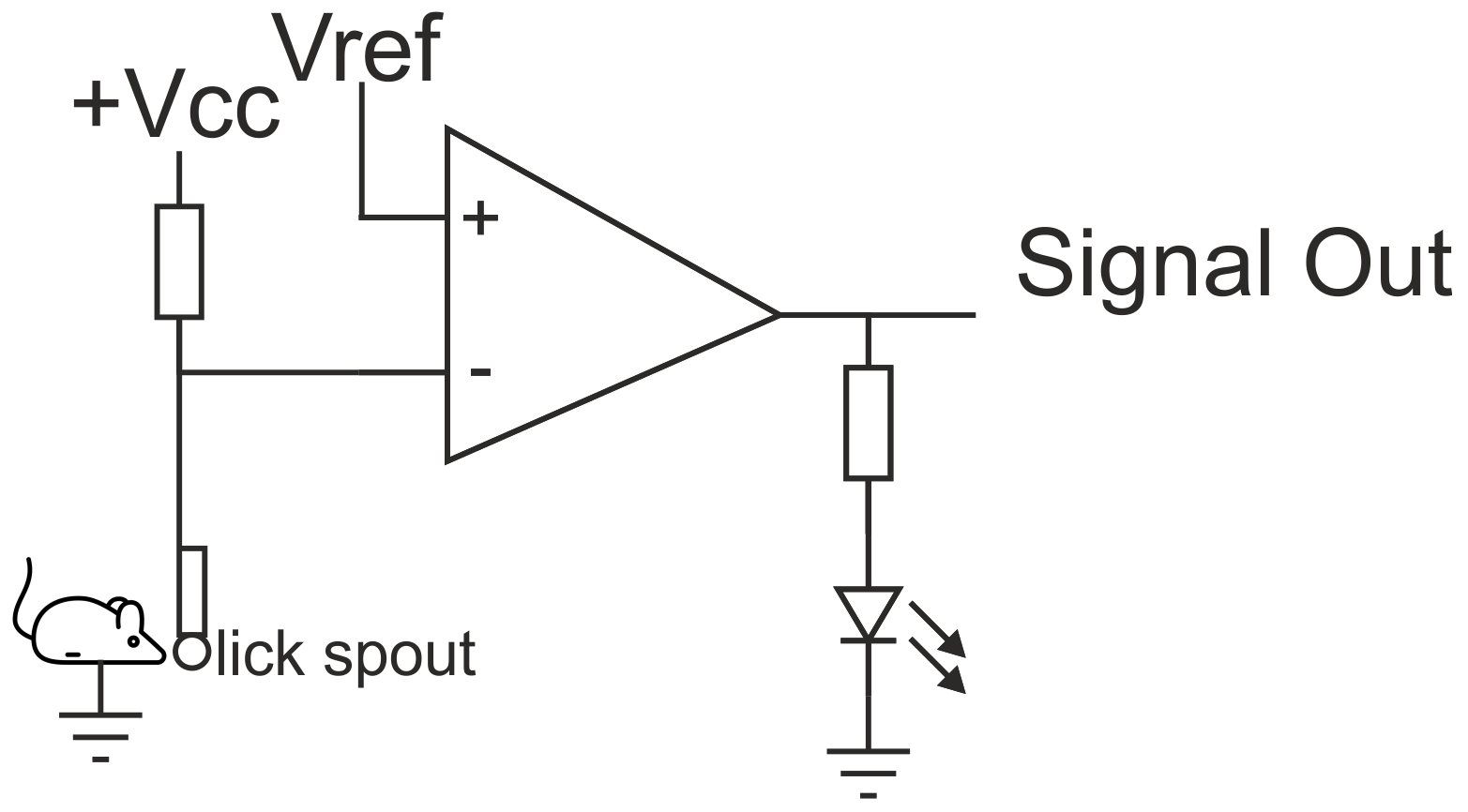
Main components on the Mouse lick detection
Mouse lick detection bill of materials (BOM)
33 components, 19 distinct parts.
| Qty | Part | Footprint | Refs |
|---|---|---|---|
| 1 | MCP6562 | SOIC-8_3.9x4.9mm_P1.27mm | U1 |
| 1 | LM78M05_TO252 | TO-252-2 | U2 |
| 2 | 74LVC1G125 | SOT-23-5_HandSoldering | U3, U4 |
| 1 | Barrel_Jack | BarrelJack_CUI_PJ-063AH_Horizontal | J1 |
| 1 | Conn_01x03 | PhoenixContact_MSTBA_2,5_3-G-5,08_1x03_P5.08mm_Horizontal | J2 |
| 2 | Conn_Coaxial | BNC_Amphenol_B6252HB-NPP3G-50_Horizontal | J3, J4 |
| 2 | 10k | Potentiometer_Alps_RK09K_Single_Vertical | RV1, RV2 |
| 1 | SW_SPST | PinSocket_1x02_P2.54mm_Vertical | SW1 |
| 1 | 10MQ040 | D_SMA_Handsoldering | D1 |
| 3 | LED | LED_D3.0mm | D2, D3, D4 |
| 1 | 10µ/25V | CP_EIA-6032-15_Kemet-U_Pad2.25x2.35mm_HandSolder | C1 |
| 1 | 10µ/10V | CP_EIA-3216-18_Kemet-A_Pad1.58x1.35mm_HandSolder | C2 |
| 3 | 100n | C_0805_2012Metric_Pad1.18x1.45mm_HandSolder | C3, C6, C7 |
| 1 | 3k3 | R_1206_3216Metric_Pad1.30x1.75mm_HandSolder | R1 |
| 2 | 47M | R_1206_3216Metric_Pad1.30x1.75mm_HandSolder | R2, R3 |
| 4 | 10k | R_1206_3216Metric_Pad1.30x1.75mm_HandSolder | R4, R5, R6, R7 |
| 2 | 50R | R_1206_3216Metric_Pad1.30x1.75mm_HandSolder | R10, R15 |
| 2 | 1,6k | R_1206_3216Metric_Pad1.30x1.75mm_HandSolder | R11, R14 |
| 2 | 4M7 | R_1206_3216Metric_Pad1.30x1.75mm_HandSolder | R12, R13 |
Mouse lick detection design files
The KiCad project lives in the iBehave-eLab/Mouse-lick-detection repository on GitHub; these links point at the commit this page was built from.
- LayoutBoard/603-A.kicad_pcb
- SchematicBoard/603-A.kicad_sch
Mouse lick detection: common questions
How big is the Mouse lick detection PCB?
The Mouse lick detection measures 56.5 × 57.5 mm, has 2 copper layers and is 1.6 mm thick.
How many components are on the Mouse lick detection?
33 components, from 19 distinct parts. The full bill of materials is listed on this page.
Where can I download the Mouse lick detection design files?
From the iBehave-eLab/Mouse-lick-detection repository on GitHub, which has the KiCad layout and the schematic; the links under Design files point to each one.
Can I use the Mouse lick detection design in my own project?
Yes, under the terms of its MIT license, which iBehave-eLab chose for the repository.
Similar boards
Sensor smd
scottbez1
40 × 20 mm5 parts2LApache-2.04.2k
Sensors
StuckAtPrototype
15.2 × 9 mm14 parts4LApache-2.03.8k
Microphone
Mentra-Community
5.5 × 6.1 mm6 parts2LMIT1.2k
TemperaturePCB PANEL
stuartpittaway
116 × 75.5 mm178 parts2LCC-BY-NC-4.01.1k
Pots
shanteacontrols
390 × 93 mm75 parts2LApache-2.0956
USB
52 × 12.6 mm6 parts2LApache-2.0956