
Halo pin


About the Halo pin PCB
Halo pin is an open source ESP32 PCB design by jayis1, published on GitHub. It is a 4-layer board measuring 80 × 50 mm, with 7 components from 7 distinct parts.
Its main chip is the ESP32-C3-MINI-1, from the ESP32 family. Other key parts include the STM32G474RET6, MAX17048G+T10 and SH1106. By type, the board carries 4 ICs, 2 connectors and 1 battery holder.
It belongs with the iot & wireless, power & battery and sensors designs in this gallery.
From the project
Novel SoC device designs: blueprints, schematics, firmware, and docs — a new invention every 24h.
This folder contains the KiCad 8 project files for the Halo Pin pocket optical particle counter.
- Analog/digital split: The OPT101 photodiode and its analog trace are on a separate analog island powered by LP5907-3.3. The ADC input trace (PA0) is kept short (< 20 mm) and shielded by ground pour. - Laser safety: A reed switch on PB12 detects the optical cell cover. The firmware refuses to fire the laser if the cover is open. - Ground: Star ground with separate AGND and DGND domains, joined at a single point under the STM32.
Main components on the Halo pin
Halo pin bill of materials (BOM)
7 components, 7 distinct parts — part numbers from the project's BOM.
| Qty | Part | Footprint | Refs |
|---|---|---|---|
| 1 | STM32G474RET6 STMicroelectronics | LQFP-64_10x10mm_P0.5mm | U1 |
| 1 | MAX17048G+T10 OPT101 Maxim/Analog | SO-8 | U7 |
| 1 | ESP32-C3-MINI-1 | ESP32-C3-MINI-1 | U11 |
| 1 | SH1106 | SH1106_128x64 | U12 |
| 1 | USB-C LEMO | USB_C_16pin | J1 |
| 1 | 12401548E4022 MicroSD Amphenol | MicroSD | J2 |
| 1 | 18650 | Keystone_1042 | BT1 |
Halo pin design files
The KiCad project lives in the jayis1/SoC-Device-Inventions repository on GitHub; these links point at the commit this page was built from.
Halo pin: common questions
What microcontroller does the Halo pin use?
The Halo pin is built around the ESP32-C3-MINI-1, from the ESP32 family.
How big is the Halo pin PCB?
The Halo pin measures 80 × 50 mm, has 4 copper layers and is 1.6 mm thick.
How many components are on the Halo pin?
7 components, from 7 distinct parts, with part numbers taken from the project's own BOM. The full bill of materials is listed on this page.
Where can I download the Halo pin design files?
From the jayis1/SoC-Device-Inventions repository on GitHub, which has the KiCad layout, the schematic and the BOM; the links under Design files point to each one.
Can I use the Halo pin design in my own project?
The repository has no license, so all rights stay with jayis1. Use it as a reference, and ask the author before reusing the design.
Can I test firmware for the Halo pin without the hardware?
Yes. HardLabs builds a simulation of the board from its netlist and BOM, so you can run and debug ESP32 firmware against it before you order a PCB.
More boards in SoC-Device-Inventions
 ESP32
ESP32Phyto pulse
80 × 50 mm37 parts4LNo license0 ESP32
ESP32Opti rot
160 × 65 mm34 parts2LNo license0 ESP32
ESP32QCM Halo — Pocket QCM-D Instrument
90 × 60 mm27 parts4LNo license0 ESP32
ESP32Refracto Bead — Pocket Digital Abbe Refractometer
85 × 54 mm25 parts4LNo license0- schematic only · 24 partsESP32
Gravi dot
24 partsNo license0  ESP32
ESP32Mold Scout
95 × 52 mm7 parts2LNo license0 ESP32
ESP32Thermo trace
50 × 45 mm5 parts2LNo license0
Similar boards
 ESP32
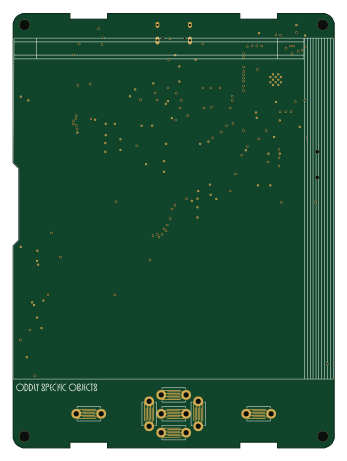
ESP32Open Book Abridged Edition
joeycastillo
85 × 115 mm65 parts2LCC-BY-SA-4.08.1k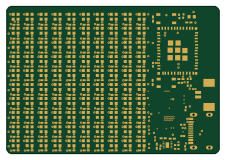 ESP32
ESP32Badge
atopile
56.3 × 39 mm239 parts4LMIT4.0k ESP32
ESP32Esp32 minimal
36.2 × 26.8 mm20 parts2LMIT4.0k ESP32
ESP32Racer
StuckAtPrototype
36 × 50.2 mm70 parts4LApache-2.03.8k ESP32
ESP32Controller
29 × 74 mm58 parts4LApache-2.03.8k ESP32
ESP32Bitaxe
skot
56.5 × 99.8 mm86 parts4LCERN-OHL-S-2.01.4k