
QCM Halo — Pocket QCM-D Instrument


About the QCM Halo — Pocket QCM-D Instrument PCB
QCM Halo — Pocket QCM-D Instrument is an open source ESP32 PCB design by jayis1, published on GitHub. It is a 4-layer board measuring 90 × 60 mm, with 27 components from 27 distinct parts.
Its main chip is the ESP32-C3-MINI-1, from the ESP32 family. Other key parts include the STM32G474RET6, AD8331ARZ, LMG1210RVRT, LM5022MM and MD0100. By type, the board carries 18 ICs, 4 connectors, 1 module, 1 battery holder and 1 LED.
It belongs with the iot & wireless, test & measurement and power & battery designs in this gallery.
From the project
Novel SoC device designs: blueprints, schematics, firmware, and docs — a new invention every 24h.
QCM Halo is a pocket-sized Quartz Crystal Microbalance with Dissipation monitoring (QCM-D) instrument that measures nanogram-scale mass changes and viscoelastic properties of thin films, coatings, biomolecular layers, and liquids in real time.
A QCM-D works by driving an AT-cut quartz crystal resonator at its series resonance frequency (typically 5–10 MHz), tracking frequency shifts (Δf) to measure mass changes via the Sauerbrey equation, and simultaneously measuring the dissipation factor (D) — the rate at which the crystal's oscillation decays when the drive is briefly turned off. The…
Main components on the QCM Halo — Pocket QCM-D Instrument
QCM Halo — Pocket QCM-D Instrument bill of materials (BOM)
27 components, 27 distinct parts — part numbers from the project's BOM.
| Qty | Part | Footprint | Refs |
|---|---|---|---|
| 1 | STM32G474RET6 STMicroelectronics | LQFP-64_10x10mm_P0.5mm | U1 |
| 1 | ESP32-C3-MINI-1 Espressif | ESP32-C3-MINI-1 | U2 |
| 1 | AD8331ARZ Si5351A-B-GT Analog Devices | MSOP-10_3x3mm_P0.5mm | U3 |
| 1 | LMG1210RVRT ADS122U04 Texas Instruments | TSSOP-16_4.4x5mm_P0.65mm | U4 |
| 1 | LM5022MM LTC1968 Texas Instruments | MSOP-8_3x3mm_P0.5mm | U5 |
| 1 | MD0100 ADG918 Microchip | SC-70-6 | U6 |
| 1 | MAX17048G+T10 ADG918 Maxim/Analog | SC-70-6 | U7 |
| 1 | TP4056 OPA656 NanJing Top Power | SOT-23-6 | U8 |
| 1 | TPS63020DSJR OPA656 Texas Instruments | SOT-23-6 | U9 |
| 1 | SSD1306-128X64-SPI DS18B20 Solomon SSD1306 | TO-92_Inline | U10 |
| 1 | BME280 | Bosch_LGA-8 | U11 |
| 1 | MT3601 | SOT-23-6 | U12 |
| 1 | DRV8833 | SOIC-16_3.9x9.9mm_P1.27mm | U13 |
| 1 | ULN2003A | DIP-16_W7.62mm | U14 |
| 1 | MCP73831T-2ACI | SOT-23-5 | U15 |
| 1 | TPS63020 | QFN-14 | U16 |
| 1 | TPS7A4700 | TO-263-7 | U17 |
| 1 | W25Q128JVSIQ | SOIC-8_3.9x4.9mm_P1.27mm | U18 |
| 1 | 28BYJ-48 | M1 | |
| 1 | MicroSD LEMO | MicroSD_socket | J1 |
Show 7 more
| Qty | Part | Footprint | Refs |
|---|---|---|---|
| 1 | 12401548E4022 QCM_CH1 Amphenol | PinHeader_1x03 | J2 |
| 1 | 502774-0891 QCM_CH2 Molex | PinHeader_1x03 | J3 |
| 1 | USB-C-16P PIN-4 | USB_C_Receptacle_HRO_TYPE-C-16P | J4 |
| 1 | 3.7V 2000mAh LiPo | BatteryHolder_Lipo | BT1 |
| 1 | PT1000-4wire | PT1000_probe | RT1 |
| 1 | TEC1-12704 | TEC_40x40mm | TEC1 |
| 1 | SH1106-1.3 | OLED_128x64_1.3in | DISP1 |
QCM Halo — Pocket QCM-D Instrument design files
The KiCad project lives in the jayis1/SoC-Device-Inventions repository on GitHub; these links point at the commit this page was built from.
QCM Halo — Pocket QCM-D Instrument: common questions
What microcontroller does the QCM Halo — Pocket QCM-D Instrument use?
The QCM Halo — Pocket QCM-D Instrument is built around the ESP32-C3-MINI-1, from the ESP32 family.
How big is the QCM Halo — Pocket QCM-D Instrument PCB?
The QCM Halo — Pocket QCM-D Instrument measures 90 × 60 mm, has 4 copper layers and is 1.6 mm thick.
How many components are on the QCM Halo — Pocket QCM-D Instrument?
27 components, from 27 distinct parts, with part numbers taken from the project's own BOM. The full bill of materials is listed on this page.
Where can I download the QCM Halo — Pocket QCM-D Instrument design files?
From the jayis1/SoC-Device-Inventions repository on GitHub, which has the KiCad layout, the schematic and the BOM; the links under Design files point to each one.
Can I use the QCM Halo — Pocket QCM-D Instrument design in my own project?
The repository has no license, so all rights stay with jayis1. Use it as a reference, and ask the author before reusing the design.
Can I test firmware for the QCM Halo — Pocket QCM-D Instrument without the hardware?
Yes. HardLabs builds a simulation of the board from its netlist and BOM, so you can run and debug ESP32 firmware against it before you order a PCB.
More boards in SoC-Device-Inventions
 ESP32
ESP32Phyto pulse
80 × 50 mm37 parts4LNo license0 ESP32
ESP32Opti rot
160 × 65 mm34 parts2LNo license0 ESP32
ESP32Refracto Bead — Pocket Digital Abbe Refractometer
85 × 54 mm25 parts4LNo license0- schematic only · 24 partsESP32
Gravi dot
24 partsNo license0  ESP32
ESP32Mold Scout
95 × 52 mm7 parts2LNo license0 ESP32
ESP32Halo pin
80 × 50 mm7 parts4LNo license0 ESP32
ESP32Thermo trace
50 × 45 mm5 parts2LNo license0
Similar boards
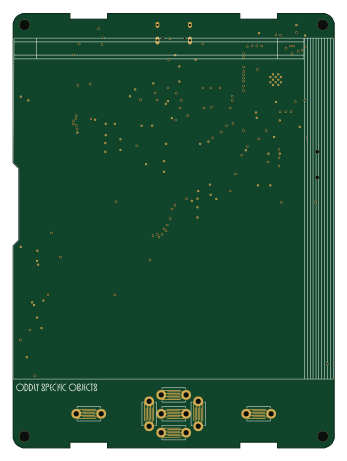 ESP32
ESP32Open Book Abridged Edition
joeycastillo
85 × 115 mm65 parts2LCC-BY-SA-4.08.1k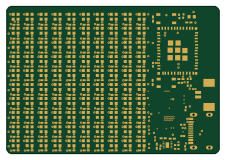 ESP32
ESP32Badge
atopile
56.3 × 39 mm239 parts4LMIT4.0k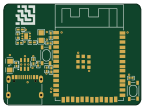 ESP32
ESP32Esp32 minimal
36.2 × 26.8 mm20 parts2LMIT4.0k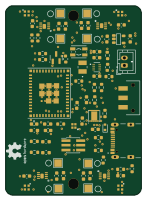 ESP32
ESP32Racer
StuckAtPrototype
36 × 50.2 mm70 parts4LApache-2.03.8k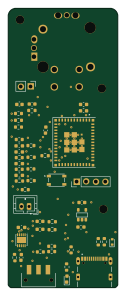 ESP32
ESP32Controller
29 × 74 mm58 parts4LApache-2.03.8k ESP32
ESP32Bitaxe
skot
56.5 × 99.8 mm86 parts4LCERN-OHL-S-2.01.4k