
Waste-Classification using-ML

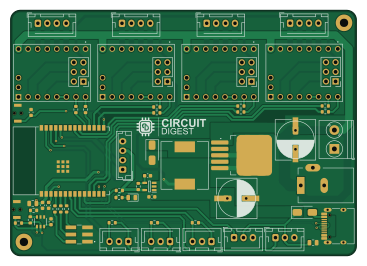
About the Waste-Classification using-ML PCB
Waste-Classification using-ML is an open source ESP32 PCB design by jobitjoseph, published on GitHub. It is a 2-layer board measuring 91.6 × 65 mm, with 62 components from 27 distinct parts.
Its main chip is the ESP32-C6-WROOM-1, from the ESP32 family. Other key parts include the ADP7118AUJZ-3.3-R7, LM2596S-5, MAX6899AAZT+T and TMC2209_SILENTSTEPSTICK. By type, the board carries 20 resistors, 17 connectors, 10 capacitors, 8 ICs, 3 diodes and 2 switches.
It belongs with the robotics & motion designs in this gallery.
From the project
Waste Classification Using Machine Learning and SCARA Robotic Arm This project introduces an innovative solution to automate waste segregation using a SCARA Robot enhanced with computer vision and machine learning. The project used a pre-deployed AI model to classify the objects
Waste Classification Using Machine Learning and SCARA Robotic Arm This project introduces an innovative solution to automate waste segregation using a SCARA Robot enhanced with computer vision and machine learning. The project used a pre-deployed AI model to classify the objects into organic or inorganic waste. At its core, the project utilises a Raspberry Pi paired with a USB camera to capture images of waste materials, this captured image is then processed with the help of inference SDK and the Roboflow waste classification API. Once classified, the robotic arm, controlled by an ESP32-C6…
Main components on the Waste-Classification using-ML
Waste-Classification using-ML bill of materials (BOM)
62 components, 27 distinct parts — part numbers from the project's BOM.
| Qty | Part | Footprint | Refs |
|---|---|---|---|
| 1 | ADP7118AUJZ-3.3-R7 | SOT95P280X100-5N | IC1 |
| 1 | LM2596S-5 | TO-263-5_TabPin3 | U1 |
| 1 | MAX6899AAZT+T | MAX6899AAZT+T | U2 |
| 1 | ESP32-C6-WROOM-1 | ESP32-C6-WROOM-1 | U3 |
| 4 | TMC2209_SILENTSTEPSTICK | MODULE_TMC2209_SILENTSTEPSTICK | U4, U5, U6, U7 |
| 1 | SCREW_TERMINAL_2_P5.00MM Screw_Terminal_2_P5.00mm | TerminalBlock_Phoenix_PT-1,5-2-5.0-H_1x02_P5.00mm_Horizontal | J1 |
| 1 | Barrel_Jack_Switch | BarrelJack_Kycon_KLDX-0202-xC_Horizontal | J2 |
| 1 | USB_C_RECEPTACLE_USB2.0 USB_C_Receptacle_USB2.0 | USB_C_Receptacle_HRO_TYPE-C-31-M-12 | J3 |
| 4 | CONN_02X03_TOP_BOTTOM Conn_02x03_Top_Bottom | PinHeader_2x03_P2.54mm_Vertical | J4, J6, J8, J10 |
| 4 | CONN_01X04 Conn_01x04 | JST_XH_B4B-XH-AM_1x04_P2.50mm_Vertical | J5, J7, J9, J11 |
| 5 | CONN_01X03 Conn_01x03 | JST_XH_B3B-XH-AM_1x03_P2.50mm_Vertical | J12, J13, J14, J15, J16 |
| 1 | CONN_01X04 Conn_01x04 | JST_EH_B4B-EH-A_1x04_P2.50mm_Vertical | J17 |
| 1 | RST | Tactile 3x4x2mm TS-A010 | SW1 |
| 1 | BOOT | Tactile 3x4x2mm TS-A010 | SW2 |
| 1 | 150505M173300 | 150505M173300 | LED1 |
| 2 | SS34 | D_SMA | D1, D3 |
| 1 | LED | LED_0805_2012Metric | D2 |
| 1 | 47UH 47uH | L_12x12mm_H8mm | L1 |
| 2 | 330UF 330uF | CAP_J-V_10X10P5_RUB | C1, C2 |
| 1 | 2.2UF 2.2uF | C_0603_1608Metric | C3 |
Show 7 more
| Qty | Part | Footprint | Refs |
|---|---|---|---|
| 1 | NC | C_0603_1608Metric | C4 |
| 2 | 10UF 10uF | C_0805_2012Metric | C5, C10 |
| 4 | 0.1UF 0.1uF | C_0603_1608Metric | C7, C8, C9, C11 |
| 1 | 0 | R_0603_1608Metric | R1 |
| 7 | 10K | R_0603_1608Metric | R2, R4, R5, R9, R18, R20, R21 |
| 1 | 47K | R_0603_1608Metric | R3 |
| 11 | 1K | R_0603_1608Metric | R6, R7, R8, R10, R11, R12, R13, R14 +3 |
Waste-Classification using-ML design files
The KiCad project lives in the jobitjoseph/Waste-Classification-using-ML repository on GitHub; these links point at the commit this page was built from.
Waste-Classification using-ML: common questions
What microcontroller does the Waste-Classification using-ML use?
The Waste-Classification using-ML is built around the ESP32-C6-WROOM-1, from the ESP32 family.
How big is the Waste-Classification using-ML PCB?
The Waste-Classification using-ML measures 91.6 × 65 mm, has 2 copper layers and is 1.6 mm thick.
How many components are on the Waste-Classification using-ML?
62 components, from 27 distinct parts, with part numbers taken from the project's own BOM. The full bill of materials is listed on this page.
Where can I download the Waste-Classification using-ML design files?
From the jobitjoseph/Waste-Classification-using-ML repository on GitHub, which has the KiCad layout, the schematic and the BOM; the links under Design files point to each one.
Can I use the Waste-Classification using-ML design in my own project?
The repository has no license, so all rights stay with jobitjoseph. Use it as a reference, and ask the author before reusing the design.
Can I test firmware for the Waste-Classification using-ML without the hardware?
Yes. HardLabs builds a simulation of the board from its netlist and BOM, so you can run and debug ESP32 firmware against it before you order a PCB.
Similar boards
 ESP32
ESP32Open Book Abridged Edition
joeycastillo
85 × 115 mm65 parts2LCC-BY-SA-4.08.1k ESP32
ESP32Badge
atopile
56.3 × 39 mm239 parts4LMIT4.0k ESP32
ESP32Esp32 minimal
36.2 × 26.8 mm20 parts2LMIT4.0k ESP32
ESP32Racer
StuckAtPrototype
36 × 50.2 mm70 parts4LApache-2.03.8k ESP32
ESP32Controller
29 × 74 mm58 parts4LApache-2.03.8k ESP32
ESP32Bitaxe
skot
56.5 × 99.8 mm86 parts4LCERN-OHL-S-2.01.4k