
ESP32-wrover

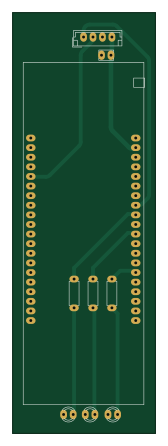
About the ESP32-wrover PCB
ESP32-wrover is an open source ESP32 PCB design by KabitaShahu, published on GitHub. It is a 2-layer board measuring 37.8 × 111.3 mm, with 9 components from 5 distinct parts.
Its main chip is the ESP32_T18 - 3.0, from the ESP32 family. By type, the board carries 3 diodes, 3 resistors, 1 connector and 1 capacitor.
ESP32-wrover bill of materials (BOM)
9 components, 5 distinct parts.
| Qty | Part | Footprint | Refs |
|---|---|---|---|
| 1 | Conn_01x04_Pin | jst_4 | J1 |
| 1 | ESP32_T18 - 3.0 | ESP32_T18-3.0 | ESP32T1 |
| 3 | LED | LED_D3.0mm | D1, D2, D3 |
| 1 | C | Capacitor_Disc_Small | C1 |
| 3 | R | Resistor_small | R1, R2, R3 |
ESP32-wrover design files
The KiCad project lives in the KabitaShahu/Circuit repository on GitHub; these links point at the commit this page was built from.
ESP32-wrover: common questions
What microcontroller does the ESP32-wrover use?
The ESP32-wrover is built around the ESP32_T18 - 3.0, from the ESP32 family.
How big is the ESP32-wrover PCB?
The ESP32-wrover measures 37.8 × 111.3 mm, has 2 copper layers and is 1.6 mm thick.
How many components are on the ESP32-wrover?
9 components, from 5 distinct parts. The full bill of materials is listed on this page.
Where can I download the ESP32-wrover design files?
From the KabitaShahu/Circuit repository on GitHub, which has the KiCad layout and the schematic; the links under Design files point to each one.
Can I use the ESP32-wrover design in my own project?
The repository has no license, so all rights stay with KabitaShahu. Use it as a reference, and ask the author before reusing the design.
Can I test firmware for the ESP32-wrover without the hardware?
Yes. HardLabs builds a simulation of the board from its netlist and BOM, so you can run and debug ESP32 firmware against it before you order a PCB.
More boards in Circuit
Microscope
133 × 64.1 mm43 parts2LNo license0 STM32
BLUEPILL
69.5 × 85.9 mm35 parts2LNo license0
New pi pico
77.5 × 87.5 mm32 parts2LNo license0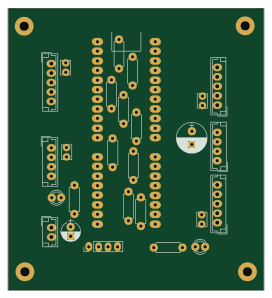 STM32
BLUEPILL NANO
67.5 × 74.4 mm27 parts2LNo license0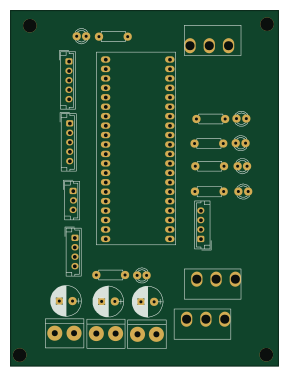
Pi pico
70.8 × 94.1 mm27 parts2LNo license0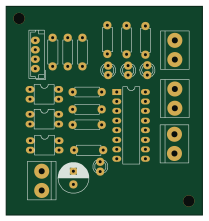
Numatic optocoupler
52 × 55.3 mm24 parts2LNo license0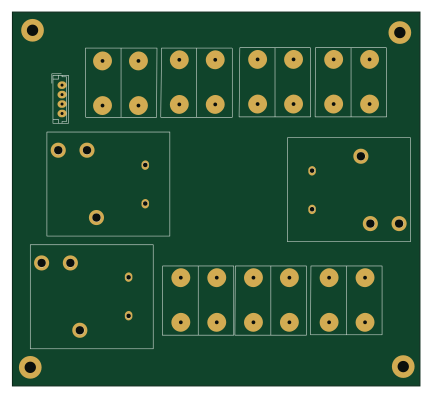
Relay power supply
107.7 × 98.8 mm11 parts2LNo license0
Similar boards
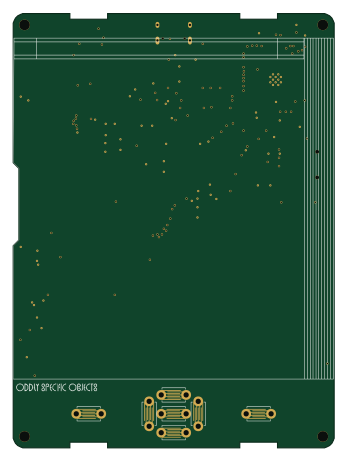 ESP32
OSO-BOOK-B1
joeycastillo
85 × 115 mm65 parts2LCC-BY-SA-4.08.1k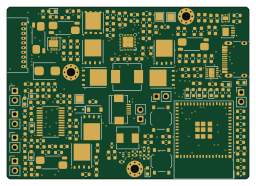 ESP32
Powertrain
byrantech
64 × 45.4 mm171 parts4LMIT4.3k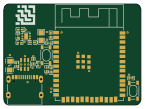 ESP32
Esp32 minimal
atopile
36.2 × 26.8 mm20 parts2LMIT4.0k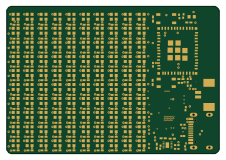 ESP32
Badge
56.3 × 39 mm239 parts4LMIT4.0k ESP32
Racer
StuckAtPrototype
36 × 50.2 mm70 parts4LApache-2.03.8k ESP32
Controller
29 × 74 mm58 parts4LApache-2.03.8k