
Bmi-270-board v3

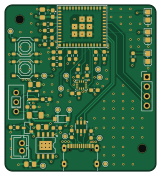
About the Bmi-270-board v3
Bmi-270-board v3 is an open source ESP32 PCB design by lewipewi, published on GitHub. It is a 4-layer board measuring 40 × 44 mm, with 44 components from 24 distinct parts.
Its main chip is the ESP32-C3-MINI-1-N4, from the ESP32 family. Other key parts include the AP2112K-3.3TRG1_C23380830, TP4056 and BMI270. By type, the board carries 17 resistors, 11 capacitors, 4 ICs, 3 switches, 3 LEDs and 2 connectors.
It belongs with the iot & wireless, power & battery and usb & debug tools designs in this gallery.
From the project
Wearable 6-axis motion node for an IMU gesture controller. Each node samples a Bosch BMI270 at 200 Hz and streams it over ESP-NOW to a USB receiver on a PC, where a classifier turns boxing motions into gamepad inputs (Tekken 7 / Steve Fox). Three identical nodes are worn: left wr
Wearable 6-axis motion node for an IMU gesture controller. Each node samples a Bosch BMI270 at 200 Hz and streams it over ESP-NOW to a USB receiver on a PC, where a classifier turns boxing motions into gamepad inputs (Tekken 7 / Steve Fox). Three identical nodes are worn: left wrist, right wrist, chest.
v3 is a full redesign of v2. v2 was built, debugged through five faults, and finally found to be unflashable (see What went wrong on v2). v3's priorities, in order: (1) flashable, (2) debuggable, (3) charging, (4) everything else.
Main components on the Bmi-270-board v3
Bmi-270-board v3 bill of materials (BOM)
44 components, 24 distinct parts.
| Qty | Part | Footprint | Refs |
|---|---|---|---|
| 1 | AP2112K-3.3TRG1_C23380830 TECH PUBLIC(台舟) | C23380830_SOT-23-5_L2_9-W1_6-P0_95-LS2_8-BR | U1 |
| 1 | TP4056 TOPPOWER(南京拓微) | C16581_ESOP-8_L4_9-W3_9-P1_27-LS6_0-BL-EP | U2 |
| 1 | ESP32-C3-MINI-1-N4 ESPRESSIF(乐鑫) | C2838502_WIFIM-SMD_ESP32-C3-MINI-1 | U4 |
| 1 | BMI270 Bosch(博世) | C2836813_LGA-14_L3_0-W2_5-P0_50-BR | U5 |
| 1 | AO3401 HKT(合科泰) | C181091_SOT-23-3_L2_9-W1_3-P1_90-LS2_4-BR | Q1 |
| 1 | B2B-PH-K-S(LF)(SN) JST | C131337_CONN-TH_B2B-PH-K-S | J1 |
| 1 | Conn_01x04_Pin | PinHeader_1x04_P2.54mm_Vertical | J2 |
| 2 | TS-1187A-B-A-B XKB Connection(中国星坤) | C318884_SW-SMD_4P-L5_1-W5_1-P3_70-LS6_5-TL_H1_5 | SW1, SW2 |
| 1 | SS-12D00-G3 SOFNG(硕方) | C22355741_SW-TH_3P-L8_8-W3_9-P2_50_SS12D00G3 | SW3 |
| 1 | TYPE-C 16PIN 2MD(073) SHOU HAN(首韩) | C2765186_USB-C-SMD_TYPE-C-16PIN-2MD-073 | USB1 |
| 3 | YLED0805G YONGYUTAI(永裕泰) | C25170728_LED0805-FD-GREEN | LED1, LED2, LED3 |
| 1 | USBLC6-2SC6 ST(意法半导体) | C7519_SOT-23-6_L2_9-W1_6-P0_95-LS2_8-BL | D1 |
| 1 | MBR0520LT1G onsemi(安森美) | C23848_SOD-123_L2_8-W1_8-LS3_7-RD | D2 |
| 4 | 10uF | C_0805_2012Metric_Pad1.18x1.45mm_HandSolder | C1, C2, C4, C7 |
| 1 | 22uF | C_1206_3216Metric_Pad1.33x1.80mm_HandSolder | C3 |
| 2 | 1uF | C_0603_1608Metric_Pad1.08x0.95mm_HandSolder | C5, C9 |
| 4 | 100nF | C_0603_1608Metric_Pad1.08x0.95mm_HandSolder | C6, C8, C10, C11 |
| 2 | 5.1k | R_0603_1608Metric_Pad0.98x0.95mm_HandSolder | R1, R2 |
| 5 | 10k | R_0603_1608Metric_Pad0.98x0.95mm_HandSolder | R3, R8, R9, R10, R11 |
| 3 | 4.7k | R_0603_1608Metric_Pad0.98x0.95mm_HandSolder | R4, R16, R17 |
Show 4 more
| Qty | Part | Footprint | Refs |
|---|---|---|---|
| 1 | 100k | R_0603_1608Metric_Pad0.98x0.95mm_HandSolder | R5 |
| 3 | 1M | R_0603_1608Metric_Pad0.98x0.95mm_HandSolder | R6, R7, R14 |
| 2 | 330 | R_0603_1608Metric_Pad0.98x0.95mm_HandSolder | R12, R13 |
| 1 | 1k | R_0603_1608Metric_Pad0.98x0.95mm_HandSolder | R15 |
Bmi-270-board v3 design files
The KiCad project lives in the lewipewi/bmi-270-board-v3 repository on GitHub; these links point at the commit this page was built from.
Bmi-270-board v3: common questions
What microcontroller does the Bmi-270-board v3 use?
The Bmi-270-board v3 is built around the ESP32-C3-MINI-1-N4, from the ESP32 family.
How big is the Bmi-270-board v3?
The Bmi-270-board v3 measures 40 × 44 mm, has 4 copper layers and is 1.6062 mm thick.
How many components are on the Bmi-270-board v3?
44 components, from 24 distinct parts. The full bill of materials is listed on this page.
Where can I download the Bmi-270-board v3 design files?
From the lewipewi/bmi-270-board-v3 repository on GitHub, which has the KiCad layout; the links under Design files point to each one.
Can I use the Bmi-270-board v3 design in my own project?
The repository has no license, so all rights stay with lewipewi. Use it as a reference, and ask the author before reusing the design.
Can I test firmware for the Bmi-270-board v3 without the hardware?
Yes. HardLabs builds a simulation of the board from its netlist and BOM, so you can run and debug ESP32 firmware against it before you order a PCB.
Similar boards
 ESP32
OSO-BOOK-B1
joeycastillo
85 × 115 mm65 parts2LCC-BY-SA-4.08.1k ESP32
Powertrain
byrantech
64 × 45.4 mm171 parts4LMIT4.3k ESP32
Badge
atopile
56.3 × 39 mm239 parts4LMIT4.0k ESP32
Esp32 minimal
36.2 × 26.8 mm20 parts2LMIT4.0k ESP32
Controller
StuckAtPrototype
29 × 74 mm58 parts4LApache-2.03.8k ESP32
Racer
36 × 50.2 mm70 parts4LApache-2.03.8k