
運び屋用

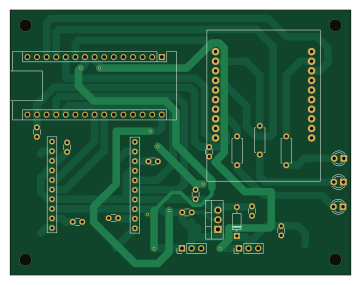
About the 運び屋用 PCB
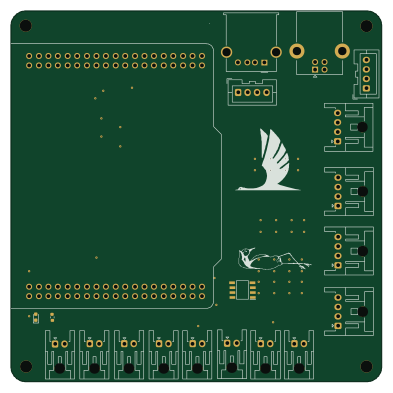
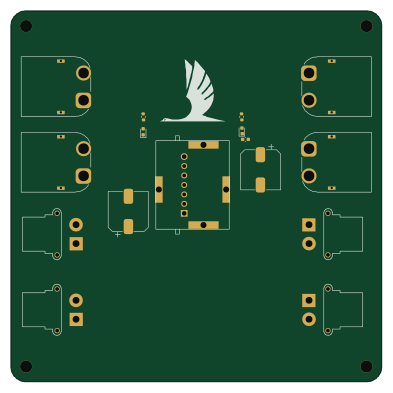
運び屋用 is an open source STM32 PCB design by makizusi, published on GitHub. It is a 2-layer board measuring 90 × 70 mm, with 24 components from 12 distinct parts.
Its main chip is the STM32F446RETX, from the STM32 family. Other key parts include the MCP2551-I-SN and Arduino_Nano_Every. By type, the board carries 10 capacitors, 4 diodes, 3 resistors, 2 ICs, 2 connectors and 1 module.
From the project
作成した回路
https://github.com/makizusi/-circuit/blob/main/%E8%A8%AD%E8%A8%88%E6%84%8F%E5%9B%B3.pdf
Main components on the 運び屋用
運び屋用 bill of materials (BOM)
24 components, 12 distinct parts — part numbers from the project's BOM.
| Qty | Part | Footprint | Refs |
|---|---|---|---|
| 1 | STM32F446RETX IM920sL | IM920c-ADP_1 | U1 |
| 1 | MCP2551-I-SN LM7805_TO220 | TO-220-3_Vertical | U2 |
| 1 | Arduino_Nano_Every | Arduino_Nano | A1 |
| 2 | Conn_01x03 | PinHeader_1x03_P2.54mm_Vertical | J3, J4 |
| 2 | ~ | BA6222 | MD1, MD2 |
| 3 | LED | LED_D3.0mm | D1, D2, D3 |
| 1 | C3758192 D | D_DO-35_SOD27_P7.62mm_Horizontal | D4 |
| 3 | 1UF 10μ | C_Disc_D3.0mm_W1.6mm_P2.50mm | C1, C4, C5 |
| 3 | 1UF 0.1μ | C_Disc_D3.0mm_W1.6mm_P2.50mm | C2, C3, C6 |
| 2 | 47U C | C_Disc_D3.0mm_W1.6mm_P2.50mm | C7, C9 |
| 2 | 0.1U C | C_Disc_D3.0mm_W1.6mm_P2.50mm | C8, C10 |
| 3 | R | R_Axial_DIN0207_L6.3mm_D2.5mm_P7.62mm_Horizontal | R1, R2, R3 |
運び屋用 design files
The KiCad project lives in the makizusi/-circuit repository on GitHub; these links point at the commit this page was built from.
運び屋用: common questions
What microcontroller does the 運び屋用 use?
The 運び屋用 is built around the STM32F446RETX, from the STM32 family.
How big is the 運び屋用 PCB?
The 運び屋用 measures 90 × 70 mm, has 2 copper layers and is 1.6 mm thick.
How many components are on the 運び屋用?
24 components, from 12 distinct parts, with part numbers taken from the project's own BOM. The full bill of materials is listed on this page.
Where can I download the 運び屋用 design files?
From the makizusi/-circuit repository on GitHub, which has the KiCad layout, the schematic and the BOM; the links under Design files point to each one.
Can I use the 運び屋用 design in my own project?
The repository has no license, so all rights stay with makizusi. Use it as a reference, and ask the author before reusing the design.
Can I test firmware for the 運び屋用 without the hardware?
Yes. HardLabs builds a simulation of the board from its netlist and BOM, so you can run and debug STM32 firmware against it before you order a PCB.
More boards in -circuit
Similar boards
 STM32
STM32AxxSolder
AxxAxx
39 × 82.5 mm122 parts2LGPL-3.01.7k STM32
STM32AIOC
skuep
21 × 31.5 mm47 parts2LMIT1.4k STM32
STM32Ferris
pierrechevalier83
208.8 × 86.8 mm102 parts2LSHL-2.11.3k STM32
STM32Module 16S
stuartpittaway
71.1 × 89.6 mm113 parts4LCC-BY-NC-4.01.1k STM32
STM32Djinn
tzarc
192.3 × 150.5 mm216 parts2LCERN-OHL-S-2.0988 STM32
STM32Ghoul
228.6 × 79.4 mm163 parts2LCERN-OHL-S-2.0988