
Super Sixteen v1

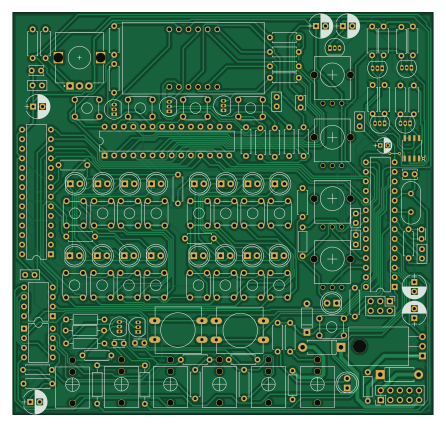
About the Super Sixteen v1 PCB
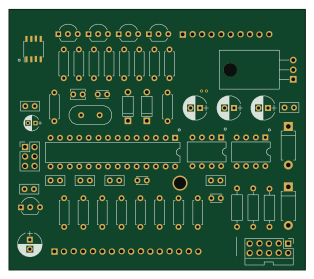
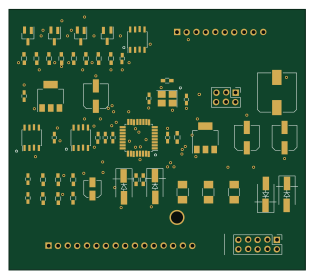
Super Sixteen v1 is an open source AVR/Arduino PCB design by matthewcieplak, published on GitHub. It is a 2-layer board measuring 111.3 × 106.4 mm, with 141 components from 52 distinct parts.
Its main chip is the ATMEGA328P-PU, from the AVR/Arduino family. Other key parts include the L7805, LP2950-3.3_TO92, MCP23S17, W25Q80DVSN and TL072. By type, the board carries 42 resistors, 24 switches, 21 diodes, 20 capacitors, 9 transistors and 9 connectors.
It belongs with the audio designs in this gallery.
From the project
Code and schematics for the Super Sixteen Eurorack sequencer
At just 20HP, it is a compact and powerful 64-step control voltage sequencer with 99 song patch memory, motion recording, scale selection, realtime pitch and rhythm effects, paraphonic modes, generative mutations, and a uniquely powerful two-handed programming interface.
Video blogs documenting the sequencer progress are available on youtube.
USER MANUAL (pdf) BUILD GUIDE (pdf) BILL OF MATERIALS (octopart list) INTERACTIVE BOM (html - for easy part placement) CPU board / Control board Video build guide 1v/oct calibration tutorial video Build support thread on Mod Wiggler ModularGrid page
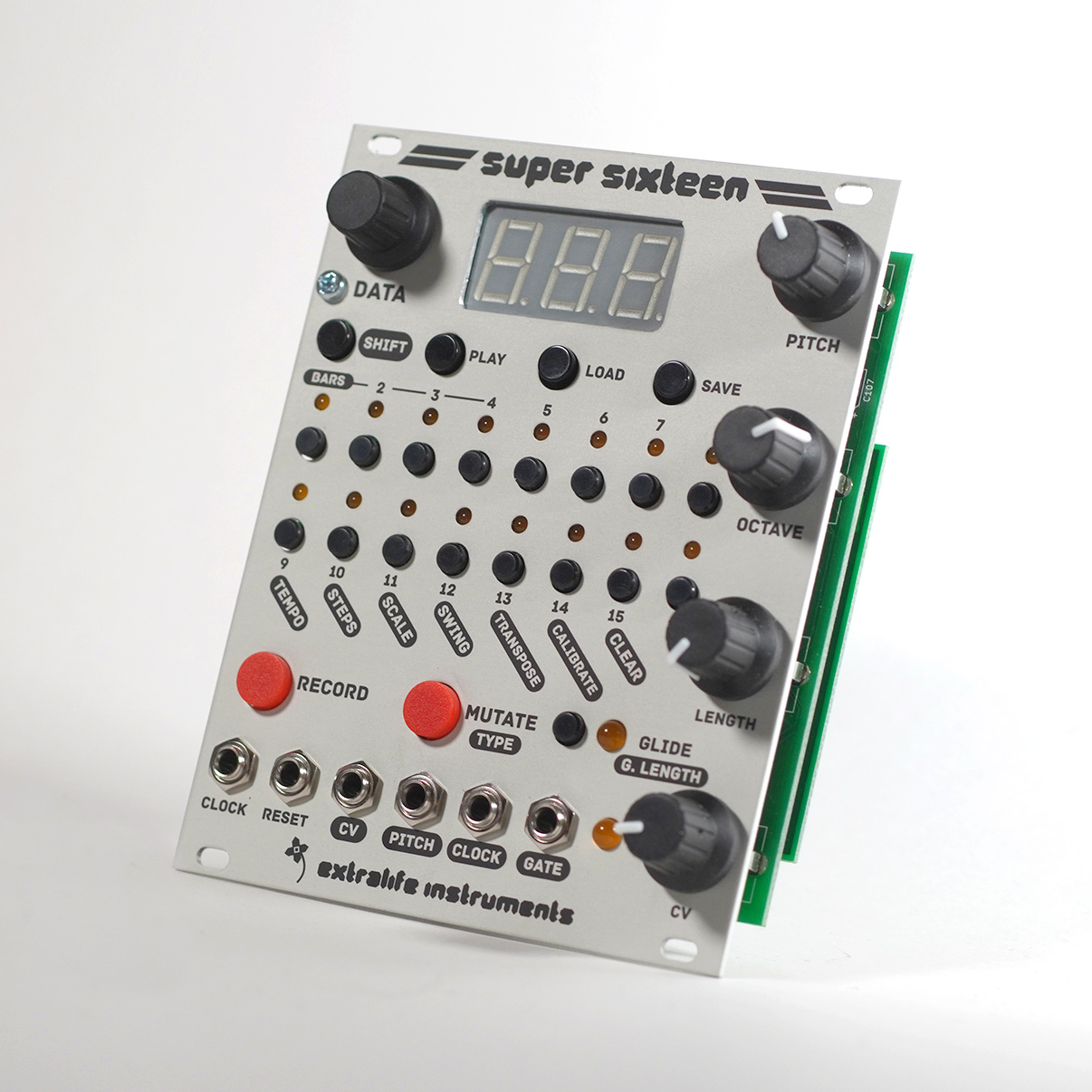
Main components on the Super Sixteen v1
Super Sixteen v1 bill of materials (BOM)
141 components, 52 distinct parts — part numbers from the project's BOM.
| Qty | Part | Footprint | Refs |
|---|---|---|---|
| 1 | L7805 | TO-220-3_Horizontal | U1 |
| 1 | ATMEGA328P-PU | DIP-28_W7.62mm | U2 |
| 1 | LP2950-3.3_TO92 | TO-92_Inline_Narrow_Oval | U3 |
| 2 | MCP23S17 | DIP-28_W7.62mm | U4, U6 |
| 1 | W25Q80DVSN | SOIC-8_3.9x4.9mm_Pitch1.27mm | U5 |
| 1 | TL072 | DIP-8_W7.62mm | U7 |
| 1 | MCP4822 | DIP-8_W7.62mm | U8 |
| 4 | 2N7000 | TO-92_Inline_Narrow_Oval | Q1, Q2, Q6, Q7 |
| 5 | 2N3904 | TO-92_Inline_Narrow_Oval | Q3, Q4, Q5, Q8, Q9 |
| 1 | 16mHz | Crystal_HC18-U_Vertical | Y1 |
| 1 | Gate Out | PJ301M-12 | J1 |
| 1 | Clock Out | PJ301M-12 | J2 |
| 1 | Clock In | PJ301M-12 | J3 |
| 1 | Conn_02x05_Odd_Even | Pin_Header_Straight_2x05_Pitch2.54mm | J4 |
| 1 | ICSP Header | Pin_Header_Straight_2x03_Pitch2.54mm | J5 |
| 1 | Pitch Out | PJ301M-12 | J6 |
| 1 | CV Out | PJ301M-12 | J7 |
| 1 | Reset In | PJ301M-12 | J8 |
| 1 | BA56_3DIG_7SEG | BA56_3DIG_7SEG | J9 |
| 4 | B100K | Alpha9mmPot | RV1, RV2, RV3, RV4 |
Show 32 more
| Qty | Part | Footprint | Refs |
|---|---|---|---|
| 16 | SW | SW_TH_Tactile_Omron_B3F-10xx | S1, S2, S3, S4, S5, S6, S7, S8 +8 |
| 1 | Load | SW_TH_Tactile_Omron_B3F-10xx | S17 |
| 1 | Save | SW_TH_Tactile_Omron_B3F-10xx | S18 |
| 1 | Play | SW_TH_Tactile_Omron_B3F-10xx | S19 |
| 1 | Shift | SW_TH_Tactile_Omron_B3F-10xx | S20 |
| 1 | GlideBtn | SW_TH_Tactile_Omron_B3F-10xx | S23 |
| 1 | Encoder | RotaryEncoder_Alps_EC12E_Vertical_H20mm | SW1 |
| 1 | Repeat | SW_PUSH-12mm | SW2 |
| 1 | Mutate | SW_PUSH-12mm | SW3 |
| 1 | TSS54URGG LED Taiwan Semiconductor | LED_D5.0mm | D1 |
| 16 | LED | LED_D5.0mm | D2, D3, D4, D5, D6, D7, D8, D9 +8 |
| 1 | GlideLED | LED_D5.0mm | D18 |
| 1 | BAT85 | D_A-405_P7.62mm_Horizontal | D20 |
| 1 | 1N4001 | D_DO-15_P10.16mm_Horizontal | D21 |
| 1 | D | D_DO-15_P10.16mm_Horizontal | D22 |
| 3 | L | L_Axial_L5.3mm_D2.2mm_P7.62mm_Horizontal_Vishay_IM-1 | L1, L2, L3 |
| 6 | 47uF | CP_Radial_D6.3mm_P2.50mm | C1, C8, C11, C12, C18, C19 |
| 3 | 22pf | C_Disc_D3.0mm_W2.0mm_P2.50mm | C2, C17, C20 |
| 1 | 1uF | CP_Radial_D4.0mm_P2.00mm | C3 |
| 7 | 100nF | C_Disc_D5.0mm_W2.5mm_P2.50mm | C4, C5, C7, C9, C13, C15, C16 |
| 1 | 22pf | C_Disc_D3.8mm_W2.6mm_P2.50mm | C6 |
| 2 | 100pF | C_Disc_D3.8mm_W2.6mm_P2.50mm | C10, C14 |
| 12 | 100 | R_Axial_DIN0207_L6.3mm_D2.5mm_P7.62mm_Horizontal | R1, R3, R5, R6, R20, R21, R22, R23 +4 |
| 4 | 10k | R_Axial_DIN0207_L6.3mm_D2.5mm_P7.62mm_Horizontal | R2, R32, R33, R40 |
| 1 | 1M | R_Axial_DIN0207_L6.3mm_D2.5mm_P7.62mm_Horizontal | R4 |
| 3 | R | R_Axial_DIN0207_L6.3mm_D2.5mm_P7.62mm_Horizontal | R7, R8, R28 |
| 15 | 1k | R_Axial_DIN0207_L6.3mm_D2.5mm_P7.62mm_Horizontal | R9, R10, R11, R12, R13, R14, R15, R16 +7 |
| 2 | 10k | R_Axial_DIN0207_L6.3mm_D2.5mm_P10.16mm_Horizontal | R30, R38 |
| 1 | 100k | R_Axial_DIN0207_L6.3mm_D2.5mm_P7.62mm_Horizontal | R34 |
| 2 | 1M | R_Axial_DIN0207_L6.3mm_D2.5mm_P10.16mm_Horizontal | R36, R42 |
| 1 | 47k | R_Axial_DIN0207_L6.3mm_D2.5mm_P7.62mm_Horizontal | R39 |
| 1 | 100k | R_Axial_DIN0207_L6.3mm_D2.5mm_P10.16mm_Horizontal | R41 |
Super Sixteen v1 design files
The KiCad project lives in the matthewcieplak/super-sixteen repository on GitHub; these links point at the commit this page was built from.
Super Sixteen v1: common questions
What microcontroller does the Super Sixteen v1 use?
The Super Sixteen v1 is built around the ATMEGA328P-PU, from the AVR/Arduino family.
How big is the Super Sixteen v1 PCB?
The Super Sixteen v1 measures 111.3 × 106.4 mm, has 2 copper layers and is 1.6 mm thick.
How many components are on the Super Sixteen v1?
141 components, from 52 distinct parts, with part numbers taken from the project's own BOM. The full bill of materials is listed on this page.
Where can I download the Super Sixteen v1 design files?
From the matthewcieplak/super-sixteen repository on GitHub, which has the KiCad layout and the BOM; the links under Design files point to each one.
Can I use the Super Sixteen v1 design in my own project?
The repository has no license, so all rights stay with matthewcieplak. Use it as a reference, and ask the author before reusing the design.
Can I test firmware for the Super Sixteen v1 without the hardware?
Yes. HardLabs builds a simulation of the board from its netlist and BOM, so you can run and debug AVR/Arduino firmware against it before you order a PCB.
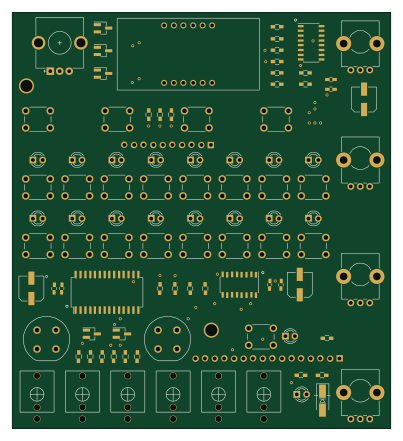
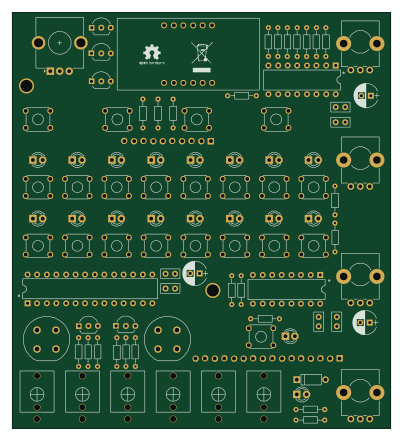
More boards in super-sixteen
Similar boards
 AVR/Arduino
Redox keyboard
mattdibi
162.2 × 126.5 mm77 parts2LMIT2.0k AVR/Arduino
ModuleV450
stuartpittaway
30 × 61.4 mm39 parts2LCC-BY-NC-4.01.1k AVR/Arduino
V4
30 × 50 mm38 parts2LCC-BY-NC-4.01.1k AVR/Arduino
Discipline
coseyfannitutti
304.9 × 122.8 mm170 parts2LCC-BY-NC-4.01.0k AVR/Arduino
Megadesk
gcormier
41.7 × 32.2 mm23 parts2LGPL-3.0818 AVR/Arduino
Easyduino Atmega Nano
Hanqaqa
43.4 × 18 mm30 parts4LCERN-OHL-P-2.0746