
Azukar-FPGA

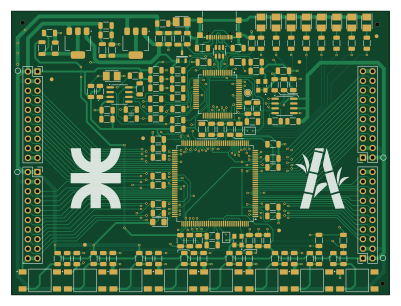
About the Azukar-FPGA PCB
Azukar-FPGA is an open source FPGA PCB design by maxisimonazzi, published on GitHub under the CERN-OHL-P-2.0 license. It is a 2-layer board measuring 100 × 75 mm, with 140 components from 31 distinct parts.
Its main chip is the ICE40HX4K-TQ144, from the FPGA family. Other key parts include the TLV76133DCYR, TLV76112DCYR, USBLC6-2SC6, FT2232HL and M93C66. By type, the board carries 53 capacitors, 48 resistors, 11 diodes, 8 switches, 7 ICs and 5 connectors.
It belongs with the dev boards & breakouts designs in this gallery.
From the project
Open-source FPGA development board for education and digital design learning. Designed for accessibility, reproducibility and seamless integration with open FPGA toolchains for students, makers and academic environments.
AZUKAR is an open-source FPGA development board designed for digital design education, laboratory training, and rapid prototyping. It provides an accessible and reproducible hardware platform that enables students, makers, and engineers to explore HDL design, digital systems architecture, and FPGA-based applications using open toolchains.
The project follows open hardware principles and is optimized for academic environments, hands-on learning, and experimentation.
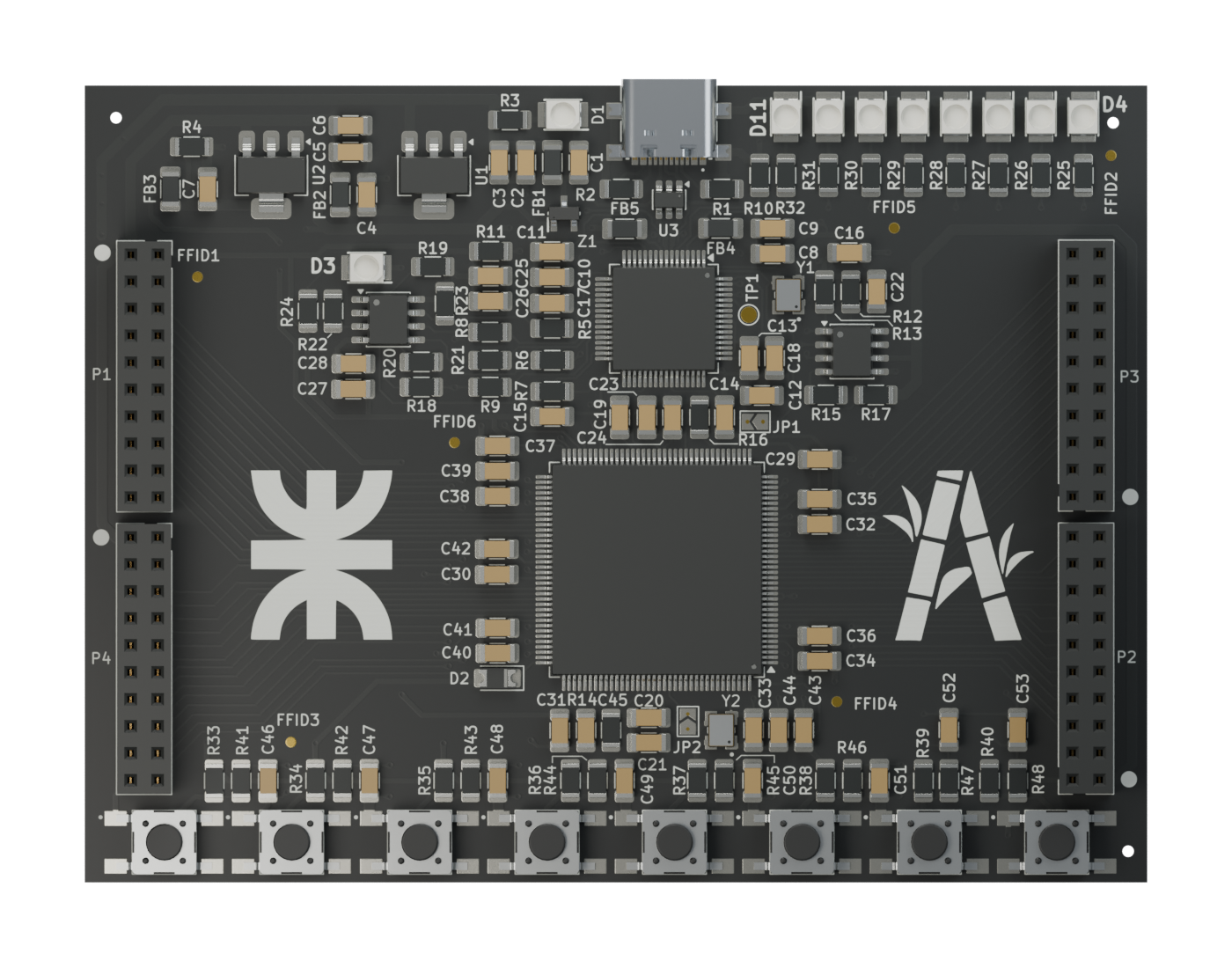
Main components on the Azukar-FPGA
Azukar-FPGA bill of materials (BOM)
140 components, 31 distinct parts — part numbers from the project's BOM.
| Qty | Part | Footprint | Refs |
|---|---|---|---|
| 1 | TLV76133DCYR | SOT-223-3_TabPin2 | U1 |
| 1 | TLV76112DCYR | SOT-223-3_TabPin2 | U2 |
| 1 | USBLC6-2SC6 | SOT-23-6 | U3 |
| 1 | FT2232HL | LQFP-64_10x10mm_P0.5mm | U4 |
| 1 | M93C66 | SOIC-8_3.9x4.9mm_P1.27mm | U5 |
| 1 | ICE40HX4K-TQ144 | TQFP-144_20x20mm_P0.5mm | U6 |
| 1 | W25X40CLSN | SOIC-8_3.9x4.9mm_P1.27mm | U7 |
| 1 | ECS-3225MV-120-CN ECS-3225MV-120-CN-TR | OSC_ECS-3225MV-120-CN-TR | Y1 |
| 1 | ECS-3225MVQ-1000-CN ECS-3225MVQ-1000-CN-TR | OSC_ECS-3225MV-120-CN-TR | Y2 |
| 1 | USB_C_RECEPTACLE_USB2.0_16P USB_C_Receptacle_USB2.0_16P | GSB1C41110SSHR | J1 |
| 4 | Conector 2x10 | PinSocket_2x10_P2.54mm_Vertical | P1, P2, P3, P4 |
| 8 | SW_Push | SW_TS04-66-75-BK-100-SMT | SW1, SW2, SW3, SW4, SW5, SW6, SW7, SW8 |
| 1 | MMBZ5231BLT3G | SOT96P237X111-3N | Z1 |
| 2 | LED Red | LEDM3528X210N | D1, D3 |
| 1 | D_Schottky | D_1206_3216Metric_Pad1.42x1.75mm_HandSolder | D2 |
| 8 | LED Green | LEDM3528X210N | D4, D5, D6, D7, D8, D9, D10, D11 |
| 5 | FerriteBead_Small | L_1206_3216Metric | FB1, FB2, FB3, FB4, FB5 |
| 3 | 10N 10n | C_1206_3216Metric | C1, C25, C27 |
| 27 | 100N 100n | C_1206_3216Metric | C2, C5, C8, C10, C13, C14, C15, C16 +19 |
| 14 | 10U 10u | C_1206_3216Metric | C3, C4, C6, C7, C20, C23, C46, C47 +6 |
Show 11 more
| Qty | Part | Footprint | Refs |
|---|---|---|---|
| 2 | 4U7 4u7 | C_1206_3216Metric | C9, C11 |
| 1 | 3U3 3u3 | C_1206_3216Metric | C12 |
| 6 | 1u | C_1206_3216Metric | C26, C28, C34, C37, C40, C43 |
| 2 | 5K1 5k1 | R_1206_3216Metric | R1, R2 |
| 3 | 1k | R_1206_3216Metric | R3, R11, R24 |
| 1 | 120 | R_1206_3216Metric | R4 |
| 24 | 220 | R_1206_3216Metric | R5, R6, R7, R8, R9, R21, R22, R23 +16 |
| 1 | 12K 12k | R_1206_3216Metric | R10 |
| 14 | 10K 10k | R_1206_3216Metric | R12, R13, R17, R18, R19, R20, R41, R42 +6 |
| 2 | 100 | R_1206_3216Metric | R14, R16 |
| 1 | 2K2 2k2 | R_1206_3216Metric | R15 |
Azukar-FPGA design files
The KiCad project lives in the maxisimonazzi/Azukar-FPGA repository on GitHub; these links point at the commit this page was built from.
Azukar-FPGA: common questions
What microcontroller does the Azukar-FPGA use?
The Azukar-FPGA is built around the ICE40HX4K-TQ144, from the FPGA family.
How big is the Azukar-FPGA PCB?
The Azukar-FPGA measures 100 × 75 mm, has 2 copper layers and is 1.6 mm thick.
How many components are on the Azukar-FPGA?
140 components, from 31 distinct parts, with part numbers taken from the project's own BOM. The full bill of materials is listed on this page.
Where can I download the Azukar-FPGA design files?
From the maxisimonazzi/Azukar-FPGA repository on GitHub, which has the KiCad layout, the schematic and the BOM; the links under Design files point to each one.
Can I use the Azukar-FPGA design in my own project?
Yes, under the terms of its CERN-OHL-P-2.0 license, which maxisimonazzi chose for the repository.
Can I test firmware for the Azukar-FPGA without the hardware?
Yes. HardLabs builds a simulation of the board from its netlist and BOM, so you can run and debug FPGA firmware against it before you order a PCB.
Similar boards
 FPGA
FPGABase board
GlasgowEmbedded
80 × 49 mm222 parts4L0BSD2.2k FPGA
FPGAThunderscope Rev5.3
EEVengers
122.5 × 103.5 mm817 parts6LMIT1.3k FPGA
FPGAUsb sniffer
ataradov
58.2 × 38.1 mm86 parts2LBSD-3-Clause1.3k FPGA
FPGATomu, I'm
theacodes
13 × 9.4 mm40 parts4LMIT1.1k FPGA
FPGAIcepi zero
cheyao
65 × 30 mm143 parts4LSHL-2.1828 FPGA
FPGASd2snes
mrehkopf
101.5 × 83 mm147 partsGPL-2.0717