
Reflex machine

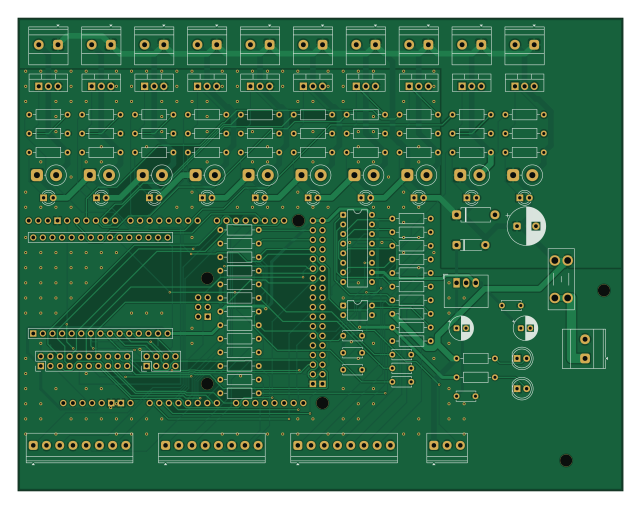
About the Reflex machine PCB
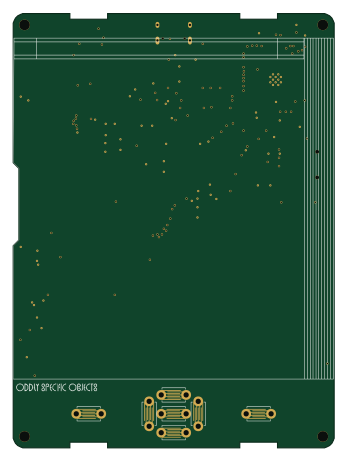
Reflex machine is an open source ESP32 PCB design by Mhamednoui, published on GitHub. It is a 2-layer board measuring 160 × 125 mm, with 123 components from 41 distinct parts.
Its main chip is the ESP32 DevKit V1 (30 pin), from the ESP32 family. Other key parts include the C18212380, PC817, 74HC595N and Arduino Mega 2560 R3. By type, the board carries 55 resistors, 24 diodes, 17 connectors, 11 capacitors, 10 transistors and 3 ICs.
From the project
AI-assisted KiCad PCB design pipeline: netlist -> schematic -> routed board -> fab files, with a 3D/simulation webview
Ordering it: everything a fab or price calculator asks (size in cm, layers, holes, parts, order-form answers) is in MANUFACTURING.md - generated from the real board, regenerate with python pipeline.py reflex-machine --only fabreport. Checking the wiring without reading a PCB: CONNECTIONS.md lists every pin of every part and where it goes, in words.
10-electromagnet reflex/whack-a-mole game controller. Arduino Mega 2560 (shield-mounted) + ESP32 DevKit V1, all through-hole parts. This file tells you which other file to open next - don't read everything.
Main components on the Reflex machine
Reflex machine bill of materials (BOM)
123 components, 41 distinct parts — part numbers from the project's BOM.
| Qty | Part | Footprint | Refs |
|---|---|---|---|
| 1 | C18212380 5V 2A module (K7805-2000R3) | Converter_DCDC_RECOM_R-78B-2.0_THT | U1 |
| 1 | PC817 | DIP-4_W7.62mm | U2 |
| 1 | 74HC595N | DIP-16_W7.62mm | U3 |
| 1 | Arduino Mega 2560 R3 | Arduino_Mega2560_R3_Shield | A1 |
| 1 | ESP32 DevKit V1 (30 pin) | ESP32_DevKit_V1_30pin_Socket | A2 |
| 10 | IRLZ44N | TO-220-3_Vertical | Q1, Q2, Q3, Q4, Q5, Q6, Q7, Q8 +2 |
| 1 | 12V_IN | TerminalBlock_Phoenix_MKDS-3-2-5.08_1x02_P5.08mm_Horizontal | J1 |
| 1 | MAG1 | TerminalBlock_Phoenix_MKDS-1,5-2-5.08_1x02_P5.08mm_Horizontal | J2 |
| 1 | MAG2 | TerminalBlock_Phoenix_MKDS-1,5-2-5.08_1x02_P5.08mm_Horizontal | J3 |
| 1 | MAG3 | TerminalBlock_Phoenix_MKDS-1,5-2-5.08_1x02_P5.08mm_Horizontal | J4 |
| 1 | MAG4 | TerminalBlock_Phoenix_MKDS-1,5-2-5.08_1x02_P5.08mm_Horizontal | J5 |
| 1 | MAG5 | TerminalBlock_Phoenix_MKDS-1,5-2-5.08_1x02_P5.08mm_Horizontal | J6 |
| 1 | MAG6 | TerminalBlock_Phoenix_MKDS-1,5-2-5.08_1x02_P5.08mm_Horizontal | J7 |
| 1 | MAG7 | TerminalBlock_Phoenix_MKDS-1,5-2-5.08_1x02_P5.08mm_Horizontal | J8 |
| 1 | MAG8 | TerminalBlock_Phoenix_MKDS-1,5-2-5.08_1x02_P5.08mm_Horizontal | J9 |
| 1 | MAG9 | TerminalBlock_Phoenix_MKDS-1,5-2-5.08_1x02_P5.08mm_Horizontal | J10 |
| 1 | MAG10 | TerminalBlock_Phoenix_MKDS-1,5-2-5.08_1x02_P5.08mm_Horizontal | J11 |
| 1 | COIN | TerminalBlock_Phoenix_PT-1,5-3-3.5-H_1x03_P3.50mm_Horizontal | J12 |
| 1 | BUTTONS | TerminalBlock_Phoenix_PT-1,5-8-3.5-H_1x08_P3.50mm_Horizontal | J13 |
| 1 | STATUS_LEDS | TerminalBlock_Phoenix_PT-1,5-8-3.5-H_1x08_P3.50mm_Horizontal | J14 |
Show 21 more
| Qty | Part | Footprint | Refs |
|---|---|---|---|
| 1 | 7SEG | TerminalBlock_Phoenix_PT-1,5-8-3.5-H_1x08_P3.50mm_Horizontal | J15 |
| 1 | MEGA SPARE | PinHeader_2x10_P2.54mm_Vertical | J16 |
| 1 | ESP32 SPARE | PinHeader_2x04_P2.54mm_Vertical | J17 |
| 1 | 10A mini blade | Fuseholder_Blade_Mini_Keystone_3568 | F1 |
| 1 | P6KE15A | D_DO-15_P10.16mm_Horizontal | D1 |
| 1 | 1N4007 | D_DO-41_SOD81_P7.62mm_Horizontal | D2 |
| 2 | GREEN | LED_D5.0mm | D3, D4 |
| 10 | 1N5822 | D_DO-201AD_P5.08mm_Vertical_CathodeUp | D11, D12, D13, D14, D15, D16, D17, D18 +2 |
| 10 | C2895470 RED | LED_D3.0mm | D21, D22, D23, D24, D25, D26, D27, D28 +2 |
| 1 | C48935382 1000uF 25V | CP_Radial_D10.0mm_P5.00mm | C1 |
| 2 | C47344177 220uF 25V | CP_Radial_D6.3mm_P2.50mm | C2, C6 |
| 7 | 100NF 100nF | C_Disc_D5.0mm_W2.5mm_P5.00mm | C3, C7, C9, C10, C11, C12, C13 |
| 1 | 1NF 1nF | C_Disc_D5.0mm_W2.5mm_P5.00mm | C8 |
| 1 | 4.7K 4.7k | R_Axial_DIN0207_L6.3mm_D2.5mm_P10.16mm_Horizontal | R1 |
| 6 | 1k | R_Axial_DIN0207_L6.3mm_D2.5mm_P10.16mm_Horizontal | R2, R43, R44, R45, R46, R62 |
| 10 | 100R | R_Axial_DIN0207_L6.3mm_D2.5mm_P10.16mm_Horizontal | R11, R12, R13, R14, R15, R16, R17, R18 +2 |
| 15 | 10K 10k | R_Axial_DIN0207_L6.3mm_D2.5mm_P10.16mm_Horizontal | R21, R22, R23, R24, R25, R26, R27, R28 +7 |
| 11 | 2.2K 2.2k | R_Axial_DIN0207_L6.3mm_D2.5mm_P10.16mm_Horizontal | R31, R32, R33, R34, R35, R36, R37, R38 +3 |
| 4 | 330R | R_Axial_DIN0207_L6.3mm_D2.5mm_P10.16mm_Horizontal | R51, R52, R53, R54 |
| 7 | 470R | R_Axial_DIN0207_L6.3mm_D2.5mm_P10.16mm_Horizontal | R55, R56, R57, R58, R59, R60, R61 |
| 1 | 2k | R_Axial_DIN0207_L6.3mm_D2.5mm_P10.16mm_Horizontal | R63 |
Reflex machine design files
The KiCad project lives in the Mhamednoui/PCB_Designer repository on GitHub; these links point at the commit this page was built from.
Reflex machine: common questions
What microcontroller does the Reflex machine use?
The Reflex machine is built around the ESP32 DevKit V1 (30 pin), from the ESP32 family.
How big is the Reflex machine PCB?
The Reflex machine measures 160 × 125 mm, has 2 copper layers and is 1.6 mm thick.
How many components are on the Reflex machine?
123 components, from 41 distinct parts, with part numbers taken from the project's own BOM. The full bill of materials is listed on this page.
Where can I download the Reflex machine design files?
From the Mhamednoui/PCB_Designer repository on GitHub, which has the KiCad layout, the schematic and the BOM; the links under Design files point to each one.
Can I use the Reflex machine design in my own project?
The repository has no license, so all rights stay with Mhamednoui. Use it as a reference, and ask the author before reusing the design.
Can I test firmware for the Reflex machine without the hardware?
Yes. HardLabs builds a simulation of the board from its netlist and BOM, so you can run and debug ESP32 firmware against it before you order a PCB.
More boards in PCB_Designer
Similar boards
 ESP32
OSO-BOOK-B1
joeycastillo
85 × 115 mm65 parts2LCC-BY-SA-4.08.1k ESP32
Powertrain
byrantech
64 × 45.4 mm171 parts4LMIT4.3k ESP32
Esp32 minimal
atopile
36.2 × 26.8 mm20 parts2LMIT4.0k ESP32
Badge
56.3 × 39 mm239 parts4LMIT4.0k ESP32
Racer
StuckAtPrototype
36 × 50.2 mm70 parts4LApache-2.03.8k ESP32
Controller
29 × 74 mm58 parts4LApache-2.03.8k