
Intent2026

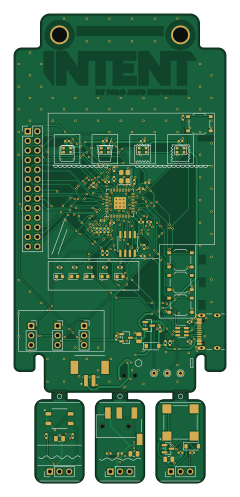
About the Intent2026 PCB
Intent2026 is an open source RP2040/RP2350 PCB design by MichaelMIL, published on GitHub. It is a 2-layer board measuring 56 × 124 mm, with 78 components from 36 distinct parts.
Its main chip is the RP2040, from the RP2040/RP2350 family. Other key parts include the W25Q16JVSNIQ, ME6206A33M3G, USBLC6-2SC6 and IRM-H638T/TR2. By type, the board carries 25 capacitors, 20 resistors, 9 connectors, 7 diodes, 5 ICs and 4 switches.
It belongs with the wearables and audio designs in this gallery.
From the project
RP2040 conference badge for the INTENT 2026 security summit, shaped like a vending machine: a header sign with the lanyard holes, the cabinet with the product window, keypad and item-pickup door, and a pedestal. 56 × 100 mm, two layers, purple solder mask, with three breakaway so
RP2040 conference badge for the INTENT 2026 security summit, shaped like a vending machine: a header sign with the lanyard holes, the cabinet with the product window, keypad and item-pickup door, and a pedestal. 56 × 100 mm, two layers, purple solder mask, with three breakaway soda-can modules (IR receiver, audio jack, speaker) that snap off and plug back into slots on the badge.
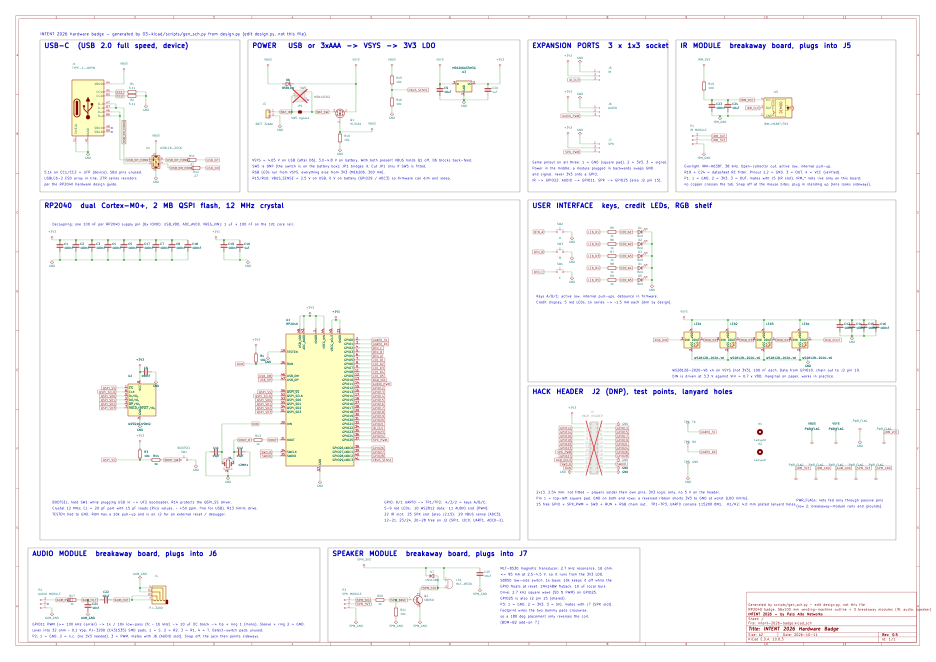
Main components on the Intent2026
Intent2026 bill of materials (BOM)
78 components, 36 distinct parts — part numbers from the project's BOM.
| Qty | Part | Footprint | Refs |
|---|---|---|---|
| 1 | RP2040 | QFN-56-1EP_7x7mm_P0.4mm_EP3.2x3.2mm | U1 |
| 1 | W25Q16JVSNIQ | SOIC-8_3.9x4.9mm_P1.27mm | U2 |
| 1 | ME6206A33M3G | SOT-23-3 | U3 |
| 1 | USBLC6-2SC6 | SOT-23-6 | U4 |
| 1 | IRM-H638T/TR2 | IRM-H638T_C91447 | U5 |
| 1 | HL3401 | SOT-23 | Q1 |
| 1 | S8050 | SOT-23 | Q2 |
| 1 | 12MHZ 12MHz | Crystal_SMD_3225-4Pin_3.2x2.5mm | Y1 |
| 1 | TYPE-C-16PIN | USB_C_TYPE-C16PIN_C393939 | J1 |
| 1 | C722761 BATT 3xAAA | JST_PH_2P_SMD_Vertical_C722761 | J3 |
| 1 | PJ-320D | Jack_3.5mm_PJ-320D_SMD_C431535 | J4 |
| 1 | C541850 IR | PinSocket_1x03_P2.54mm_Vertical | J5 |
| 1 | C541850 AUDIO | PinSocket_1x03_P2.54mm_Vertical | J6 |
| 1 | C541850 SPK | PinSocket_1x03_P2.54mm_Vertical | J7 |
| 1 | C49257 IR MODULE | PinHeader_1x03_P2.54mm_Vertical | P1 |
| 1 | C49257 AUDIO MODULE | PinHeader_1x03_P2.54mm_Vertical | P2 |
| 1 | C49257 SPK MODULE | PinHeader_1x03_P2.54mm_Vertical | P3 |
| 1 | MLT-8530 | Buzzer_MLT-8530_C94599 | LS1 |
| 1 | C318884 BOOTSEL | SW_Push_1P1T_XKB_TS-1187A | SW1 |
| 1 | C318884 A | SW_Push_1P1T_XKB_TS-1187A | SW2 |
Show 16 more
| Qty | Part | Footprint | Refs |
|---|---|---|---|
| 1 | C318884 B | SW_Push_1P1T_XKB_TS-1187A | SW3 |
| 1 | C318884 C | SW_Push_1P1T_XKB_TS-1187A | SW4 |
| 4 | WS2812B-2020-V6 | LED_WS2812B-2020_PLCC4_2.0x2.0mm | LED1, LED2, LED3, LED4 |
| 5 | C2286 Red | LED_0603_1608Metric | D1, D2, D3, D4, D5 |
| 1 | B5819W | D_SOD-123 | D6 |
| 1 | 1N4148W | D_SOD-123 | D7 |
| 16 | 100NF 100nF | C_0402_1005Metric | C1, C2, C3, C4, C5, C6, C7, C8 +8 |
| 4 | 10UF 10uF | C_0805_2012Metric | C9, C22, C24, C25 |
| 2 | 1UF 1uF | C_0402_1005Metric | C10, C20 |
| 2 | 15PF 15pF | C_0402_1005Metric | C11, C12 |
| 1 | 10NF 10nF | C_0402_1005Metric | C21 |
| 2 | 5.1K 5.1k | R_0402_1005Metric | R1, R2 |
| 6 | 10K 10k | R_0402_1005Metric | R3, R4, R10, R15, R16, R21 |
| 9 | 1k | R_0402_1005Metric | R5, R6, R7, R8, R9, R13, R14, R17 +1 |
| 2 | 27 | R_0402_1005Metric | R11, R12 |
| 1 | 100 | R_0402_1005Metric | R19 |
Intent2026 design files
The KiCad project lives in the MichaelMIL/intent2026 repository on GitHub; these links point at the commit this page was built from.
Intent2026: common questions
What microcontroller does the Intent2026 use?
The Intent2026 is built around the RP2040, from the RP2040/RP2350 family.
How big is the Intent2026 PCB?
The Intent2026 measures 56 × 124 mm, has 2 copper layers and is 1.6 mm thick.
How many components are on the Intent2026?
78 components, from 36 distinct parts, with part numbers taken from the project's own BOM. The full bill of materials is listed on this page.
Where can I download the Intent2026 design files?
From the MichaelMIL/intent2026 repository on GitHub, which has the KiCad layout, the schematic and the BOM; the links under Design files point to each one.
Can I use the Intent2026 design in my own project?
The repository has no license, so all rights stay with MichaelMIL. Use it as a reference, and ask the author before reusing the design.
Can I test firmware for the Intent2026 without the hardware?
Yes. HardLabs builds a simulation of the board from its netlist and BOM, so you can run and debug RP2040/RP2350 firmware against it before you order a PCB.
Similar boards
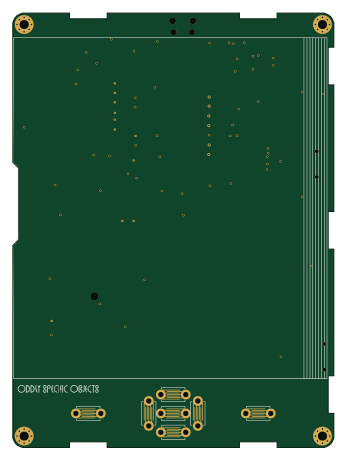 RP2040/RP2350
Open Book Abridged Edition
joeycastillo
85 × 115 mm29 parts2LCC-BY-SA-4.08.1k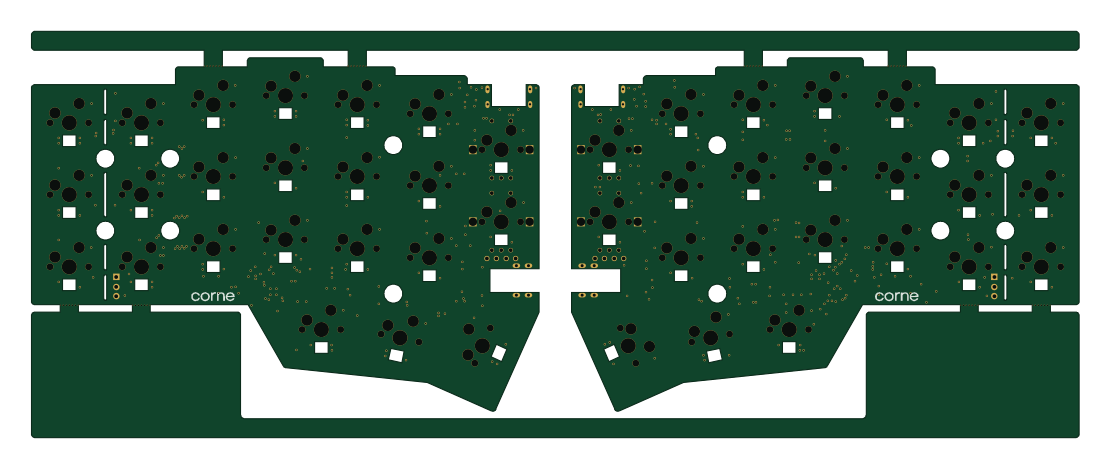 RP2040/RP2350
Corne
foostan
277.2 × 107.5 mm164 parts2LCC-BY-4.07.7k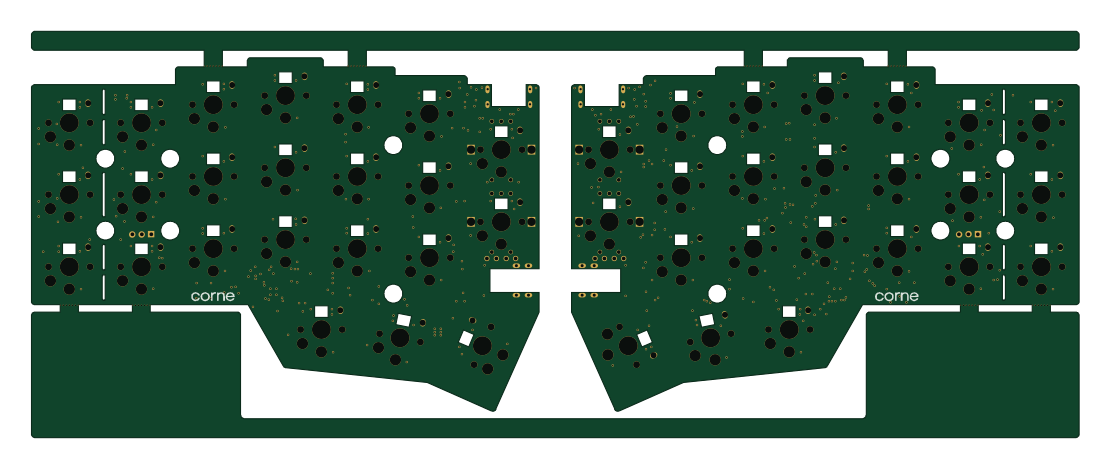 RP2040/RP2350
Corne
277.2 × 107.5 mm164 parts2LCC-BY-4.07.7k RP2040/RP2350
Jitx design
gusmanb
55.5 × 65 mm26 parts4LGPL-3.05.0k RP2040/RP2350
LogicAnalyzer
57 × 55.2 mm6 parts2LGPL-3.05.0k RP2040/RP2350
Main
google
98 × 71 mm102 parts2LApache-2.02.9k