
Citofono vintage

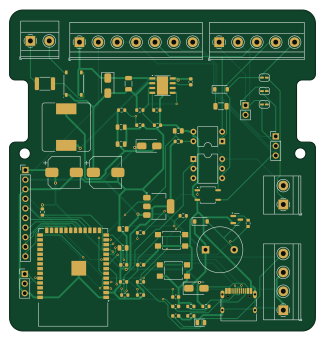
About the Citofono vintage PCB
Citofono vintage is an open source ESP32 PCB design by michele88pg, published on GitHub under the CC-BY-SA-4.0 license. It is a 2-layer board measuring 81 × 85 mm, with 61 components from 46 distinct parts.
Its main chip is the ESP32-S3-WROOM-1-N16R2, from the ESP32 family. Other key parts include the LM5164DDA and AMS1117-3.3. By type, the board carries 18 resistors, 14 capacitors, 10 connectors, 7 diodes, 3 ICs and 2 relays.
It belongs with the iot & wireless and retro computing designs in this gallery.
From the project
Scheda open hardware ESP32-S3 che trasforma un telefono a disco d'epoca in citofono smart: apri con il disco, notifiche e apertura remota via ESPHome/Home Assistant. Compatibile con Siemens/Italtel S62 da parete e citofoni URMET 4+N.
Il progetto è stato sviluppato con KiCad 10, che apre anche i file dei formati precedenti. Tutti i simboli e i footprint vengono dalle librerie ufficiali di KiCad e sono incorporati nei file, quindi non servono librerie esterne.
Minimi: pista 0,2 mm, via 0,5/0,2 mm, distanza dal bordo 0,2 mm. Sono tutti entro le capacità standard di JLCPCB.
Zone: - GNDplane: sullo strato inferiore, solo nella zona logica. La massa è anche sbrogliata con piste, quindi il piano non è l'unico collegamento. - isolamento1…6: le strisce della barriera. Sono vietati piste, via e rame; pad e componenti sono…
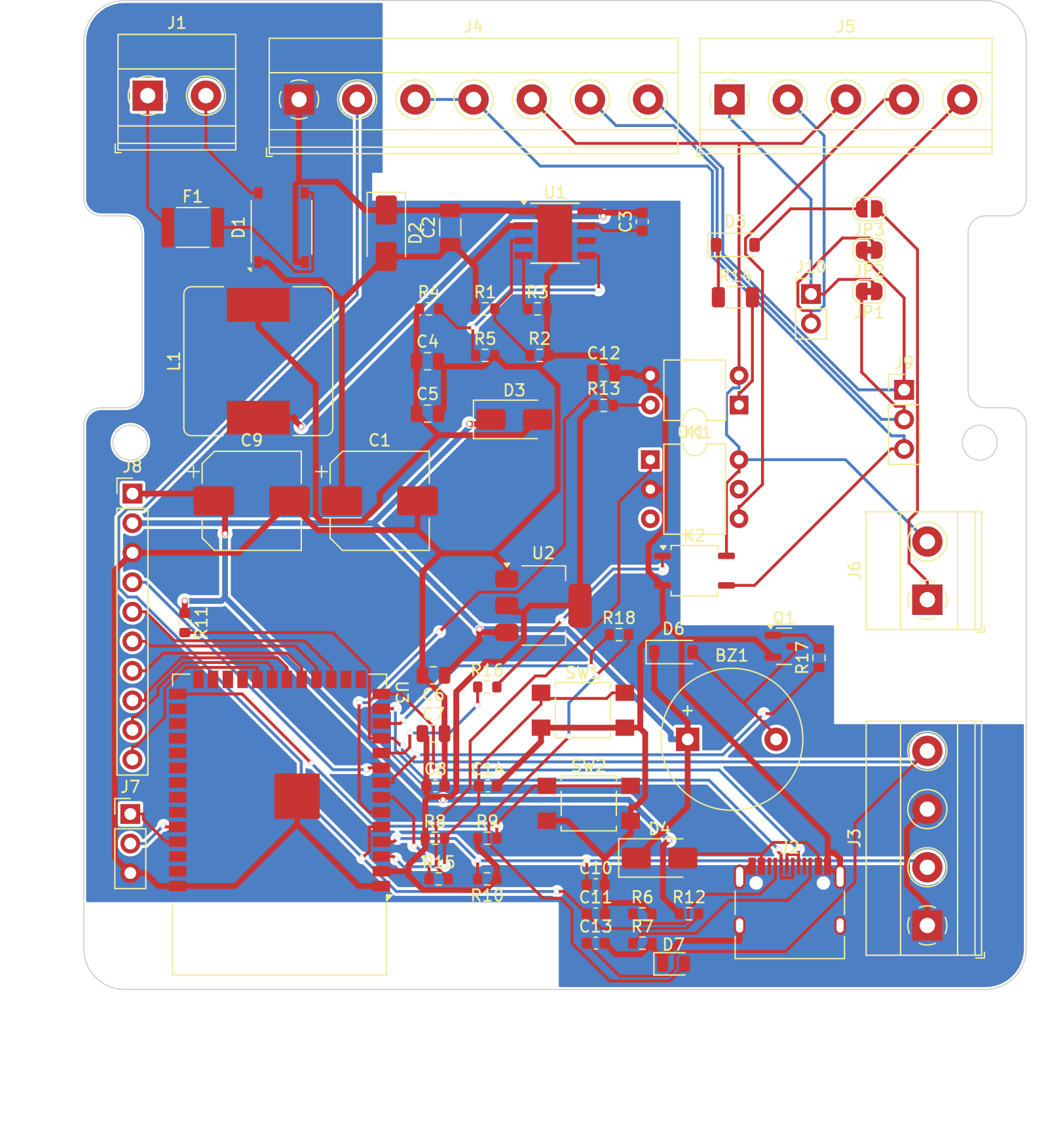
Main components on the Citofono vintage
Citofono vintage bill of materials (BOM)
61 components, 46 distinct parts — part numbers from the project's BOM.
| Qty | Part | Footprint | Refs |
|---|---|---|---|
| 1 | LM5164DDA | Texas_HSOP-8-1EP_3.9x4.9mm_P1.27mm | U1 |
| 1 | AMS1117-3.3 | SOT-223-3_TabPin2 | U2 |
| 1 | ESP32-S3-WROOM-1-N16R2 | ESP32-S3-WROOM-1 | U3 |
| 1 | MMBT3904 | SOT-23 | Q1 |
| 1 | PWR IN 9-40V AC/DC | TerminalBlock_Phoenix_MKDS-1,5-2_1x02_P5.00mm_Horizontal | J1 |
| 1 | USB-C | USB_C_Receptacle_HRO_TYPE-C-31-M-12 | J2 |
| 1 | DISCO 1 2 3 4 | TerminalBlock_Phoenix_MKDS-1,5-4_1x04_P5.00mm_Horizontal | J3 |
| 1 | HS2 HS1 M/R HK1 HK2 R M | TerminalBlock_Phoenix_MKDS-1,5-7_1x07_P5.00mm_Horizontal | J4 |
| 1 | URMET 1 2 6 9 CA | TerminalBlock_Phoenix_MKDS-1,5-5_1x05_P5.00mm_Horizontal | J5 |
| 1 | SUONERIA S b (opz.) | TerminalBlock_Phoenix_MKDS-1,5-2_1x02_P5.00mm_Horizontal | J6 |
| 1 | UART DBG TX RX GND | PinHeader_1x03_P2.54mm_Vertical | J7 |
| 1 | EXP AUDIO V3 | PinHeader_1x10_P2.54mm_Vertical | J8 |
| 1 | EXP HANDSET | PinHeader_1x03_P2.54mm_Vertical | J9 |
| 1 | EXP LINE AUDIO | PinHeader_1x02_P2.54mm_Vertical | J10 |
| 1 | TMB12A05 | Buzzer_12x9.5RM7.6 | BZ1 |
| 1 | 0.5A 60V | Fuse_1812_4532Metric | F1 |
| 1 | TLP3546A(F) o AQV252G | DIP-6_W7.62mm | K1 |
| 1 | CPC1017N 60V 1A | SOP-4_3.8x4.1mm_P2.54mm | K2 |
| 1 | PC817 | DIP-4_W7.62mm | OK1 |
| 1 | RESET | SW_SPST_TL3305B | SW1 |
Show 26 more
| Qty | Part | Footprint | Refs |
|---|---|---|---|
| 1 | BOOT | SW_SPST_TL3305B | SW2 |
| 1 | ABS10 1000V 0.8A | Diode_Bridge_Diotec_ABS | D1 |
| 1 | SMAJ36A | D_SMA | D2 |
| 2 | SS34 | D_SMA | D3, D4 |
| 2 | 1N4148W | D_SOD-123 | D5, D6 |
| 1 | LED verde | LED_0805_2012Metric | D7 |
| 1 | 47uH 2A SRR1260-470M | L_Bourns_SRR1260 | L1 |
| 1 | 100uF 50V | CP_Elec_8x10 | C1 |
| 1 | 2.2uF 100V | C_1206_3216Metric | C2 |
| 1 | 2.2nF 50V | C_0603_1608Metric | C3 |
| 2 | 22uF 10V | C_0805_2012Metric | C4, C5 |
| 2 | 10uF 10V | C_0805_2012Metric | C6, C7 |
| 4 | 100NF 100nF | C_0603_1608Metric | C8, C10, C11, C13 |
| 1 | 470uF 10V | CP_Elec_8x10 | C9 |
| 1 | 4.7UF 4.7uF | C_0805_2012Metric | C12 |
| 1 | 1UF 1uF | C_0603_1608Metric | C14 |
| 2 | 100K 100k | R_0603_1608Metric | R1, R4 |
| 1 | 24.9K 24.9k | R_0603_1608Metric | R2 |
| 1 | 49.9K 49.9k | R_0603_1608Metric | R3 |
| 1 | 31.6K 31.6k | R_0603_1608Metric | R5 |
| 2 | 5.1K 5.1k | R_0603_1608Metric | R6, R7 |
| 6 | 10K 10k | R_0603_1608Metric | R8, R9, R10, R11, R12, R13 |
| 1 | 15k 0.25W | R_1206_3216Metric | R14 |
| 1 | 390 | R_0603_1608Metric | R15 |
| 1 | 560 | R_0603_1608Metric | R16 |
| 2 | 1k | R_0603_1608Metric | R17, R18 |
Citofono vintage design files
The KiCad project lives in the michele88pg/citofono-vintage repository on GitHub; these links point at the commit this page was built from.
Citofono vintage: common questions
What microcontroller does the Citofono vintage use?
The Citofono vintage is built around the ESP32-S3-WROOM-1-N16R2, from the ESP32 family.
How big is the Citofono vintage PCB?
The Citofono vintage measures 81 × 85 mm, has 2 copper layers and is 1.6 mm thick.
How many components are on the Citofono vintage?
61 components, from 46 distinct parts, with part numbers taken from the project's own BOM. The full bill of materials is listed on this page.
Where can I download the Citofono vintage design files?
From the michele88pg/citofono-vintage repository on GitHub, which has the KiCad layout, the schematic and the BOM; the links under Design files point to each one.
Can I use the Citofono vintage design in my own project?
Yes, under the terms of its CC-BY-SA-4.0 license, which michele88pg chose for the repository.
Can I test firmware for the Citofono vintage without the hardware?
Yes. HardLabs builds a simulation of the board from its netlist and BOM, so you can run and debug ESP32 firmware against it before you order a PCB.
Similar boards
 ESP32
ESP32Open Book Abridged Edition
joeycastillo
85 × 115 mm65 parts2LCC-BY-SA-4.08.1k ESP32
ESP32Badge
atopile
56.3 × 39 mm239 parts4LMIT4.0k ESP32
ESP32Esp32 minimal
36.2 × 26.8 mm20 parts2LMIT4.0k ESP32
ESP32Racer
StuckAtPrototype
36 × 50.2 mm70 parts4LApache-2.03.8k ESP32
ESP32Controller
29 × 74 mm58 parts4LApache-2.03.8k ESP32
ESP32Bitaxe
skot
56.5 × 99.8 mm86 parts4LCERN-OHL-S-2.01.4k