
Twinkling butterfly


About the Twinkling butterfly PCB
Twinkling butterfly is an open source ESP32 PCB design by Normansrule, published on GitHub under the MIT license. It is a 2-layer board measuring 83.8 × 63.3 mm, with 60 components from 29 distinct parts.
Its main chip is the ESP32-C3FH4, from the ESP32 family. Other key parts include the MCP73831T-2ACI/OT, AP2112K-3.3TRG1, USBLC6-2SC6 and FT231XS-R. By type, the board carries 24 capacitors, 15 resistors, 7 diodes, 4 ICs, 2 transistors and 2 battery holders.
It belongs with the displays & leds and power & battery designs in this gallery.
From the project
USB-C VBUS feeds an MCP73831 charger (~42 mA) into two LIR2032 cells in parallel, and feeds the FT231XS bridge directly. The cells run through slide switch SW1 into an AP2112K regulator for the ESP32-C3FH4. The bridge's DTR#/RTS# lines drive a cross-coupled transistor pair that p
USB-C VBUS feeds an MCP73831 charger (~42 mA) into two LIR2032 cells in parallel, and feeds the FT231XS bridge directly. The cells run through slide switch SW1 into an AP2112K regulator for the ESP32-C3FH4. The bridge's DTR#/RTS# lines drive a cross-coupled transistor pair that pulls CHIPENABLE and BOOT, so esptool resets the chip and enters the bootloader by itself. GPIO4 drives the pixel chain from the switched battery* rail, not the regulator.
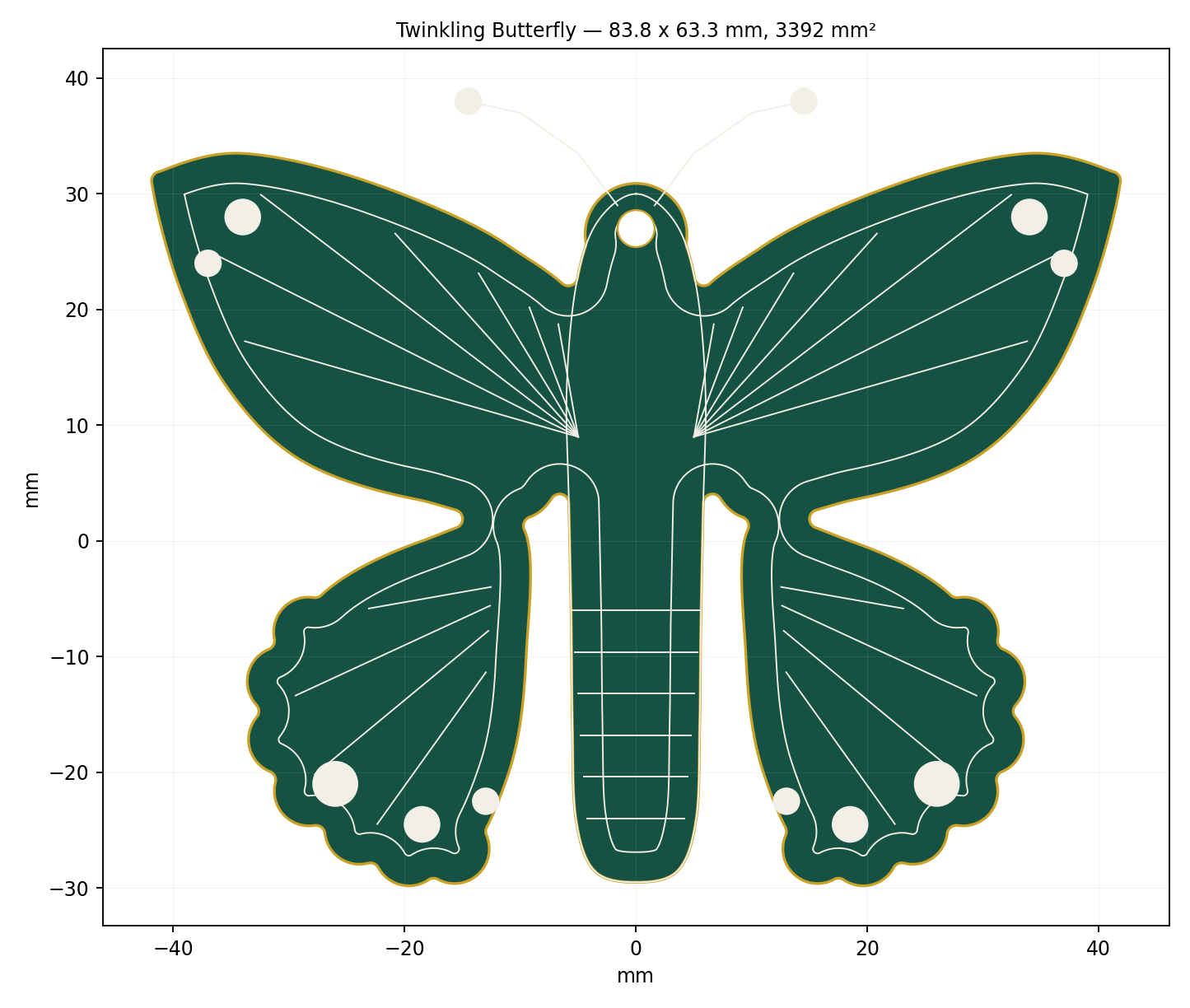
Main components on the Twinkling butterfly
Twinkling butterfly bill of materials (BOM)
60 components, 29 distinct parts — part numbers from the project's BOM.
| Qty | Part | Footprint | Refs |
|---|---|---|---|
| 1 | MCP73831T-2ACI/OT | SOT-23-5 | U2 |
| 1 | AP2112K-3.3TRG1 | SOT-23-5 | U3 |
| 1 | USBLC6-2SC6 | U4 | |
| 1 | FT231XS-R | U5 | |
| 2 | MMBT2222A | Q1, Q2 | |
| 1 | USB4110-GF-A | J1 | |
| 1 | 40.0MHz-Crystal | XTAL_ABM3B-40.000MHZ-10-1-U-T | 40.0MHz-Crystral |
| 2 | LIR2032 | BatteryHolder_Keystone_3034_1x20mm | BT1a, BT1b |
| 1 | ESP32-C3FH4 | QFN50P500X500X90-33N | ESP32-C3FH4 |
| 1 | JS102011SAQN | SW_SPDT_CK-JS102011SAQN | SW1 |
| 1 | USB_D+ | TestPoint_Pad_1.5x1.5mm | TP1 |
| 1 | USB_D- | TestPoint_Pad_1.5x1.5mm | TP2 |
| 6 | WS2812B | LED_WS2812B_PLCC4_5.0x5.0mm_P3.2mm | D1, D2, D3, D4, D5, D6 |
| 1 | LED_CHG | LED_1206_3216Metric | D7 |
| 2 | C1206C120J5GACTU 12pF | CAPC3216X94N | C3, C4 |
| 5 | C1206C104K5RACTU 0.1uF | VARC3216X85N | C5, C6, C7, C8, C9 |
| 2 | C1206C105K3RACTU 1uF | CAPC340180_140N_KEM-L | C10, C11 |
| 1 | CL31A106KAHNNNE 10uF | CAP_CL31_SAM-L | C12 |
| 3 | C1206C475K8RACTU 4.7uF | C_1206_3216Metric | C13, C16, C17 |
| 8 | C1206C104K5RACTU 100nF | C_1206_3216Metric | C14, C15, C20, C21, C22, C23, C24, C25 |
Show 9 more
| Qty | Part | Footprint | Refs |
|---|---|---|---|
| 2 | C1206C105K3RACTU 1uF | C_1206_3216Metric | C18, C19 |
| 1 | 470UF 470uF | CP_Elec_8x10.5 | C26 |
| 4 | RC1206FR-0710KL 10kOhm | RESC3116X65N | R1, R2, R3, R4 |
| 2 | RC1206FR-075K1L 5.1k | R_1206_3216Metric | R5, R6 |
| 2 | RC1206FR-0710KL 10k | R_1206_3216Metric | R7, R8 |
| 3 | RC1206FR-07470RL 470 | R_1206_3216Metric | R9, R10, R15 |
| 2 | RC1206FR-0727RL 27 | R_1206_3216Metric | R11, R12 |
| 1 | RC1206FR-071KL 1k | R_1206_3216Metric | R13 |
| 1 | RC1206FR-0724KL 24k | R_1206_3216Metric | R14 |
Twinkling butterfly design files
The KiCad project lives in the Normansrule/twinkling-butterfly repository on GitHub; these links point at the commit this page was built from.
Twinkling butterfly: common questions
What microcontroller does the Twinkling butterfly use?
The Twinkling butterfly is built around the ESP32-C3FH4, from the ESP32 family.
How big is the Twinkling butterfly PCB?
The Twinkling butterfly measures 83.8 × 63.3 mm, has 2 copper layers and is 1.6 mm thick.
How many components are on the Twinkling butterfly?
60 components, from 29 distinct parts, with part numbers taken from the project's own BOM. The full bill of materials is listed on this page.
Where can I download the Twinkling butterfly design files?
From the Normansrule/twinkling-butterfly repository on GitHub, which has the KiCad layout, the schematic and the BOM; the links under Design files point to each one.
Can I use the Twinkling butterfly design in my own project?
Yes, under the terms of its MIT license, which Normansrule chose for the repository.
Can I test firmware for the Twinkling butterfly without the hardware?
Yes. HardLabs builds a simulation of the board from its netlist and BOM, so you can run and debug ESP32 firmware against it before you order a PCB.
Similar boards
 ESP32
ESP32Open Book Abridged Edition
joeycastillo
85 × 115 mm65 parts2LCC-BY-SA-4.08.1k ESP32
ESP32Powertrain
byrantech
64 × 45.4 mm171 parts4LMIT4.3k ESP32
ESP32Badge
atopile
56.3 × 39 mm239 parts4LMIT4.0k ESP32
ESP32Esp32 minimal
36.2 × 26.8 mm20 parts2LMIT4.0k ESP32
ESP32Controller
StuckAtPrototype
29 × 74 mm58 parts4LApache-2.03.8k ESP32
ESP32Racer
36 × 50.2 mm70 parts4LApache-2.03.8k