
CRASHSENSE

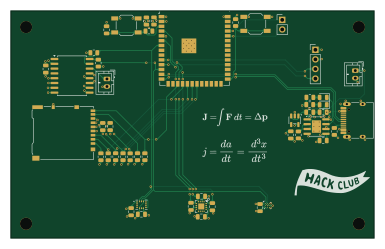
About the CRASHSENSE PCB
CRASHSENSE is an open source ESP32 PCB design by ParthDhiman32, published on GitHub under the MIT license. It is a 4-layer board measuring 96 × 60.1 mm, with 48 components from 24 distinct parts.
Its main chip is the ESP32-S3-WROOM-1, from the ESP32 family. Other key parts include the ADXL377, BMM150, BMI270, TP4056-42-ESOP8 and ME6211C10M5. By type, the board carries 17 capacitors, 15 resistors, 7 ICs, 5 connectors, 2 switches and 2 diodes.
It belongs with the robotics & motion, sensors and power & battery designs in this gallery.
From the project
Crashsense is a high level embedded sytems project which senses crashes in vehicles like cars trucks and also drones and records the every bit of data of that crash and gives enough data for the crash to be reoncstructed
Now this idea grew from a silly project of dropping and analyzing to something bigger i decided to add the best of the best sensors and analyze the data given by then
Basically Crashsense by it's name you can figure out it is related to something which crashes what crashes? A lot of things Cars, motorbikes, trucks, drones, ships, and many more vehicles Now imagine you could take out something useful from something as negative as a crash from am engineering presepective if Crashsense is intalled in a vehicle from the start if it ever crashes it would give us a lot of DATA....DATA is the most…
Main components on the CRASHSENSE
CRASHSENSE bill of materials (BOM)
48 components, 24 distinct parts — part numbers from the project's BOM.
| Qty | Part | Footprint | Refs |
|---|---|---|---|
| 1 | ESP32-S3-WROOM-1 | ESP32-S3-WROOM-1 | U1 |
| 1 | ADXL377 | LFCSP-16-3X3 | U2 |
| 1 | BMM150 | WLCSP-12_1.56x1.56mm_P0.4mm | U3 |
| 1 | BMI270 | XDCR_BMI270 | U5 |
| 1 | TP4056-42-ESOP8 | SOIC-8-1EP_3.9x4.9mm_P1.27mm_EP2.41x3.3mm_ThermalVias | U6 |
| 1 | ME6211C10M5 | SOT-23-5 | U7 |
| 1 | u-blox NEO-M8N | PinHeader_1x04_P2.54mm_Vertical | u-blox NEO-M8N |
| 1 | MICRO_SD_CARD_DET1 Micro_SD_Card_Det1 | microSD_HC_Hirose_DM3AT-SF-PEJM5 | J2 |
| 1 | BATTERY_CONNECTOR | JST_PH_B2B-PH-K_1x02_P2.00mm_Vertical | J3 |
| 1 | Debug_pins | PinHeader_1x02_P2.54mm_Vertical | J4 |
| 1 | Coincell_BAT | JST_PH_B2B-PH-K_1x02_P2.00mm_Vertical | J5 |
| 1 | USB_C_PLUG_USB2.0 USB_C_Plug_USB2.0 | USB_C_Receptacle_HRO_TYPE-C-31-M-12 | P1 |
| 2 | SW_Push | SW_SPST_SKQG_WithStem | SW1, SW2 |
| 1 | RLED | LED_0805_2012Metric | D1 |
| 1 | GLED | LED_0805_2012Metric | D2 |
| 5 | 10UF 10uF | C_0805_2012Metric | C1, C2, C4, C5, C15 |
| 2 | 1UF 1uF | C_0805_2012Metric | C3, C17 |
| 7 | 100NF 100nF | C_0805_2012Metric | C6, C7, C11, C12, C13, C14, C16 |
| 3 | 10NF 10nF | C_0805_2012Metric | C8, C9, C10 |
| 1 | 5.1KR | R_0805_2012Metric | R1 |
Show 4 more
| Qty | Part | Footprint | Refs |
|---|---|---|---|
| 1 | 1.2KR | R_0805_2012Metric | R2 |
| 2 | 1KR 1kR | R_0805_2012Metric | R3, R4 |
| 9 | 10KR | R_0805_2012Metric | R5, R6, R7, R8, R9, R10, R11, R14 +1 |
| 2 | 4.7KR 4.7kR | R_0805_2012Metric | R12, R13 |
CRASHSENSE design files
The KiCad project lives in the ParthDhiman32/CRASHSENSE repository on GitHub; these links point at the commit this page was built from.
CRASHSENSE: common questions
What microcontroller does the CRASHSENSE use?
The CRASHSENSE is built around the ESP32-S3-WROOM-1, from the ESP32 family.
How big is the CRASHSENSE PCB?
The CRASHSENSE measures 96 × 60.1 mm, has 4 copper layers and is 1.6 mm thick.
How many components are on the CRASHSENSE?
48 components, from 24 distinct parts, with part numbers taken from the project's own BOM. The full bill of materials is listed on this page.
Where can I download the CRASHSENSE design files?
From the ParthDhiman32/CRASHSENSE repository on GitHub, which has the KiCad layout, the schematic and the BOM; the links under Design files point to each one.
Can I use the CRASHSENSE design in my own project?
Yes, under the terms of its MIT license, which ParthDhiman32 chose for the repository.
Can I test firmware for the CRASHSENSE without the hardware?
Yes. HardLabs builds a simulation of the board from its netlist and BOM, so you can run and debug ESP32 firmware against it before you order a PCB.
Similar boards
 ESP32
ESP32Open Book Abridged Edition
joeycastillo
85 × 115 mm65 parts2LCC-BY-SA-4.08.1k ESP32
ESP32Powertrain
byrantech
64 × 45.4 mm171 parts4LMIT4.3k ESP32
ESP32Esp32 minimal
atopile
36.2 × 26.8 mm20 parts2LMIT4.0k ESP32
ESP32Badge
56.3 × 39 mm239 parts4LMIT4.0k ESP32
ESP32Controller
StuckAtPrototype
29 × 74 mm58 parts4LApache-2.03.8k ESP32
ESP32Racer
36 × 50.2 mm70 parts4LApache-2.03.8k