
MsfOwlClock

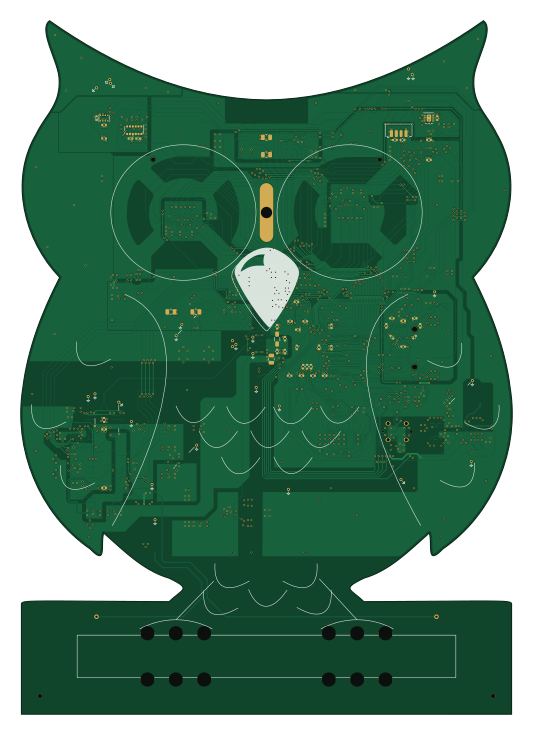
About the MsfOwlClock PCB
MsfOwlClock is an open source PIC PCB design by pete-restall, published on GitHub under the MIT license. It is a 4-layer board measuring 130.1 × 183.6 mm, with 378 components from 82 distinct parts.
Its main chip is the PIC32CX1025SG41100-I/E5X, from the PIC family. Other key parts include the BC805M, TSOP75338TT, MP5016HGQH, BQ24392RSER and FUSB302BMPX. By type, the board carries 164 resistors, 147 capacitors, 25 ICs, 15 diodes, 10 transistors and 7 inductors.
It belongs with the audio, power & battery and sensors designs in this gallery.
From the project
MSF Owl Clock
The board with the ferrite rod antenna and two TFT displays attached.
The above images are the boards as delivered from fabrication, not the end product. Namely: The edge / tool rails need to be cut off to leave only the owl-shaped board A ferrite rod antenna (and tuning capacitors) need to be attached, creating a branch on which the owl perches (yellow tie-wraps for talons) Two TFT displays need to be secured in place for the eyes A base / stand needs to be 3D printed, which will also hold a speaker and its cavity
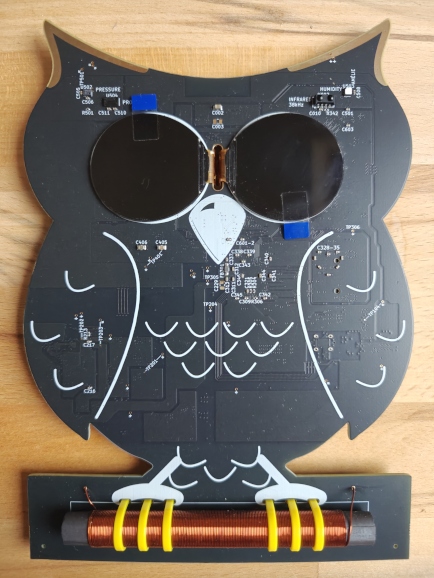
Main components on the MsfOwlClock
MsfOwlClock bill of materials (BOM)
378 components, 82 distinct parts — part numbers from the project's BOM.
| Qty | Part | Footprint | Refs |
|---|---|---|---|
| 1 | BC805M Fanstel | BC805M | U001 |
| 1 | TSOP75338TT Vishay | TSOP7????TT | U002 |
| 1 | MP5016HGQH Monolithic Power Solutions | QFN10-1.5x2.0mm-0.5mm | U101 |
| 1 | BQ24392RSER Texas Instruments | UQFN10-1.5x2.0mm-0.5mm | U102 |
| 1 | FUSB302BMPX ON Semiconductor | WQFN14-2.5x2.5mm-0.5mm-expad-1.45x1.45mm-thermvias | U103 |
| 1 | TPS628512DRLR Texas Instruments | SOT583 | U104 |
| 1 | TPS7A2042PDBVR Texas Instruments | TPS7A20??PDBVR | U201 |
| 1 | TPS7A2036PDBVR Texas Instruments | TPS7A20??PDBVR | U202 |
| 2 | MCP6499T-E-SL MCP6499 Microchip | SOIC14-3.9x8.65mm-1.27mm | U203, U204 |
| 1 | 74HC595BQ Nexperia | DHVQFN16-2.5x3.5mm-0.5mm-expad-2x1mm | U205 |
| 2 | TMUX1511RSVR TMUX1511RSV Texas Instruments | UQFN16-1.8x2.6mm-0.4mm | U206, U207 |
| 1 | PIC32CX1025SG41100-I/E5X Microchip | TQFP100-14x14mm-0.5mm | U301 |
| 2 | AP22653AW6-7 AP22653AW6 Diodes Incorporated | SOT26 | U302, U401 |
| 1 | MCP6486UT-E-LT MCP6486U Microchip | SOT353 | U402 |
| 1 | IS31AP4991A-SLS2-TR IS31AP4991A-SLS2 Lumissil Microsystems | MSOP8-3x3mm-0.65mm | U403 |
| 1 | TPS7A2028PDBVR Texas Instruments | TPS7A20??PDBVR | U501 |
| 1 | DPS310XTSA1 Infineon | PG-VLGA-8-1-2.0x2.5mm-0.65mm | U502 |
| 1 | HDC3022DEJR HDC3022 Texas Instruments | WSON8-2.5x2.5mm-0.5mm-expad-1.2x1.9mm-thermvias | U503 |
| 1 | VL6180V1NR1-1 VL6180V1NR1 ST Microelectronics | OPTICAL-LGA12-2.8x4.8mm-0.75mm | U504 |
| 3 | TMUX1574RSVR TMUX1574RSV Texas Instruments | UQFN16-1.8x2.6mm-0.4mm | U601, U602, U603 |
Show 62 more
| Qty | Part | Footprint | Refs |
|---|---|---|---|
| 8 | NX6008NBKW Nexperia | SOT323 | Q101, Q301, Q501, Q502, Q503, Q504, Q505, Q601 |
| 2 | BC847BS-7-F BC847BS Diodes Incorporated | SOT363 | Q602, Q603 |
| 1 | GSB1CA11101DSHR Amphenol | GSB1CA11101DSHR | CONN001 |
| 1 | MSD-11-A CUI Devices | MSD-11-A | CONN002 |
| 1 | FTSH-105-01-L-DV-007-K Cortex-M Debug Header Samtec | FTSH-105-?-?-DV-007-?-? | CONN003 |
| 1 | FTSH-110-01-F-DV-007-K Cortex-M Debug Header with ETM Samtec | FTSH-110-01-?-DV-007-?-? | CONN004 |
| 2 | OK-14GF024-04 EastRising ER-TFT1.32-1 EastRising | OK-14GF024-04 | CONN005, CONN006 |
| 1 | AC0402DR-0716KL Header (Molex 502443-0270) Molex | 502443-0270 | SPK001 |
| 1 | RH100-24.000-12-1010-EXT-TR 24MHz Raltron | 3225-1-3 | XTAL301 |
| 1 | DH2032K768C5T1521011 32.768kHz JWT | 3215 | XTAL303 |
| 1 | B1931USD-20D000814U1930 SD Card Busy Harvatek | nominal-0603-1608 | LED001 |
| 7 | D5V0FS4U10LP Diodes Incorporated | D5V0FS4U10LP | D001, D002, D003, D004, D005, D006, D007 |
| 8 | SD103AWS Evvo Semi | SOD323 | D101, D201, D202, D203, D204, D205, D206, D401 |
| 3 | WLBD2012HCU601TH Walsin Technology | WLBD2012 | FB001, FB201, FB301 |
| 2 | WLBD2012HCU121TH Walsin Technology | WLBD2012 | FB101, FB401 |
| 1 | LMLP07A7MR68DTAS 680nH Kyocera | 07A7 | L101 |
| 1 | HPC4018NF-100M 10μH Tai Tech | HPC4018NF | L301 |
| 95 | CL05A475MP5NRNC 4.7μF Samsung | unpolarised-nominal-0402-1005 | C001, C004, C005, C006, C007, C008, C009, C010 +87 |
| 22 | CL21A226MPQNNN 22μF Samsung | unpolarised-nominal-0805-2012 | C002, C116, C117, C123, C124, C201, C202, C207 +14 |
| 6 | CL05B104KA5NNNC 100nF Samsung | unpolarised-nominal-0402-1005 | C011, C103, C104, C107, C111, C321 |
| 2 | CL21A475KAQNNNE 4.7μF Samsung | unpolarised-nominal-0805-2012 | C101, C102 |
| 1 | CC0402JRNPO9BN390 39pF Yageo | unpolarised-nominal-0402-1005 | C106 |
| 1 | GMC04CG101G50NT 100pF Cal-Chip | unpolarised-nominal-0402-1005 | C108 |
| 4 | GCM1555C1H471FA16D 470pF Murata | unpolarised-nominal-0402-1005 | C114, C115, C237, C242 |
| 1 | VJ0402Y473KXQCW1BC 47nF Vishay | unpolarised-nominal-0402-1005 | C122 |
| 1 | 885012005007 10pF Würth Elektronik | unpolarised-nominal-0402-1005 | C127 |
| 7 | CC0603FRNPO9BN472 4.7nF Yageo | unpolarised-nominal-0603-1608 | C230, C236, C238, C241, C324, C409, C410 |
| 2 | GJM1555C1H130FB01D 13pF Murata | unpolarised-nominal-0402-1005 | C315, C316 |
| 2 | GCM1555C1H160FA16D 16pF Murata | unpolarised-nominal-0402-1005 | C319, C320 |
| 2 | GRM3195C1H104JA05D 100nF Murata | unpolarised-nominal-1206-3216 | C408, C412 |
| 1 | GCM1555C1H220FA16D 22pF Murata | unpolarised-nominal-0402-1005 | C411 |
| 4 | WR04X3300FTL 330Ω Walsin | nominal-0402-1005 | R001, R015, R328, R329 |
| 8 | WR04X1002FTL 10kΩ Walsin | nominal-0402-1005 | R002, R003, R006, R012, R301, R302, R303, R304 |
| 30 | RC0402FR-0743RL 43Ω Yageo | nominal-0402-1005 | R004, R005, R007, R008, R009, R010, R011, R018 +22 |
| 5 | WR04X1001FTL 1kΩ Walsin | nominal-0402-1005 | R013, R014, R103, R305, R306 |
| 2 | RC0402FR-07390RL 390Ω Yageo | nominal-0402-1005 | R016, R017 |
| 1 | RC0402FR-07300KL 300kΩ Yageo | nominal-0402-1005 | R101 |
| 7 | RC0402FR-070RL 0Ω Yageo | nominal-0402-1005 | R102, R203, R209, R234, R244, R307, R309 |
| 41 | WR04X3302FTL 33kΩ Walsin | nominal-0402-1005 | R104, R105, R106, R110, R111, R222, R223, R224 +33 |
| 2 | RMCF0402FT2R20 2.2Ω Vishay | nominal-0402-1005 | R107, R108 |
| 2 | CRCW04022R20FKED 3.3kΩ Walsin | nominal-0402-1005 | R109, R114 |
| 1 | WR04X8872FTL 88.7kΩ Walsin | nominal-0402-1005 | R112 |
| 4 | WR04X1962FTL 19.6kΩ Walsin | nominal-0402-1005 | R113, R404, R408, R409 |
| 7 | RT0402BRD074K99L 4.99kΩ Yageo | nominal-0402-1005 | R201, R202, R208, R220, R221, R230, R240 |
| 2 | CPF0402B27RE1 27Ω TE Connectivity | nominal-0402-1005 | R205, R211 |
| 2 | RT0402BRD074K3L 4.3kΩ Yageo | nominal-0402-1005 | R206, R207 |
| 9 | RT0402BRD072K49L 2.49kΩ Yageo | nominal-0402-1005 | R212, R213, R215, R216, R217, R218, R229, R235 +1 |
| 2 | RT0402BRD0768RL 68Ω Yageo | nominal-0402-1005 | R214, R219 |
| 3 | RT0402BRD07390RL 390Ω Yageo | nominal-0402-1005 | R225, R227, R237 |
| 1 | ERA-2AEB470X 47Ω Panasonic | nominal-0402-1005 | R226 |
| 2 | RT0402BRD071K24L 1.24kΩ Yageo | nominal-0402-1005 | R228, R238 |
| 2 | RT0402BRD074K12L 4.12kΩ Yageo | nominal-0402-1005 | R231, R241 |
| 2 | RP73PF1E64R9BTD 64.9Ω TE Connectivity | nominal-0402-1005 | R232, R242 |
| 2 | RT0402BRD0749K9L 49.9kΩ Yageo | nominal-0402-1005 | R233, R243 |
| 6 | RC0402FR-071K8L 1.8kΩ Yageo | nominal-0402-1005 | R318, R319, R340, R341, R505, R506 |
| 5 | RC0402FR-0741R2L 41.2Ω Yageo | nominal-0402-1005 | R335, R336, R337, R338, R339 |
| 2 | WR04X5101FTL 5.1kΩ Walsin | nominal-0402-1005 | R345, R405 |
| 2 | RC0402FR-0739KL 39kΩ Yageo | nominal-0402-1005 | R346, R407 |
| 1 | RN73R1ETTP6802B25 68kΩ KOA Speer | nominal-0402-1005 | R403 |
| 1 | AC0402DR-0716KL 16kΩ Yageo | nominal-0402-1005 | R406 |
| 4 | WR04X1000FTL 100Ω Walsin | nominal-0402-1005 | R503, R504, R510, R511 |
| 2 | RC0402FR-0718RL 18Ω Yageo | nominal-0402-1005 | R619, R620 |
MsfOwlClock design files
The KiCad project lives in the pete-restall/MsfOwlClock repository on GitHub; these links point at the commit this page was built from.
MsfOwlClock: common questions
What microcontroller does the MsfOwlClock use?
The MsfOwlClock is built around the PIC32CX1025SG41100-I/E5X, from the PIC family.
How big is the MsfOwlClock PCB?
The MsfOwlClock measures 130.1 × 183.6 mm, has 4 copper layers and is 1.6062 mm thick.
How many components are on the MsfOwlClock?
378 components, from 82 distinct parts, with part numbers taken from the project's own BOM. The full bill of materials is listed on this page.
Where can I download the MsfOwlClock design files?
From the pete-restall/MsfOwlClock repository on GitHub, which has the KiCad layout, the schematic and the BOM; the links under Design files point to each one.
Can I use the MsfOwlClock design in my own project?
Yes, under the terms of its MIT license, which pete-restall chose for the repository.
Can I test firmware for the MsfOwlClock without the hardware?
Yes. HardLabs builds a simulation of the board from its netlist and BOM, so you can run and debug PIC firmware against it before you order a PCB.
Similar boards
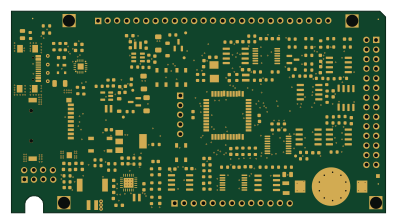 PIC
PICPslab hardware
fossasia
99 × 53.3 mm187 parts4LApache-2.01.7k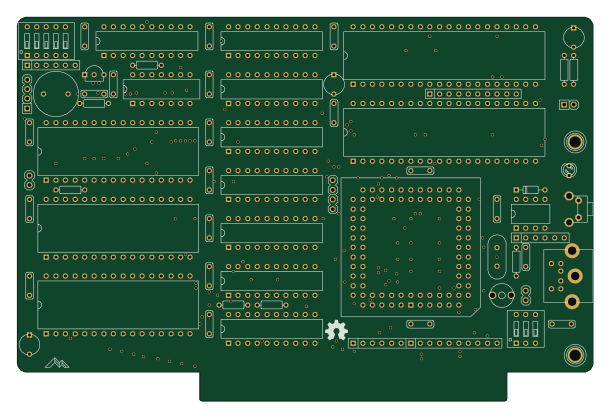 PIC
PICMicro 8088
skiselev
152.4 × 101.6 mm71 partsGPL-3.0414 PIC
PICGB-MBCTEST
Gekkio
51.4 × 61 mm32 parts2LCC-BY-4.0376 PIC
PICGB-BENCH-G1
100 × 100 mm98 parts4LCC-BY-4.0376 PIC
PICGB-CARTPP-DIY
100 × 100 mm22 parts2LCC-BY-4.0376 PIC
PICGB-LIVE32
51.4 × 61 mm46 parts4LCC-BY-4.0376