
TI83x

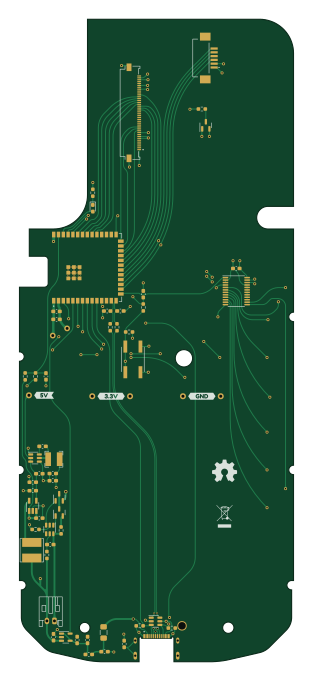
About the TI83x PCB
TI83x is an open source ESP32 PCB design by pjschinske, published on GitHub under the CERN-OHL-S-2.0 license. It is a 4-layer board measuring 72.5 × 170 mm, with 103 components from 37 distinct parts.
Its main chip is the ESP32-S3-WROOM-2-N32R8V, from the ESP32 family. Other key parts include the STS234050U160, TCA9535PWR, AP63203WU-7, MCP73811T-420I/OT and XC9142B50CMR-G. By type, the board carries 51 switches, 19 capacitors, 13 resistors, 7 ICs, 4 connectors and 4 inductors.
From the project
New internals for a TI-83 Plus graphing calculator
If Texas Instruments still made a TI-83... well, it would probably look a lot a lot different than this, but this is what I would want it to look like.
I'm completely replacing the internals of a TI-83 Plus graphing calculator and moderizing them.
This project is licenced under CERN-OHL-S v2.
- A full–color 240x320 IPS touchscreen from Newhaven Display - An ESP32 microcontroller - A Lithium ion battery, charged via USB-C
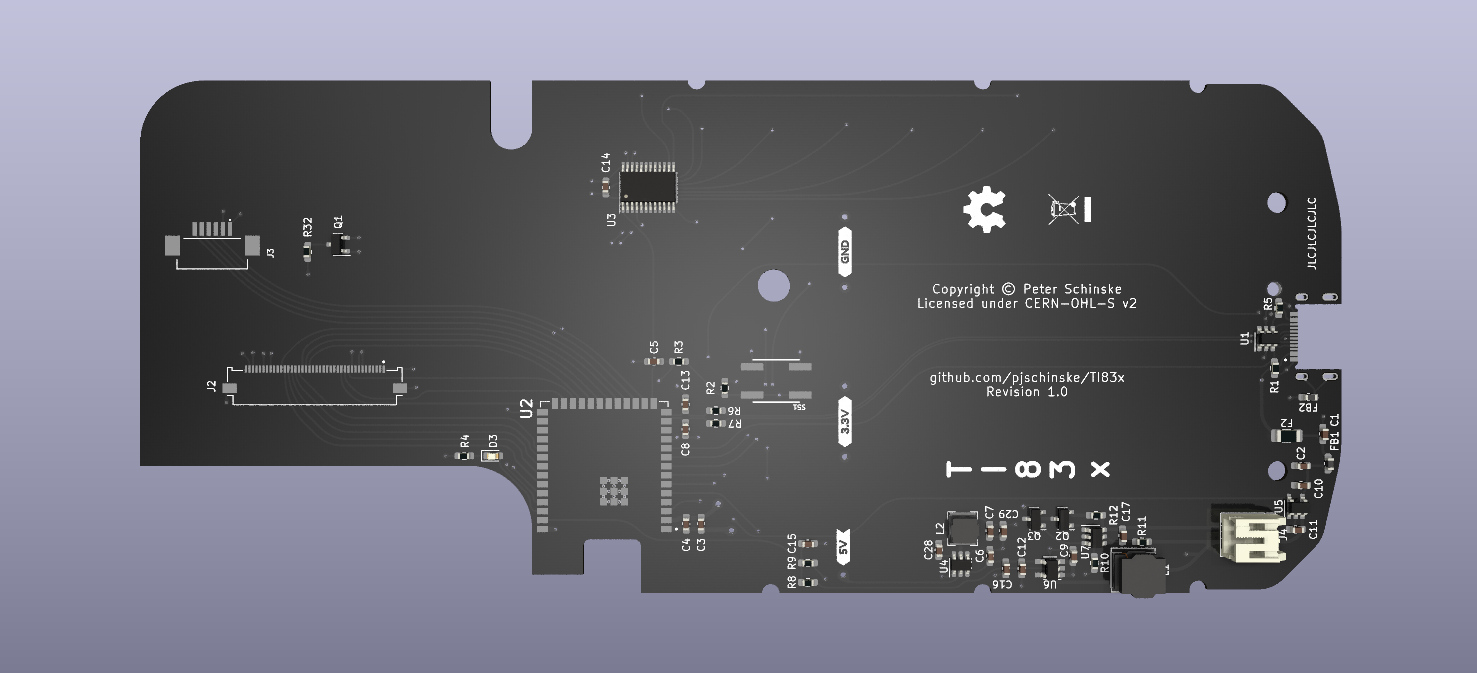
Main components on the TI83x
TI83x bill of materials (BOM)
103 components, 37 distinct parts.
| Qty | Part | Footprint | Refs |
|---|---|---|---|
| 1 | STS234050U160 | SOT-23-6 | U1 |
| 1 | ESP32-S3-WROOM-2-N32R8V | XCVR_ESP32-S3-WROOM-2-N32R8V | U2 |
| 1 | TCA9535PWR | TSSOP-24_4.4x7.8mm_P0.65mm | U3 |
| 1 | AP63203WU-7 | TSOT-23-6 | U4 |
| 1 | MCP73811T-420I/OT | SOT-23-5 | U5 |
| 1 | XC9142B50CMR-G | SOT-23-5_HandSoldering | U6 |
| 1 | AP9101CK6-BVTRG1 | SOT-23-6 | U7 |
| 1 | SSM3K335R,LF | SOT-23 | Q1 |
| 2 | G6N02L | SOT-23 | Q2, Q3 |
| 1 | USB4520-03-1-A_REVA | GCT_USB4520-03-1-A_REVA | J1 |
| 1 | 505110-4091 | MOLEX_505110-4091 | J2 |
| 1 | 52271-0679 | MOLEX_52271-0679 | J3 |
| 1 | S2B-PH-K-S(LF)(SN) | JST_PH_S2B-PH-K_1x02_P2.00mm_Horizontal | J4 |
| 1 | 0ZCJ0075AF2E | Fuse_1206_3216Metric_Pad1.42x1.75mm_HandSolder | F2 |
| 50 | TS07-667-37-BK-100-SMT-TR | SW_TS07-667-37-BK-100-SMT-TR | S1, S2, S3, S4, S5, S6, S7, S8 +42 |
| 1 | EVQ-Q2B02W | SW_EVQ-Q2B02W | S51 |
| 1 | LS Q976-NR-1 | LED_0603_1608Metric_Pad1.05x0.95mm_HandSolder | D3 |
| 2 | BLM18PG330SN1D | L_0603_1608Metric_Pad1.05x0.95mm_HandSolder | FB1, FB2 |
| 1 | LQH5BPN4R7NT0L | L_Bourns_SRN6045TA | L1 |
| 1 | SRR3818A-3R9Y | L_Bourns-SRN4018 | L2 |
Show 17 more
| Qty | Part | Footprint | Refs |
|---|---|---|---|
| 1 | 10nF | C_0603_1608Metric_Pad1.08x0.95mm_HandSolder | C1 |
| 6 | 0.1uF | C_0603_1608Metric_Pad1.08x0.95mm_HandSolder | C2, C4, C14, C15, C17, C28 |
| 3 | 22uF | C_0603_1608Metric_Pad1.08x0.95mm_HandSolder | C3, C7, C29 |
| 1 | 2.2uF | C_0603_1608Metric_Pad1.08x0.95mm_HandSolder | C5 |
| 4 | 10uF | C_0603_1608Metric_Pad1.08x0.95mm_HandSolder | C6, C9, C12, C16 |
| 2 | 47pF | C_0603_1608Metric_Pad1.08x0.95mm_HandSolder | C8, C13 |
| 2 | 1uF | C_0603_1608Metric_Pad1.08x0.95mm_HandSolder | C10, C11 |
| 2 | 5.1K | R_0603_1608Metric_Pad0.98x0.95mm_HandSolder | R1, R5 |
| 1 | 10K | R_0603_1608Metric_Pad0.98x0.95mm_HandSolder | R2 |
| 2 | 2.2k | R_0603_1608Metric_Pad0.98x0.95mm_HandSolder | R3, R10 |
| 1 | 82R | R_0603_1608Metric_Pad0.98x0.95mm_HandSolder | R4 |
| 2 | 27R | R_0603_1608Metric_Pad0.98x0.95mm_HandSolder | R6, R7 |
| 1 | 82K | R_0603_1608Metric_Pad0.98x0.95mm_HandSolder | R8 |
| 1 | 20K | R_0603_1608Metric_Pad0.98x0.95mm_HandSolder | R9 |
| 1 | 330R | R_0603_1608Metric_Pad0.98x0.95mm_HandSolder | R11 |
| 1 | 50m | R_0603_1608Metric_Pad0.98x0.95mm_HandSolder | R12 |
| 1 | 18R 1/4W | R_0603_1608Metric_Pad0.98x0.95mm_HandSolder | R32 |
TI83x design files
The KiCad project lives in the pjschinske/TI83x repository on GitHub; these links point at the commit this page was built from.
- LayoutTI-83x.kicad_pcb
- SchematicTI-83x.kicad_sch
TI83x: common questions
What microcontroller does the TI83x use?
The TI83x is built around the ESP32-S3-WROOM-2-N32R8V, from the ESP32 family.
How big is the TI83x PCB?
The TI83x measures 72.5 × 170 mm, has 4 copper layers and is 0.7912 mm thick.
How many components are on the TI83x?
103 components, from 37 distinct parts. The full bill of materials is listed on this page.
Where can I download the TI83x design files?
From the pjschinske/TI83x repository on GitHub, which has the KiCad layout and the schematic; the links under Design files point to each one.
Can I use the TI83x design in my own project?
Yes, under the terms of its CERN-OHL-S-2.0 license, which pjschinske chose for the repository.
Can I test firmware for the TI83x without the hardware?
Yes. HardLabs builds a simulation of the board from its netlist and BOM, so you can run and debug ESP32 firmware against it before you order a PCB.
Similar boards
 ESP32
ESP32Open Book Abridged Edition
joeycastillo
85 × 115 mm65 parts2LCC-BY-SA-4.08.1k ESP32
ESP32Badge
atopile
56.3 × 39 mm239 parts4LMIT4.0k ESP32
ESP32Esp32 minimal
36.2 × 26.8 mm20 parts2LMIT4.0k ESP32
ESP32Racer
StuckAtPrototype
36 × 50.2 mm70 parts4LApache-2.03.8k ESP32
ESP32Controller
29 × 74 mm58 parts4LApache-2.03.8k ESP32
ESP32Bitaxe
skot
56.5 × 99.8 mm86 parts4LCERN-OHL-S-2.01.4k