
Candy87

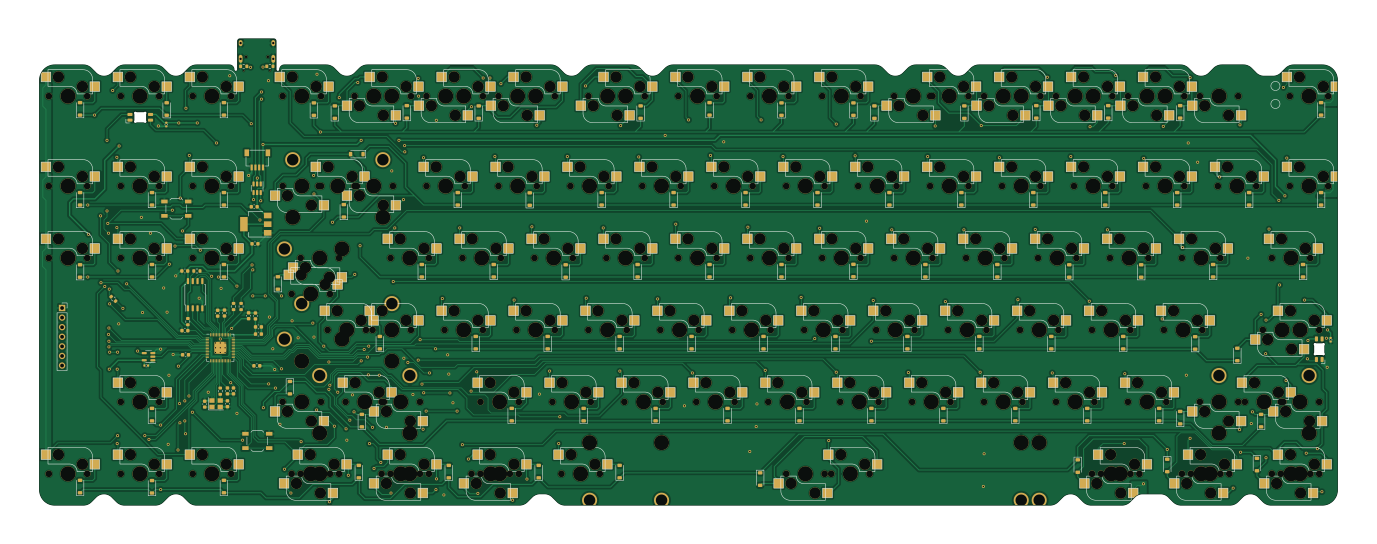
About the Candy87 PCB
Candy87 is an open source RP2040/RP2350 PCB design by rarepotato8de, published on GitHub. It is a 2-layer board measuring 343.6 × 123.4 mm, with 235 components from 33 distinct parts.
Its main chip is the RP2040, from the RP2040/RP2350 family. Other key parts include the AMS1117-3.3, W25Q128JVS, USBLC6-2SC6 and 74AHCT1G125. By type, the board carries 91 diodes, 19 capacitors, 8 resistors, 5 ICs, 3 connectors and 2 LEDs.
It belongs with the keyboards designs in this gallery.
From the project
Universal TKL PCB that was designed for the F1-8X V2 and similar keyboards. It's exclusively made for Candykeys! 💙
To flash the PCB the first time, you just have to plug it into your computer via. USB-C or Daughterboard and then in your explorer there should appear a new drive medium called "RPI-RP2" or similar. Just drag&drop the .UF2 file onto the drive and the window should automatically close and the PCB will now be flashed and functional. For flashing it another time, plug in the PCB and hold down the "BOOT" button on the backside of the PCB, press the "RESET" button two times and then release the "BOOT" button again. After that the "RPI-RP2" medium should appear.
Main components on the Candy87
Candy87 bill of materials (BOM)
235 components, 33 distinct parts — part numbers from the project's BOM.
| Qty | Part | Footprint | Refs |
|---|---|---|---|
| 1 | RP2040 | RP2040-QFN-56 | U1 |
| 1 | AMS1117-3.3 | SOT-223-3_TabPin2 | U2 |
| 1 | W25Q128JVS | SOIC-8_5.23x5.23mm_P1.27mm | U3 |
| 1 | USBLC6-2SC6 | SOT-23-6 | U4 |
| 1 | 74AHCT1G125 | SOT-23-5 | U5 |
| 1 | Crystal MPN 12MHz | Crystal_SMD_3225-4Pin_3.2x2.5mm | Y1 |
| 1 | AI03_UD ai03_ud | JST-SR-4 | J1 |
| 1 | USB_C_RECEPTACLE_USB2.0 USB_C_Receptacle_USB2.0 | USB_C_Receptacle_HRO_TYPE-C-31-M-12 | J2 |
| 1 | Conn_01x07_Pin | PinSocket_1x07_P2.54mm_Vertical | J3 |
| 80 | 1u | MXOnly-1U-Hotswap | MX1, MX2, MX3, MX4, MX5, MX6, MX7, MX8 +72 |
| 1 | 2u | MXOnly-2U-Hotswap | MX18 |
| 1 | ISO_ENTER | MXOnly-ISO-Hotswap-ReversedStabilizers | MX37 |
| 6 | 1.5u | MXOnly-1.5U-Hotswap | MX38, MX51, MX95, MX97, MX99, MX101 |
| 9 | 1.25u | MXOnly-1.25U-Hotswap | MX55, MX70, MX87, MX88, MX89, MX91, MX92, MX93 +1 |
| 2 | 1.75u | MXOnly-1.75U-Hotswap | MX57, MX84 |
| 2 | 2.25u | MXOnly-2.25U-Hotswap | MX69, MX72 |
| 1 | 2.75u | MXOnly-2.75U-Hotswap | MX71 |
| 1 | 6.25u | MXOnly-6.25U-Hotswap-ReversedStabilizers | MX90 |
| 1 | 7u | MXOnly-7U-Hotswap | MX98 |
| 1 | C318884 RESET | SW_SPST_TL3342 | RESET1 |
Show 13 more
| Qty | Part | Footprint | Refs |
|---|---|---|---|
| 1 | USB_BOOT | SW_SPST_TL3342 | USB_BOOT1 |
| 2 | SK6812MINI-E | LED_6028R | LED1, LED2 |
| 91 | 1N4148 | D_SOD-123 | D1, D2, D3, D4, D5, D6, D7, D8 +83 |
| 2 | 22P 22p | C_0603_1608Metric | C1, C11 |
| 10 | 100N 100n | C_0603_1608Metric | C2, C3, C4, C5, C6, C7, C8, C9 +2 |
| 2 | 1u | C_0603_1608Metric | C12, C13 |
| 2 | 22U 22u | C_0603_1608Metric | C14, C15 |
| 3 | 100NF 100nF | C_0402_1005Metric | C17, C18, C19 |
| 2 | 22 | R_0603_1608Metric | R1, R2 |
| 2 | 1k | R_0603_1608Metric | R3, R7 |
| 2 | 5.1K 5.1k | R_0603_1608Metric | R4, R5 |
| 1 | DNP | R_0603_1608Metric | R6 |
| 1 | 470 | R_0603_1608Metric | R8 |
Candy87 design files
The KiCad project lives in the rarepotato8de/Candy87 repository on GitHub; these links point at the commit this page was built from.
Candy87: common questions
What microcontroller does the Candy87 use?
The Candy87 is built around the RP2040, from the RP2040/RP2350 family.
How big is the Candy87 PCB?
The Candy87 measures 343.6 × 123.4 mm, has 2 copper layers and is 1.6 mm thick.
How many components are on the Candy87?
235 components, from 33 distinct parts, with part numbers taken from the project's own BOM. The full bill of materials is listed on this page.
Where can I download the Candy87 design files?
From the rarepotato8de/Candy87 repository on GitHub, which has the KiCad layout, the schematic and the BOM; the links under Design files point to each one.
Can I use the Candy87 design in my own project?
The repository has no license, so all rights stay with rarepotato8de. Use it as a reference, and ask the author before reusing the design.
Can I test firmware for the Candy87 without the hardware?
Yes. HardLabs builds a simulation of the board from its netlist and BOM, so you can run and debug RP2040/RP2350 firmware against it before you order a PCB.
Similar boards
 RP2040/RP2350
Open Book Abridged Edition
joeycastillo
85 × 115 mm29 parts2LCC-BY-SA-4.08.1k RP2040/RP2350
Corne
foostan
277.2 × 107.5 mm164 parts2LCC-BY-4.07.7k RP2040/RP2350
Corne
277.2 × 107.5 mm164 parts2LCC-BY-4.07.7k RP2040/RP2350
Hid remapper
jfedor2
100 × 100 mm124 parts2LMIT1.7k RP2040/RP2350
Msa
Mentra-Community
47.8 × 9.4 mm53 parts2LMIT1.2k RP2040/RP2350
Open Source Smart Glasses
93 × 10.5 mm80 parts4LMIT1.2k