
Hand main

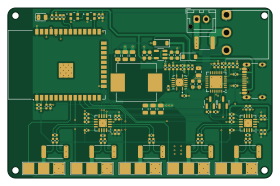
About the Hand main PCB
Hand main is an open source ESP32 PCB design by SonDinh23, published on GitHub under the GPL-3.0 license. It is a 4-layer board measuring 70 × 45 mm, with 105 components from 43 distinct parts.
Its main chip is the ESP32-WROOM-32D-N4, from the ESP32 family. Other key parts include the Pad 3, CP2102N-Axx-xQFN28, INA3221, TPS54620RGYR and XC6220B331MR. By type, the board carries 44 resistors, 38 capacitors, 12 ICs, 5 diodes, 2 transistors and 1 connector.
It belongs with the iot & wireless, wearables and robotics & motion designs in this gallery.
From the project
Full-stack 6-ch dry-electrode sEMG wearable (ESP32/BLE, 1 kHz/ch, JSON presets) with DC removal + HPF/LPF + Kalman DSP and dual-path gesture control (Amplitude thresholds + 6-ch Radar-shape matching) + Flutter app; SNR>=8 dB, latency<=80-100 ms, >=85% online (4 grips)
The definitive pit stop for every PCB in the EMGBand/Hand Bionic stack. Each section tells you what the board does, how it talks to the rest, where to grab build assets, and what to check before you power it up—plus a gallery pulled straight from the committed files.
- Use forward slashes / in image paths; links are relative to this README. - Example: ``. - GitHub renders images once the PNG files are present; add new renders/photos in the matching board folder. - Prefer per-board READMEs or a PDF gallery? Say the word and we will scaffold it.
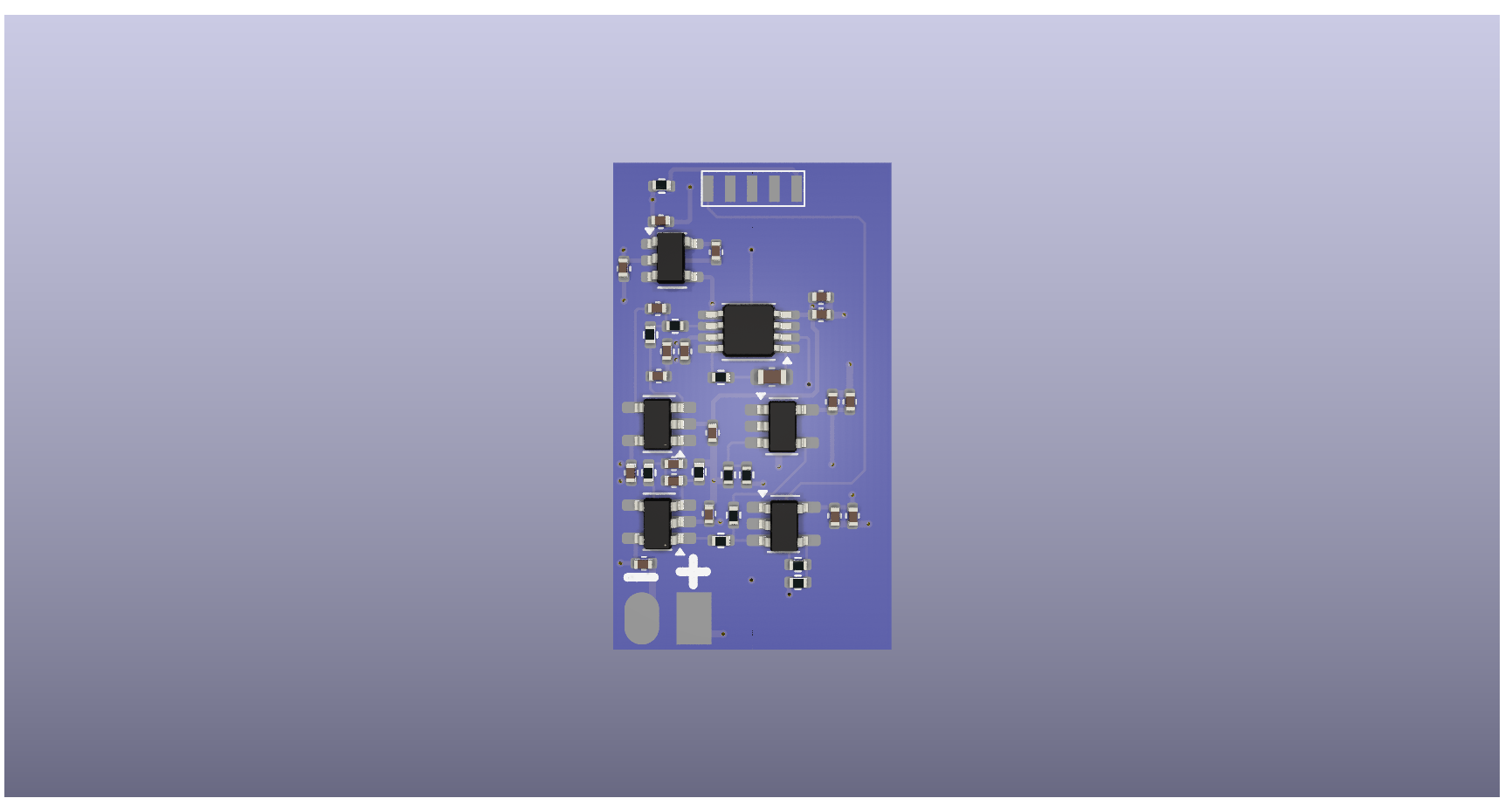
Main components on the Hand main
Hand main bill of materials (BOM)
105 components, 43 distinct parts.
| Qty | Part | Footprint | Refs |
|---|---|---|---|
| 5 | Pad 3 | Pad 3 | U1, U8, U9, U10, U12 |
| 1 | CP2102N-Axx-xQFN28 | QFN-28-1EP_5x5mm_P0.5mm_EP3.35x3.35mm | U2 |
| 2 | INA3221 | Texas_RGV0016A_VQFN-16-1EP_4x4mm_P0.65mm_EP2.1x2.1mm | U3, U4 |
| 1 | TPS54620RGYR | QFN50P350X350X100-15N | U5 |
| 1 | XC6220B331MR | SOT-23-5 | U6 |
| 1 | Pad_Battery | JST_XH_B2B-XH-AM_1x02_P2.50mm_Vertical | U7 |
| 1 | ESP32-WROOM-32D-N4 | ESP32-WROOM-32D | U14 |
| 2 | SS8050 | SOT-23 | Q2, Q3 |
| 1 | USB_C_Receptacle_USB2.0_16P | USB_C_Receptacle_GCT_USB4105-xx-A_16P_TopMnt_Horizontal | J1 |
| 1 | Fuse | Fuse_1812_4532Metric | F1 |
| 1 | SW_SPDT | SS-12D06G5 | SW1 |
| 2 | WS2812B2020 | LED_WS2812B2020 | D1, D2 |
| 1 | LED | LED_0805_2012Metric | D3 |
| 2 | D_Schottky | D_SOD-123 | D4, D5 |
| 1 | SPM10040T-3R3M-HZ | IND_SPM10040T-3R3M-HZ | L1 |
| 13 | 100nF | C_0402_1005Metric | C1, C4, C22, C30, C38, C39, C40, C42 +5 |
| 7 | 4.7uF | C_0402_1005Metric | C2, C3, C23, C41, C43, C48, C50 |
| 7 | 47uF | C_0805_2012Metric | C5, C6, C7, C8, C31, C32, C36 |
| 2 | 22uF | C_0603_1608Metric | C20, C24 |
| 2 | 1uF | C_0603_1608Metric | C21, C25 |
Show 23 more
| Qty | Part | Footprint | Refs |
|---|---|---|---|
| 1 | 10uF | C_0603_1608Metric | C26 |
| 1 | 4.7uF | C_0603_1608Metric | C27 |
| 1 | 5.6nF | C_0402_1005Metric | C28 |
| 1 | 82pF | C_0402_1005Metric | C29 |
| 1 | 2.2nF | C_0402_1005Metric | C33 |
| 1 | 10nF | C_0402_1005Metric | C37 |
| 1 | 1uF | C_0402_1005Metric | C69 |
| 2 | 5.1K | C_0402_1005Metric | R3, R4 |
| 1 | 24K | C_0402_1005Metric | R5 |
| 1 | 47K | C_0402_1005Metric | R6 |
| 1 | 4.7K | C_0402_1005Metric | R7 |
| 1 | 0R | C_0402_1005Metric | R8 |
| 15 | 10K | C_0402_1005Metric | R9, R10, R11, R18, R31, R32, R33, R34 +7 |
| 1 | 330R | C_0402_1005Metric | R12 |
| 1 | 102K | C_0402_1005Metric | R13 |
| 1 | 36.5K | C_0402_1005Metric | R15 |
| 1 | 3.92K | C_0402_1005Metric | R16 |
| 1 | 50K | C_0402_1005Metric | R17 |
| 1 | 28.7K | C_0402_1005Metric | R19 |
| 1 | 300K | C_0402_1005Metric | R20 |
| 1 | 100K | C_0402_1005Metric | R21 |
| 10 | 10R | C_0402_1005Metric | R22, R23, R26, R27, R29, R30, R40, R41 +2 |
| 5 | 0.1 | R_2512_6332Metric | R24, R25, R28, R37, R38 |
Hand main design files
The KiCad project lives in the SonDinh23/EMGBand-HandBionic repository on GitHub; these links point at the commit this page was built from.
Hand main: common questions
What microcontroller does the Hand main use?
The Hand main is built around the ESP32-WROOM-32D-N4, from the ESP32 family.
How big is the Hand main PCB?
The Hand main measures 70 × 45 mm, has 4 copper layers and is 1.6 mm thick.
How many components are on the Hand main?
105 components, from 43 distinct parts. The full bill of materials is listed on this page.
Where can I download the Hand main design files?
From the SonDinh23/EMGBand-HandBionic repository on GitHub, which has the KiCad layout and the schematic; the links under Design files point to each one.
Can I use the Hand main design in my own project?
Yes, under the terms of its GPL-3.0 license, which SonDinh23 chose for the repository.
Can I test firmware for the Hand main without the hardware?
Yes. HardLabs builds a simulation of the board from its netlist and BOM, so you can run and debug ESP32 firmware against it before you order a PCB.
More boards in EMGBand-HandBionic
Similar boards
 ESP32
ESP32Open Book Abridged Edition
joeycastillo
85 × 115 mm65 parts2LCC-BY-SA-4.08.1k ESP32
ESP32Badge
atopile
56.3 × 39 mm239 parts4LMIT4.0k ESP32
ESP32Esp32 minimal
36.2 × 26.8 mm20 parts2LMIT4.0k ESP32
ESP32Racer
StuckAtPrototype
36 × 50.2 mm70 parts4LApache-2.03.8k ESP32
ESP32Controller
29 × 74 mm58 parts4LApache-2.03.8k ESP32
ESP32Bitaxe
skot
56.5 × 99.8 mm86 parts4LCERN-OHL-S-2.01.4k