
Otto-DIY-MUST

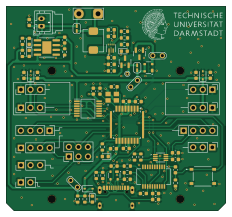
About the Otto-DIY-MUST PCB
Otto-DIY-MUST is an open source AVR/Arduino PCB design by TUDA-MUST, published on GitHub under the CC-BY-SA-4.0 license. It is a 4-layer board measuring 58 × 54 mm, with 76 components from 39 distinct parts.
Its main chip is the ATMEGA328P-A, from the AVR/Arduino family. Other key parts include the TP4056, SN74HC08PWR, FT231XS, TPS61022RWUR and TXB0102DCU. By type, the board carries 26 capacitors, 16 resistors, 13 connectors, 10 diodes, 6 ICs and 2 transistors.
It belongs with the power & battery and robotics & motion designs in this gallery.
From the project
Otto DIY MUST, is an improved version of the famous Otto DIY, specifically designed for classroom use.
An open-source, classroom-ready PCB and hardware update for the Otto DIY robot, developed to improve reliability, reduce power consumption, and streamline assembly in hands-on STEM workshops at the Technical University of Darmstadt. This repository contains the hardware design files, 3D-printable parts, firmware references, and educator guides to run student-centered build-and-program sessions where learners construct and program individualized robots.

Main components on the Otto-DIY-MUST
Otto-DIY-MUST bill of materials (BOM)
76 components, 39 distinct parts — part numbers from the project's BOM.
| Qty | Part | Footprint | Refs |
|---|---|---|---|
| 1 | TP4056 | SOP127P600X175-9N | IC1 |
| 1 | SN74HC08PWR | SOP65P640X120-14N | IC2 |
| 1 | ATMEGA328P-A ATmega328P-A | TQFP-32_7x7mm_P0.8mm | U1 |
| 1 | FT231XS | SSOP-20_3.9x8.7mm_P0.635mm | U2 |
| 1 | TPS61022RWUR | CONV_TPS61022RWUR | U3 |
| 1 | TXB0102DCU | VSSOP-8_2.3x2mm_P0.5mm | U5 |
| 2 | AO3401A | SOT-23 | Q2, Q3 |
| 1 | X322516MLB4SI | OSC_X322516MLB4SI | Y2 |
| 1 | CONN_02X03_ODD_EVEN Conn_02x03_Odd_Even | PinHeader_2x03_P2.54mm_Vertical | J1 |
| 1 | CONN_01X04_MALE_BLUETOOTH Conn_01x04_Male_bluetooth | PinHeader_1x04_P2.54mm_Vertical | J2 |
| 1 | CONN_01X02_SOCKET Conn_01x02_Socket | JST_PH_B2B-PH-K_1x02_P2.00mm_Vertical | J3 |
| 1 | CONN_01X03_MALE_NOISE Conn_01x03_Male_noise | PinHeader_1x03_P2.54mm_Vertical | J5 |
| 1 | CONN_01X04_MALE_SONIC Conn_01x04_Male_sonic | PinHeader_1x04_P2.54mm_Vertical | J6 |
| 1 | CONN_01X03_MALE_LEG_L Conn_01x03_Male_leg_l | PinHeader_1x03_P2.54mm_Vertical | J7 |
| 1 | CONN_01X03_MALE_LEG_R Conn_01x03_Male_leg_r | PinHeader_1x03_P2.54mm_Vertical | J8 |
| 1 | CONN_01X03_MALE_FOOT_L Conn_01x03_Male_foot_l | PinHeader_1x03_P2.54mm_Vertical | J9 |
| 1 | CONN_01X03_MALE_FOOT_R Conn_01x03_Male_foot_r | PinHeader_1x03_P2.54mm_Vertical | J10 |
| 1 | CONN_01X04_MALE_I2C Conn_01x04_Male_I2C | PinHeader_1x04_P2.54mm_Vertical | J13 |
| 1 | CONN_01X02_MALE_PIEZO Conn_01x02_Male_piezo | PinHeader_1x02_P2.54mm_Vertical | J14 |
| 1 | CONN_01X03_MALE_TOUCH Conn_01x03_Male_touch | PinHeader_1x03_P2.54mm_Vertical | J15 |
Show 19 more
| Qty | Part | Footprint | Refs |
|---|---|---|---|
| 1 | USB_C_RECEPTACLE_USB2.0_16P USB_C_Receptacle_USB2.0_16P | USB_C_Receptable_16Pin_C393939 | J16 |
| 1 | TS-1187A-B-A-B | SW_TS-1187A-B-A-B | S1 |
| 2 | SP0503BAHTG | SOT-143 | D1, D2 |
| 2 | C72038 LED_Y | LED_0603_1608Metric | D4, D11 |
| 3 | C2290 LED_W | LED_0603_1608Metric | D5, D6, D12 |
| 3 | C191023 D_Schottky | D_SOD-323 | D8, D9, D10 |
| 1 | 1UH 1uH | MAPM0530F | L1 |
| 11 | 100N 100n | C_0603_1608Metric | C1, C2, C7, C8, C13, C14, C15, C19 +3 |
| 1 | 1u | C_0603_1608Metric | C3 |
| 5 | 10U 10u | C_0603_1608Metric | C4, C9, C10, C11, C24 |
| 2 | 47P 47p | C_0603_1608Metric | C5, C6 |
| 5 | 22U 22u | C_0603_1608Metric | C12, C20, C21, C27, C28 |
| 2 | 22P 22p | C_0603_1608Metric | C17, C18 |
| 4 | 10K | R_0603_1608Metric | R2, R6, R10, R11 |
| 1 | 732K 732k | R_0603_1608Metric | R3 |
| 2 | 27R | R_0603_1608Metric | R4, R5 |
| 3 | 5.1K 5.1k | R_0603_1608Metric | R7, R12, R13 |
| 5 | 330R | R_0603_1608Metric | R8, R9, R16, R17, R18 |
| 1 | 100K 100k | R_0603_1608Metric | R15 |
Otto-DIY-MUST design files
The KiCad project lives in the TUDA-MUST/Otto-DIY-MUST repository on GitHub; these links point at the commit this page was built from.
Otto-DIY-MUST: common questions
What microcontroller does the Otto-DIY-MUST use?
The Otto-DIY-MUST is built around the ATMEGA328P-A, from the AVR/Arduino family.
How big is the Otto-DIY-MUST PCB?
The Otto-DIY-MUST measures 58 × 54 mm, has 4 copper layers and is 1.6312 mm thick.
How many components are on the Otto-DIY-MUST?
76 components, from 39 distinct parts, with part numbers taken from the project's own BOM. The full bill of materials is listed on this page.
Where can I download the Otto-DIY-MUST design files?
From the TUDA-MUST/Otto-DIY-MUST repository on GitHub, which has the KiCad layout, the schematic and the BOM; the links under Design files point to each one.
Can I use the Otto-DIY-MUST design in my own project?
Yes, under the terms of its CC-BY-SA-4.0 license, which TUDA-MUST chose for the repository.
Can I test firmware for the Otto-DIY-MUST without the hardware?
Yes. HardLabs builds a simulation of the board from its netlist and BOM, so you can run and debug AVR/Arduino firmware against it before you order a PCB.
Similar boards
 AVR/Arduino
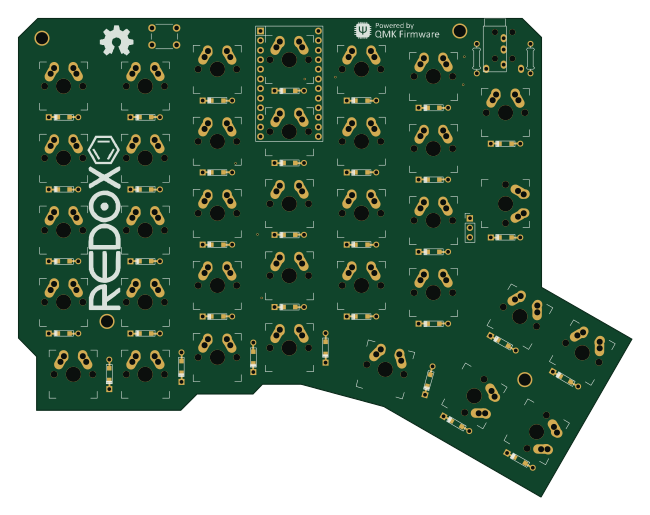
Redox keyboard
mattdibi
162.2 × 126.5 mm77 parts2LMIT2.0k AVR/Arduino
ModuleV450
stuartpittaway
30 × 61.4 mm39 parts2LCC-BY-NC-4.01.1k AVR/Arduino
V4
30 × 50 mm38 parts2LCC-BY-NC-4.01.1k AVR/Arduino
Discipline
coseyfannitutti
304.9 × 122.8 mm170 parts2LCC-BY-NC-4.01.0k AVR/Arduino
Megadesk
gcormier
41.7 × 32.2 mm23 parts2LGPL-3.0818 AVR/Arduino
Easyduino Atmega Nano
Hanqaqa
43.4 × 18 mm30 parts4LCERN-OHL-P-2.0746