
FlightComputer-SRAD-2026

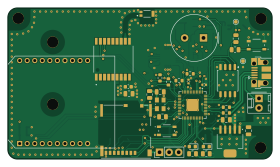
About the FlightComputer-SRAD-2026 PCB
FlightComputer-SRAD-2026 is an open source RP2040/RP2350 PCB design by vito-pp, published on GitHub. It is a 4-layer board measuring 70 × 40 mm, with 76 components from 44 distinct parts.
Its main chip is the RP2040, from the RP2040/RP2350 family. Other key parts include the IIM-20670, ADXL375BCCZ-RL7, MAX-M10M-00B, W25Q128JVS and XBP9B-DMSTB002. By type, the board carries 11 capacitors, 7 ICs, 7 resistors, 4 connectors, 2 switches and 2 diodes.
From the project
HW and SW documentation of a Student Researched And Developed (SRAD) flight computer in charge of telemetry for ITBA's rocketry team 2026
This project uses the Raspberry Pi Pico SDK with CMake and the ARM GCC toolchain.
Follow these steps to set up the build environment.
Clone the SDK somewhere on your system (outside this repo):
Set this variable so CMake can find the SDK:
After building, the firmware file will be generated:
1. Hold the BOOTSEL button on the Pico 2. Plug the Pico into USB 3. Release BOOTSEL 4. Copy the UF2 file:
Main components on the FlightComputer-SRAD-2026
FlightComputer-SRAD-2026 bill of materials (BOM)
76 components, 44 distinct parts — part numbers from the project's BOM.
| Qty | Part | Footprint | Refs |
|---|---|---|---|
| 1 | IIM-20670 | QFN50P450X450X115-25N | U1 |
| 1 | RP2040 | QFN-56-1EP_7x7mm_P0.4mm_EP3.2x3.2mm_ThermalVias | U3 |
| 1 | ADXL375BCCZ-RL7 | LGA-14_3x5mm_P0.8mm_LayoutBorder1x6y | U4 |
| 1 | MAX-M10M-00B | XCVR_MAX-M10M-00B | U5 |
| 1 | W25Q128JVS | SOIC-8_5.3x5.3mm_P1.27mm | U6 |
| 1 | XBP9B-DMSTB002 | XBEEPRO | U7 |
| 1 | TPS73733DCQ | SOT-223-6 | U8 |
| 1 | MS561101BA03-50 | XDCR_MS561101BA03-50 | A1 |
| 1 | BC847 | SOT-23 | Q1 |
| 1 | ABM8-272-T3 | XTAL_ABM8-272-T3 | Y1 |
| 1 | 503398-1892 | MOLEX_503398-1892 | J1 |
| 1 | CONNECTOR_3 Connector_3 | PinHeader_1x03_P2.54mm_Vertical | J2 |
| 1 | USB_B_Micro | USB_Micro-B_Amphenol_10103594-0001LF_Horizontal | J3 |
| 1 | Vin_Bat | Molex_1x02_P2.54mm | J5 |
| 1 | W3011 | XDCR_W3011 | AE1 |
| 8 | 100n | C_0402_1005Metric | CADXL_1, CBAR_1, CBAR_2, CFLASH_1, CIIM_1, CIIM_2, CIIM_3, CIIM_4 |
| 3 | 1u | C_0805_2012Metric | CADXL_2, CGPS_1, CXB_2 |
| 1 | 100n | C_0603_1608Metric | CGPS_2 |
| 3 | 10u | C_0805_2012Metric | CPS_1, CPS_2, CPS_3 |
| 1 | 47p | C_0805_2012Metric | CXB_1 |
Show 24 more
| Qty | Part | Footprint | Refs |
|---|---|---|---|
| 2 | 15p | C_0805_2012Metric | CX_1, CX_2 |
| 1 | 100k | R_0805_2012Metric | Div_res_bat1 |
| 1 | 470k | R_0805_2012Metric | Div_res_bat2 |
| 2 | 82k | R_0805_2012Metric | Div_res_reg1a1, Div_res_reg2a1 |
| 1 | 150k | R_0805_2012Metric | Div_res_reg1b1 |
| 1 | 47k | R_0805_2012Metric | Div_res_reg2b1 |
| 1 | PS1240P02BT | Buzzer_TDK_PS1240P02BT_D12.2mm_H6.5mm | LS1 |
| 1 | DNF | R_0805_2012Metric | RFLASH_1 |
| 2 | 1k | R_0805_2012Metric | RFLASH_2, RX_1 |
| 7 | 1k | R_0603_1608Metric | RI2C_1, RI2C_2, RI2C_3, RI2C_4, RSPI_1, RSPI_2, RSPI_3 |
| 1 | 39 | R_0805_2012Metric | RL_1 |
| 1 | 150 | R_0805_2012Metric | RL_2 |
| 1 | 10k | R_0603_1608Metric | RSPI_4 |
| 1 | 10k | R_0805_2012Metric | R_RST1 |
| 2 | PTS810SJK250SMTR LFS PTS810SJK250SMTR_LFS | PTS810SJK250SMTRLFS | S1, S2 |
| 1 | LED_B | LED_0603_1608Metric | D1 |
| 1 | LED_R | LED_0603_1608Metric | D2 |
| 9 | 100N 100n | C_0402_1005Metric | C6, C7, C9, C11, C12, C13, C14, C15 +1 |
| 2 | 1u | C_0402_1005Metric | C8, C10 |
| 1 | 22K 22k | R_0805_2012Metric | R1 |
| 1 | 1k | R_0805_2012Metric | R2 |
| 2 | 27 | R_0603_1608Metric | R3, R4 |
| 2 | 10K 10k | R_0805_2012Metric | R6, R7 |
| 1 | DNF | R_0805_2012Metric | R8 |
FlightComputer-SRAD-2026 design files
The KiCad project lives in the vito-pp/FlightComputer-SRAD-2026 repository on GitHub; these links point at the commit this page was built from.
FlightComputer-SRAD-2026: common questions
What microcontroller does the FlightComputer-SRAD-2026 use?
The FlightComputer-SRAD-2026 is built around the RP2040, from the RP2040/RP2350 family.
How big is the FlightComputer-SRAD-2026 PCB?
The FlightComputer-SRAD-2026 measures 70 × 40 mm, has 4 copper layers and is 1.6 mm thick.
How many components are on the FlightComputer-SRAD-2026?
76 components, from 44 distinct parts, with part numbers taken from the project's own BOM. The full bill of materials is listed on this page.
Where can I download the FlightComputer-SRAD-2026 design files?
From the vito-pp/FlightComputer-SRAD-2026 repository on GitHub, which has the KiCad layout, the schematic and the BOM; the links under Design files point to each one.
Can I use the FlightComputer-SRAD-2026 design in my own project?
The repository has no license, so all rights stay with vito-pp. Use it as a reference, and ask the author before reusing the design.
Can I test firmware for the FlightComputer-SRAD-2026 without the hardware?
Yes. HardLabs builds a simulation of the board from its netlist and BOM, so you can run and debug RP2040/RP2350 firmware against it before you order a PCB.
Similar boards
 RP2040/RP2350
Open Book Abridged Edition
joeycastillo
85 × 115 mm29 parts2LCC-BY-SA-4.08.1k RP2040/RP2350
Corne
foostan
277.2 × 107.5 mm164 parts2LCC-BY-4.07.7k RP2040/RP2350
Corne
277.2 × 107.5 mm164 parts2LCC-BY-4.07.7k RP2040/RP2350
LogicAnalyzer
gusmanb
57 × 55.2 mm6 parts2LGPL-3.05.0k RP2040/RP2350
Jitx design
55.5 × 65 mm26 parts4LGPL-3.05.0k RP2040/RP2350
Main
google
98 × 71 mm102 parts2LApache-2.02.9k