
Mimigotchu

About the Mimigotchu PCB
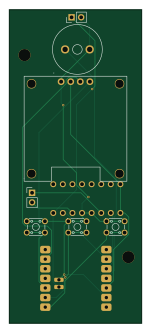
Mimigotchu is an open source ESP32 PCB design by WinnyT, published on GitHub under the MIT license. It is a 2-layer board measuring 35 × 83 mm, with 9 components from 7 distinct parts.
Its main chip is the XIAO-ESP32-C3-SMD, from the ESP32 family. Other key parts include the HS96L03W2C03 and L293D. By type, the board carries 3 ICs, 3 switches, 1 module and 1 battery holder.
It belongs with the robotics & motion designs in this gallery.
From the project
Right Button: Short press - Start countdown Long press - Switch to pet screen
Right Button: Short press - Start countdown Long press - Switch to pet screen
Oled screen: Timer mode: showing countdown of the timer MM:SS Pet mode: showing hapiness and age
Download gebber file ### 3D view of the PCB
You can flash Mimigotchi without installing PlatformIO.
2. Connect your Mimigotchi via USB-C 3. Download bootloader.bin, partitions.bin, and firmware.bin from the release 4. Run (from the folder containing all three files): esptool.py --port /dev/tty.usbmodem writeflash
Main components on the Mimigotchu
Mimigotchu bill of materials (BOM)
9 components, 7 distinct parts — part numbers from the project's BOM.
| Qty | Part | Footprint | Refs |
|---|---|---|---|
| 1 | XIAO-ESP32-C3-SMD | XIAO-ESP32-C3-SMD | U1 |
| 1 | HS96L03W2C03 HS(汉昇) | OLED-TH_L27.8-W27.2-P2.54_C9900033791 | U2 |
| 1 | L293D ST(意法半导体) | DIP-16_L20.0-W6.4-P2.54-LS7.6-BL | U3 |
| 1 | Motor_DC | PinHeader_1x02_P2.54mm_Vertical | M1 |
| 1 | Battery_Cell | PinHeader_1x02_P2.54mm_Vertical | BT1 |
| 1 | 1207-P6.5MM XHXDZ(兴华鑫) | BUZ-TH_BD12.5-P6.50-D1.4 | BUZZER1 |
| 3 | SW_Push | SW-TH_4P-L4.5-W4.5-P3.00-LS4.8 | SW1, SW2, SW3 |
Mimigotchu design files
The KiCad project lives in the WinnyT/mimigotchu repository on GitHub; these links point at the commit this page was built from.
Mimigotchu: common questions
What microcontroller does the Mimigotchu use?
The Mimigotchu is built around the XIAO-ESP32-C3-SMD, from the ESP32 family.
How big is the Mimigotchu PCB?
The Mimigotchu measures 35 × 83 mm, has 2 copper layers and is 1.6 mm thick.
How many components are on the Mimigotchu?
9 components, from 7 distinct parts, with part numbers taken from the project's own BOM. The full bill of materials is listed on this page.
Where can I download the Mimigotchu design files?
From the WinnyT/mimigotchu repository on GitHub, which has the KiCad layout, the schematic and the BOM; the links under Design files point to each one.
Can I use the Mimigotchu design in my own project?
Yes, under the terms of its MIT license, which WinnyT chose for the repository.
Can I test firmware for the Mimigotchu without the hardware?
Yes. HardLabs builds a simulation of the board from its netlist and BOM, so you can run and debug ESP32 firmware against it before you order a PCB.
Similar boards
 ESP32
ESP32Open Book Abridged Edition
joeycastillo
85 × 115 mm65 parts2LCC-BY-SA-4.08.1k ESP32
ESP32Badge
atopile
56.3 × 39 mm239 parts4LMIT4.0k ESP32
ESP32Esp32 minimal
36.2 × 26.8 mm20 parts2LMIT4.0k ESP32
ESP32Racer
StuckAtPrototype
36 × 50.2 mm70 parts4LApache-2.03.8k ESP32
ESP32Controller
29 × 74 mm58 parts4LApache-2.03.8k ESP32
ESP32Bitaxe
skot
56.5 × 99.8 mm86 parts4LCERN-OHL-S-2.01.4k