
BitaxeNajaDuo

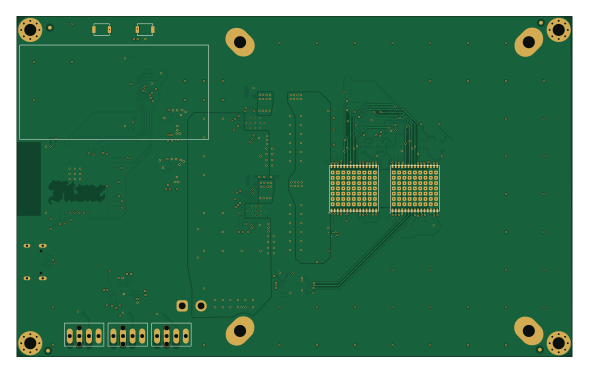
About the BitaxeNajaDuo PCB
BitaxeNajaDuo is an open source ESP32 PCB design by Zayno, published on GitHub under the CERN-OHL-S-2.0 license. It is a 6-layer board measuring 147 × 90 mm, with 198 components from 63 distinct parts.
Its main chip is the ESP32-S3-WROOM-1-N16R8, from the ESP32 family. Other key parts include the SN74AXC4T774PWR, TPS546D24SRVFR, TPS62933DRLR, SX3M25.000E20F30THN and TLV77308PDBVR. By type, the board carries 115 capacitors, 52 resistors, 15 ICs, 6 connectors, 6 inductors and 2 modules.
From the project
Current revision: A0 engineering draft. The conversion is not ready for fabrication, assembly or powered ASIC testing. The supplied firmware integration patch deliberately inhibits ASIC power and cannot mine.
Current revision: A0 engineering draft. The conversion is not ready for fabrication, assembly or powered ASIC testing. The supplied firmware integration patch deliberately inhibits ASIC power and cannot mine.
Bitaxe Flux is a single-chip Bitcoin miner derived from Bitaxe Naja Duo. Its goal is to support one Bitmain BM1373, a programmable high-current core supply and substantial desktop CPU cooling, with compatibility with the open-source ESP-Miner architecture. Maximum practical overclocking is the development objective; no hashrate, safe overclock, continuous current, board-power or thermal…
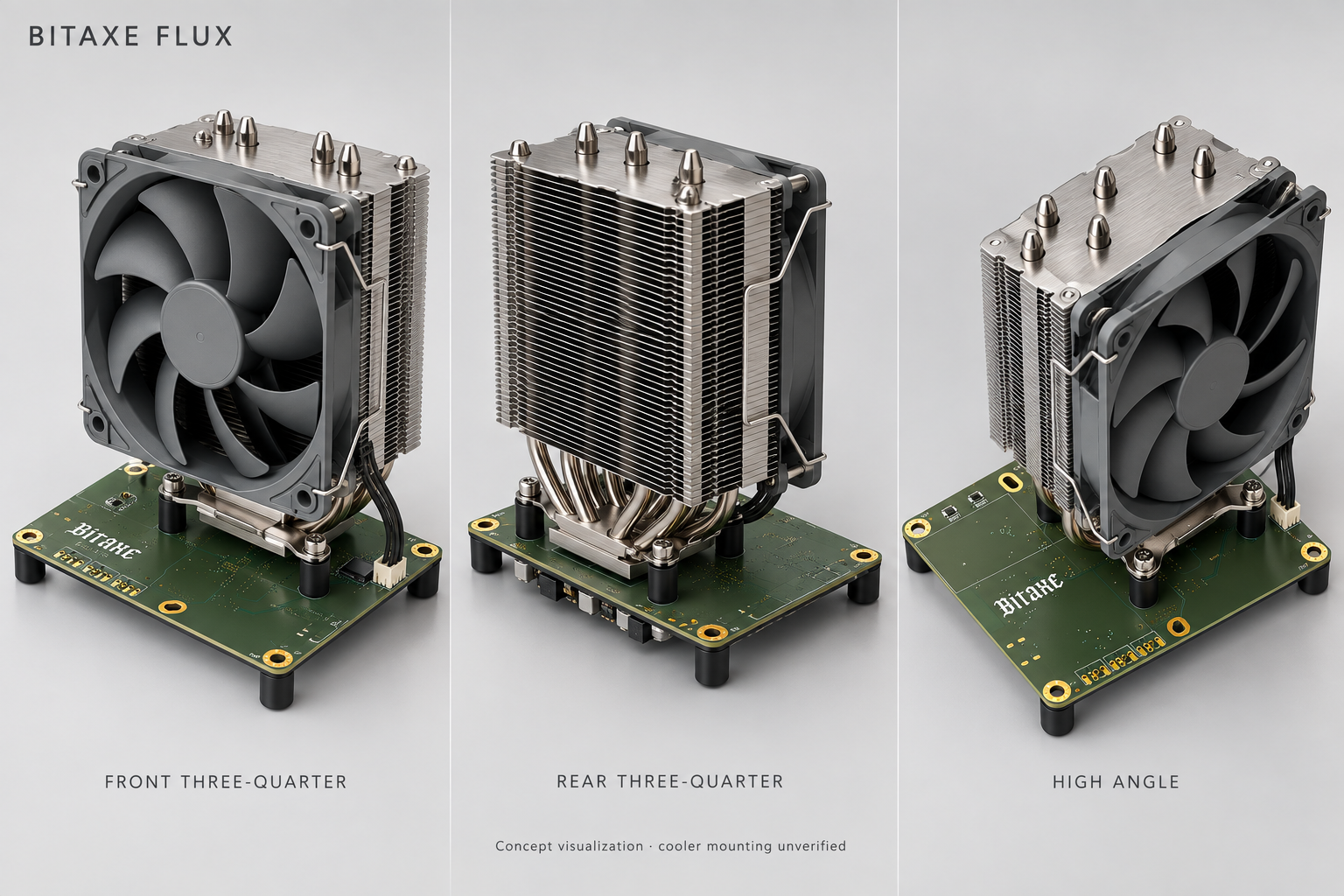
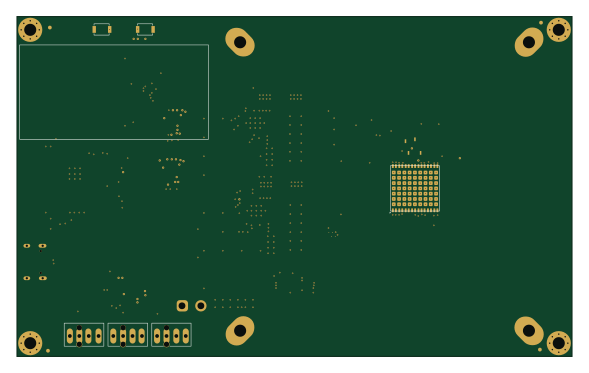
Main components on the BitaxeNajaDuo
BitaxeNajaDuo bill of materials (BOM)
198 components, 63 distinct parts — part numbers from the project's BOM.
| Qty | Part | Footprint | Refs |
|---|---|---|---|
| 1 | SN74AXC4T774PWR SN74AXC4T774 | TSSOP-16_4.4x5mm_P0.65mm | U2 |
| 2 | TPS546D24SRVFR TPS546D24S | LQFN40-CLIP | U3, U7 |
| 2 | TPS62933DRLR | SOT-583-8_L2.1-W1.2-P0.50-LS1.6-BR | U4, U5 |
| 1 | ESP32-S3-WROOM-1-N16R8 | ESP32-S3-WROOM-1 | U6 |
| 1 | SX3M25.000E20F30THN 25MHz | SMD3225-4P | U8 |
| 1 | TLV77308PDBVR | SOT-23-5 | U10 |
| 1 | TLV77312PDBVR | SOT-23-5 | U11 |
| 1 | TLV77308PDBVR | SOT-23-5 | U12 |
| 1 | EMC2103-2-AP EMC2103-2-AP-TR | QFN-16-1EP_4x4mm_P0.65mm_EP2.1x2.1mm | U13 |
| 1 | TLV77312PDBVR | SOT-23-5 | U14 |
| 1 | 25MHz | SMD3225-4P | U15 |
| 1 | AP2502KTR-G1 | SOT-23-6 | U16 |
| 1 | TLV3544 | TSSOP-14_4.4x5mm_P0.65mm | U17 |
| 1 | BM1373 BM1340_mode1 | BM1340 | A1 |
| 1 | BM1340_mode1 | BM1340 | A2 |
| 1 | XT30PW-M XT30 | AMASS_XT30UPB-M_1x02_P5.0mm_Vertical | J1 |
| 1 | FPC-05FB-30PH20 FPC-05F-30PH20 | FPC-SMD_30P-P0.50_XUNPU_FPC-05F-30PH20 | J2 |
| 1 | USB4105-GF-A USB_C_Receptacle_USB2.0 | USB_C_Receptacle_GCT_USB4105-xx-A | J4 |
| 3 | 0470531000 Conn_01x04 | 470531000 | J7, J8, J9 |
| 2 | CS1213AGF260 SWITCH-SPST | SW_CS1213AGF260_CRS | SW1, SW2 |
Show 43 more
| Qty | Part | Footprint | Refs |
|---|---|---|---|
| 2 | BLM31KN601SN1L FerriteBead | C_1206_3216Metric | FB1, FB2 |
| 1 | SLC1175-301 300nH | SLC1175-271MEC_COC | L1 |
| 2 | FTC201612S1R5MBCA 1.5uH | IND-SMD_L2.0-W1.6 | L2, L3 |
| 1 | SLC1175-271MEC 300nH | SLC1175-271MEC_COC | L4 |
| 19 | GRM188R61E106KA73D 10uF | C_0603_1608Metric | C2, C3, C8, C12, C24, C26, C38, C41 +11 |
| 9 | TMK107B7105KA-T 1uF | C_0402_1005Metric | C4, C16, C21, C27, C44, C45, C48, C199 +1 |
| 2 | GRM155R71E472KA01D 4.7nF | C_0402_1005Metric | C5, C31 |
| 2 | GRM155R61H222KA01D 2.2nF | C_0402_1005Metric | C6, C32 |
| 8 | KGM05AR71C104KH 0.1uF | C_0402_1005Metric | C7, C18, C33, C51, C52, C53, C92, C94 |
| 2 | CC0805KRX7R9BB102 1000pF | C_0805_2012Metric | C9, C46 |
| 12 | CL31A107MQHNNNE 100uF | C_1206_3216Metric | C10, C11, C13, C14, C15, C102, C105, C107 +4 |
| 2 | GRM155R61A475MEAAD 4.7uF | C_0402_1005Metric | C19, C40 |
| 5 | GRM155R71H104KE14D 0.1uF | C_0402_1005Metric | C22, C37, C39, C42, C43 |
| 3 | 0.1uF | C_0402_1005Metric | C23, C99, C206 |
| 2 | CC0402KRX7R9BB333 33nF | C_0402_1005Metric | C29, C30 |
| 2 | CL21A226MPQNNNE 22uF | C_0805_2012Metric | C35, C36 |
| 3 | KGM05ACG1E330JH 33pF | C_0402_1005Metric | C47, C100, C103 |
| 1 | 33pF | C_0402_1005Metric | C50 |
| 5 | 10uF | C_0603_1608Metric | C58, C59, C60, C61, C62 |
| 16 | EMK105BJ105MV-F 1uF | C_0402_1005Metric | C63, C64, C65, C66, C67, C68, C69, C70 +8 |
| 17 | 1uF | C_0402_1005Metric | C72, C73, C74, C75, C76, C77, C78, C79 +9 |
| 1 | GRM1555C1H471JA01D 470pF | C_0402_1005Metric | C93 |
| 1 | 470pF | C_0402_1005Metric | C95 |
| 1 | CC0402JRNPO9BN101 100pF | C_0402_1005Metric | C101 |
| 2 | 120UF 120uF | CP_Elec_6.3x5.9 | C104, C106 |
| 2 | RC0402FR-0749R9L 49.9 | R_0402_1005Metric | R1, R10 |
| 2 | ESR10EZPJ1R0 1 | R_0805_2012Metric | R2, R21 |
| 2 | RC0402FR-0710RL 10 | R_0402_1005Metric | R3, R19 |
| 9 | RC0402JR-0710KL 10k | R_0402_1005Metric | R5, R6, R13, R16, R20, R24, R30, R37 +1 |
| 1 | RC0402FR-0730K9L 30.9k | R_0402_1005Metric | R12 |
| 2 | RMCF0402JT5K10 5.1k | R_0402_1005Metric | R14, R25 |
| 1 | RC0402FR-0713K7L 13.7k | R_0402_1005Metric | R15 |
| 1 | RC0402FR-0752K3L 52.3k | R_0402_1005Metric | R17 |
| 1 | RC0402FR-0720KL 20k | R_0402_1005Metric | R23 |
| 2 | RC0402FR-071KL 1k | R_0402_1005Metric | R26, R38 |
| 1 | RT0402BRD072KL 2k | R_0402_1005Metric | R27 |
| 10 | 1k | R_0402_1005Metric | R28, R55, R58, R61, R64, R68, R69, R70 +2 |
| 2 | RC0402JR-070RL 0 | R_0402_1005Metric | R29, R32 |
| 1 | RC0402FR-075K6L 5.6k | R_0402_1005Metric | R31 |
| 4 | 0 | R_0402_1005Metric | R34, R36, R67, R73 |
| 1 | RC0402JR-074K7L 4.7k | R_0402_1005Metric | R39 |
| 2 | RC0402DR-0710KL 10k | R_0402_1005Metric | R45, R47 |
| 8 | 10k | R_0402_1005Metric | R56, R57, R59, R60, R62, R63, R65, R66 |
BitaxeNajaDuo design files
The KiCad project lives in the Zayno/BitaxeFluxAstra repository on GitHub; these links point at the commit this page was built from.
BitaxeNajaDuo: common questions
What microcontroller does the BitaxeNajaDuo use?
The BitaxeNajaDuo is built around the ESP32-S3-WROOM-1-N16R8, from the ESP32 family.
How big is the BitaxeNajaDuo PCB?
The BitaxeNajaDuo measures 147 × 90 mm, has 6 copper layers and is 1.6 mm thick.
How many components are on the BitaxeNajaDuo?
198 components, from 63 distinct parts, with part numbers taken from the project's own BOM. The full bill of materials is listed on this page.
Where can I download the BitaxeNajaDuo design files?
From the Zayno/BitaxeFluxAstra repository on GitHub, which has the KiCad layout, the schematic and the BOM; the links under Design files point to each one.
Can I use the BitaxeNajaDuo design in my own project?
Yes, under the terms of its CERN-OHL-S-2.0 license, which Zayno chose for the repository.
Can I test firmware for the BitaxeNajaDuo without the hardware?
Yes. HardLabs builds a simulation of the board from its netlist and BOM, so you can run and debug ESP32 firmware against it before you order a PCB.
More boards in BitaxeFluxAstra
Similar boards
 ESP32
ESP32Open Book Abridged Edition
joeycastillo
85 × 115 mm65 parts2LCC-BY-SA-4.08.1k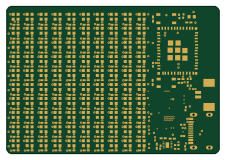 ESP32
ESP32Badge
atopile
56.3 × 39 mm239 parts4LMIT4.0k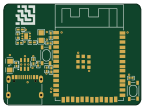 ESP32
ESP32Esp32 minimal
36.2 × 26.8 mm20 parts2LMIT4.0k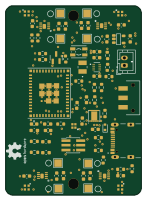 ESP32
ESP32Racer
StuckAtPrototype
36 × 50.2 mm70 parts4LApache-2.03.8k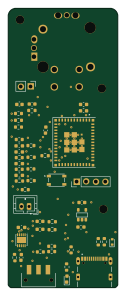 ESP32
ESP32Controller
29 × 74 mm58 parts4LApache-2.03.8k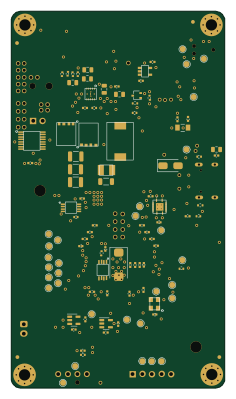 ESP32
ESP32Bitaxe
skot
56.5 × 99.8 mm86 parts4LCERN-OHL-S-2.01.4k