
Anima

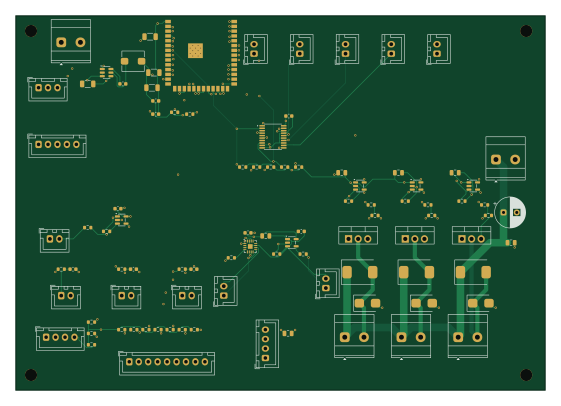
About the Anima PCB
Anima is an open source ESP32 PCB design by abhishekascodes, published on GitHub. It is a 4-layer board measuring 140 × 99 mm, with 95 components from 47 distinct parts.
Its main chip is the ESP32-S3-WROOM-1-N8, from the ESP32 family. Other key parts include the AP63203WU-7, SN74LVC1G00DBVR, SN74AHCT244PWR, SN74AHCT1G125DBVR and MAX98357AETE+T. By type, the board carries 34 resistors, 21 connectors, 21 capacitors, 9 ICs, 6 diodes and 3 transistors.
It belongs with the robotics & motion, audio and sensors designs in this gallery.
From the project
An interactive, tabletop humanoid upper torso robot built for Hack Club Fallen and showcasing at Maker Faire Shenzhen 2026.
An interactive, tabletop humanoid upper torso robot built for Hack Club Fallen and showcasing at Maker Faire Shenzhen 2026.
Honestly, I spent the first 6 hours of this build trying to make an insane 51-axis radial bio-organism. But once I rendered the 3D model, it looked like a rigid, awkward spider ball. Worse, the mechanical load math showed that standard servo splines would shear off under radial cantilever weight, and trying to route 60 amps of power across 24 moving limbs was asking for a fire.
Main components on the Anima
Anima bill of materials (BOM)
95 components, 47 distinct parts — part numbers from the project's BOM.
| Qty | Part | Footprint | Refs |
|---|---|---|---|
| 1 | ESP32-S3-WROOM-1-N8 | ESP32-S3-WROOM-1_Edge | U1 |
| 1 | AP63203WU-7 | TSOT-23-6 | U2 |
| 1 | SN74LVC1G00DBVR | SOT-23-5 | U3 |
| 1 | SN74AHCT244PWR | TSSOP-20_4.4x6.5mm_P0.65mm | U4 |
| 1 | SN74AHCT1G125DBVR | SOT-23-5 | U5 |
| 1 | MAX98357AETE+T | TQFN-16-1EP_3x3mm_P0.5mm_EP1.23x1.23mm | U6 |
| 3 | UCC27517ADBVR | SOT-23-5 | U7, U8, U9 |
| 3 | IRLZ44NPBF | TO-220-3_Vertical | Q1, Q2, Q3 |
| 1 | 5V LOGIC IN | TerminalBlock_Phoenix_MKDS-3-2-5.08_1x02_P5.08mm_Horizontal | J1 |
| 1 | PI UART | JST_XH_B3B-XH-A_1x03_P2.50mm_Vertical | J2 |
| 1 | PROGRAM UART | JST_XH_B5B-XH-A_1x05_P2.50mm_Vertical | J3 |
| 1 | STOP AUX CONTACT | JST_XH_B2B-XH-A_1x02_P2.50mm_Vertical | J5 |
| 1 | HALL HARNESS | JST_XH_B9B-XH-A_1x09_P2.50mm_Vertical | J6 |
| 1 | COIL 1 NTC | JST_XH_B2B-XH-A_1x02_P2.50mm_Vertical | J7 |
| 1 | COIL 2 NTC | JST_XH_B2B-XH-A_1x02_P2.50mm_Vertical | J8 |
| 1 | COIL 3 NTC | JST_XH_B2B-XH-A_1x02_P2.50mm_Vertical | J9 |
| 1 | MODE START REMATCH | JST_XH_B4B-XH-A_1x04_P2.50mm_Vertical | J10 |
| 1 | LD2410 RADAR | JST_XH_B4B-XH-A_1x04_P2.50mm_Vertical | J11 |
| 1 | PAN_SERVO | JST_XH_B2B-XH-A_1x02_P2.50mm_Vertical | J12 |
| 1 | TILT_SERVO | JST_XH_B2B-XH-A_1x02_P2.50mm_Vertical | J13 |
Show 27 more
| Qty | Part | Footprint | Refs |
|---|---|---|---|
| 1 | ELBOW_SERVO | JST_XH_B2B-XH-A_1x02_P2.50mm_Vertical | J14 |
| 1 | JAW_SERVO | JST_XH_B2B-XH-A_1x02_P2.50mm_Vertical | J15 |
| 1 | SHUTTER_SERVO | JST_XH_B2B-XH-A_1x02_P2.50mm_Vertical | J16 |
| 1 | PIXELS SIGNAL | JST_XH_B2B-XH-A_1x02_P2.50mm_Vertical | J17 |
| 1 | SPEAKER BTL | JST_XH_B2B-XH-A_1x02_P2.50mm_Vertical | J18 |
| 1 | 12V COIL CUT INPUT | TerminalBlock_Phoenix_MKDS-3-2-5.08_1x02_P5.08mm_Horizontal | J19 |
| 1 | COIL 1 | TerminalBlock_Phoenix_MKDS-3-2-5.08_1x02_P5.08mm_Horizontal | J20 |
| 1 | COIL 2 | TerminalBlock_Phoenix_MKDS-3-2-5.08_1x02_P5.08mm_Horizontal | J21 |
| 1 | COIL 3 | TerminalBlock_Phoenix_MKDS-3-2-5.08_1x02_P5.08mm_Horizontal | J22 |
| 3 | SS54-E3/57T | D_SMC | D1, D2, D3 |
| 3 | SMBJ24A-E3/52 | D_SMB | D4, D5, D6 |
| 1 | 4.7uH SRP5030TA-4R7M | L_Bourns_SRP5030T | L1 |
| 1 | 1UF 1uF | C_0603_1608Metric | C1 |
| 9 | 100NF 100nF | C_0603_1608Metric | C2, C4, C8, C10, C11, C12, C14, C15 +1 |
| 1 | 22UF 22uF | C_1206_3216Metric | C3 |
| 1 | 10uF 16V | C_1206_3216Metric | C5 |
| 2 | 22uF 10V | C_1206_3216Metric | C6, C7 |
| 2 | 10UF 10uF | C_0805_2012Metric | C13, C17 |
| 1 | 470uF 25V | CP_Radial_D8.0mm_P3.50mm | C18 |
| 1 | 100nF 50V | C_0805_2012Metric | C19 |
| 3 | 1UF 1uF | C_0805_2012Metric | C20, C21, C22 |
| 16 | 10K 10k | R_0603_1608Metric | R1, R2, R3, R10, R11, R12, R13, R14 +8 |
| 10 | 100K 100k | R_0603_1608Metric | R4, R23, R24, R25, R26, R27, R29, R31 +2 |
| 3 | 10k 1% | R_0603_1608Metric | R17, R18, R19 |
| 1 | 330R | R_0603_1608Metric | R28 |
| 1 | 0R | R_0603_1608Metric | R30 |
| 3 | 22R | R_0603_1608Metric | R34, R35, R36 |
Anima design files
The KiCad project lives in the abhishekascodes/Anima repository on GitHub; these links point at the commit this page was built from.
Anima: common questions
What microcontroller does the Anima use?
The Anima is built around the ESP32-S3-WROOM-1-N8, from the ESP32 family.
How big is the Anima PCB?
The Anima measures 140 × 99 mm, has 4 copper layers and is 1.6 mm thick.
How many components are on the Anima?
95 components, from 47 distinct parts, with part numbers taken from the project's own BOM. The full bill of materials is listed on this page.
Where can I download the Anima design files?
From the abhishekascodes/Anima repository on GitHub, which has the KiCad layout, the schematic and the BOM; the links under Design files point to each one.
Can I use the Anima design in my own project?
The repository has no license, so all rights stay with abhishekascodes. Use it as a reference, and ask the author before reusing the design.
Can I test firmware for the Anima without the hardware?
Yes. HardLabs builds a simulation of the board from its netlist and BOM, so you can run and debug ESP32 firmware against it before you order a PCB.
Similar boards
 ESP32
OSO-BOOK-B1
joeycastillo
85 × 115 mm65 parts2LCC-BY-SA-4.08.1k ESP32
Powertrain
byrantech
64 × 45.4 mm171 parts4LMIT4.3k ESP32
Badge
atopile
56.3 × 39 mm239 parts4LMIT4.0k ESP32
Esp32 minimal
36.2 × 26.8 mm20 parts2LMIT4.0k ESP32
Controller
StuckAtPrototype
29 × 74 mm58 parts4LApache-2.03.8k ESP32
Racer
36 × 50.2 mm70 parts4LApache-2.03.8k