
Hux

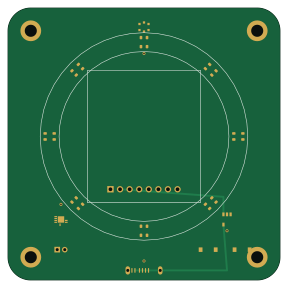
About the Hux PCB
Hux is an open source ESP32 PCB design by AwesomeSno, published on GitHub. It is a 2-layer board measuring 72 × 72 mm, with 17 components from 10 distinct parts.
Its main chip is the ESP32-S3-WROOM-1, from the ESP32 family. Other key parts include the TLV75533PDBVR, INMP441 and MAX98357AETE+T. By type, the board carries 8 LEDs, 4 ICs, 3 connectors and 2 switches.
It belongs with the iot & wireless, displays & leds and audio designs in this gallery.
From the project
A desktop AI companion and Home Assistant controller with an expressive face display and Jarvis personality.
A desktop AI smart home companion built with an ESP32-S3, featuring an animated expressive face display, an addressable RGB status ring, dual I2S voice I/O, and native local integration with Home Assistant. Inspired by Jarvis from Iron Man.
Most smart home speakers on the market are completely lifeless—they're just boring black plastic pucks sitting on your desk that listen to you with zero personality and no visual feedback beyond a single blinking LED.
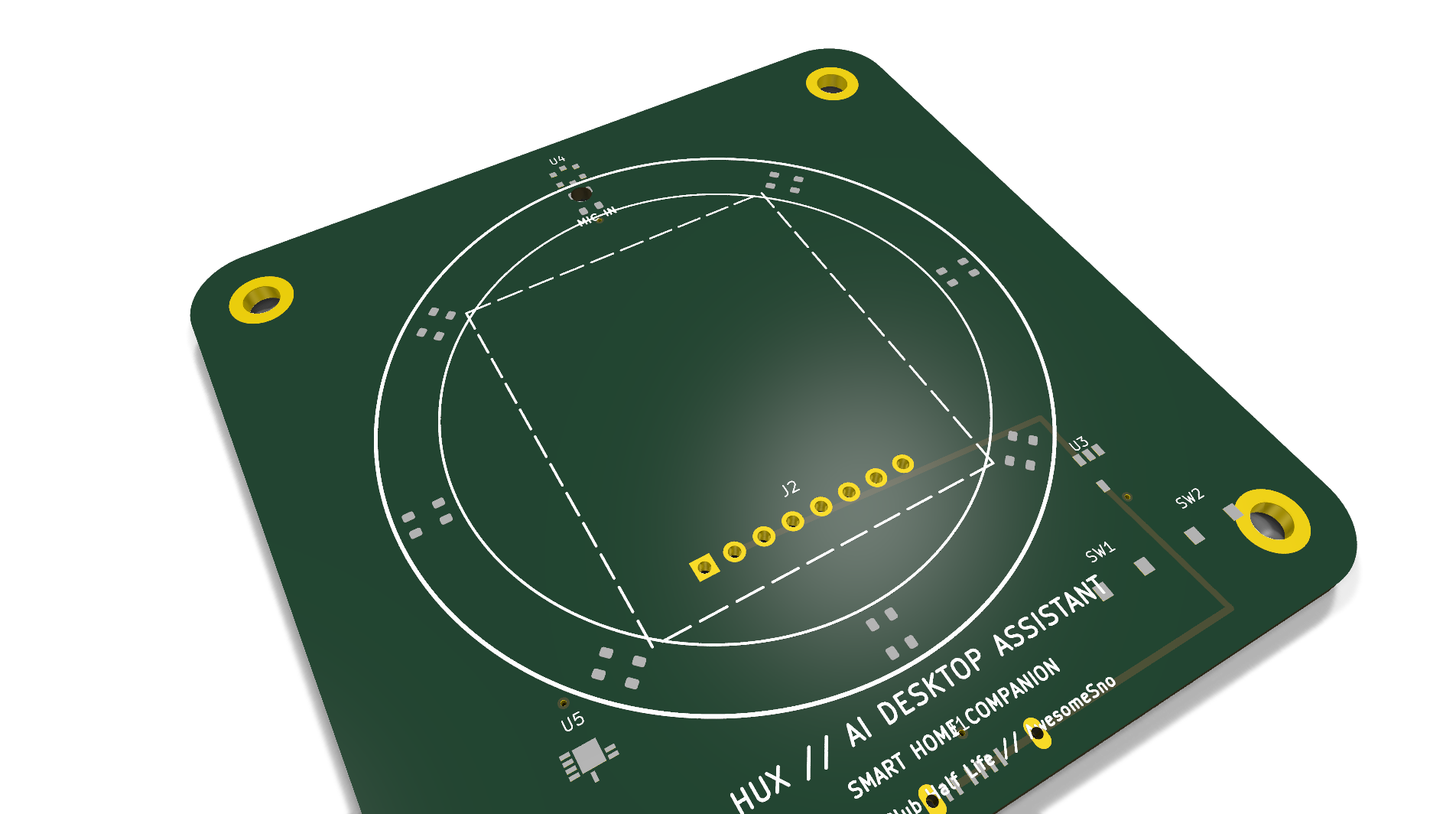
Main components on the Hux
Hux bill of materials (BOM)
17 components, 10 distinct parts — part numbers from the project's BOM.
| Qty | Part | Footprint | Refs |
|---|---|---|---|
| 1 | ESP32-S3-WROOM-1 | ESP32-S3-WROOM-1 | U1 |
| 1 | TLV75533PDBVR TLV75533 | SOT-23-5 | U3 |
| 1 | INMP441 | INMP441 | U4 |
| 1 | MAX98357AETE+T MAX98357A | QFN-16-1EP_3x3mm_P0.5mm_EP1.7x1.7mm | U5 |
| 1 | TYPE-C-31-M-12 USB-C-16P | USB_C_Receptacle_16P | J1 |
| 1 | ST7789_1.69_IPS | PinHeader_1x08_P2.54mm_Vertical | J2 |
| 1 | JST-PH-2P SPK_OUT | JST_PH_S2B-PH-K_1x02_P2.00mm_Horizontal | J3 |
| 1 | TL3342F160QG RST | SW_SPST_TL3342 | SW1 |
| 1 | TL3342F160QG BOOT | SW_SPST_TL3342 | SW2 |
| 8 | SK6812MINI-E | LED_SK6812MINI-E | LED1, LED2, LED3, LED4, LED5, LED6, LED7, LED8 |
Hux design files
The KiCad project lives in the AwesomeSno/Hux repository on GitHub; these links point at the commit this page was built from.
- Layoutkicad/hux.kicad_pcb
- Schematickicad/hux.kicad_sch
- BOMkicad/bom.csv
Hux: common questions
What microcontroller does the Hux use?
The Hux is built around the ESP32-S3-WROOM-1, from the ESP32 family.
How big is the Hux PCB?
The Hux measures 72 × 72 mm, has 2 copper layers and is 1.6 mm thick.
How many components are on the Hux?
17 components, from 10 distinct parts, with part numbers taken from the project's own BOM. The full bill of materials is listed on this page.
Where can I download the Hux design files?
From the AwesomeSno/Hux repository on GitHub, which has the KiCad layout, the schematic and the BOM; the links under Design files point to each one.
Can I use the Hux design in my own project?
The repository has no license, so all rights stay with AwesomeSno. Use it as a reference, and ask the author before reusing the design.
Can I test firmware for the Hux without the hardware?
Yes. HardLabs builds a simulation of the board from its netlist and BOM, so you can run and debug ESP32 firmware against it before you order a PCB.
Similar boards
 ESP32
OSO-BOOK-B1
joeycastillo
85 × 115 mm65 parts2LCC-BY-SA-4.08.1k ESP32
Powertrain
byrantech
64 × 45.4 mm171 parts4LMIT4.3k ESP32
Badge
atopile
56.3 × 39 mm239 parts4LMIT4.0k ESP32
Esp32 minimal
36.2 × 26.8 mm20 parts2LMIT4.0k ESP32
Racer
StuckAtPrototype
36 × 50.2 mm70 parts4LApache-2.03.8k ESP32
Controller
29 × 74 mm58 parts4LApache-2.03.8k