
Dragonfly

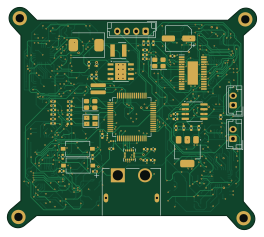
About the Dragonfly PCB
Dragonfly is an open source STM32 PCB design by Broccoliux, published on GitHub under the MIT license. It is a 4-layer board measuring 66 × 58.8 mm, with 226 components from 44 distinct parts.
Its main chip is the STM32F405RGTX, from the STM32 family. Other key parts include the ICM-20602, AT32F421G8U7, FD6288Q, TPS5430DDA and AMS1117-3.3. By type, the board carries 90 resistors, 71 capacitors, 24 transistors, 15 ICs, 15 diodes and 4 connectors.
It belongs with the robotics & motion, sensors and power & battery designs in this gallery.
From the project
A very cool, drone that can perform maneuvers.
A custom all-in-one flight controller + ESC, built entirely from discrete ICs rather than premade modules, designed for me by me. Flight control and all 4 motor drivers live on a single 4-layer PCB, designed from scratch in KiCad.
I wanted to go past just building a flight controller most DIY FC projects stop at a board that reads a gyro and outputs signals. I wanted the whole thing: FC and ESC combined on one board, IC-level design instead of stacking pre-built modules, a custom 3D-printed frame, and firmware configured to actually fly and hold up to real maneuvers, not just hover.
Main components on the Dragonfly
Dragonfly bill of materials (BOM)
226 components, 44 distinct parts — part numbers from the project's BOM.
| Qty | Part | Footprint | Refs |
|---|---|---|---|
| 1 | STM32F405RGTX STM32F405RGTx | LQFP-64_10x10mm_P0.5mm | U1 |
| 1 | ICM-20602 | LGA-16_3x3mm_P0.5mm_LayoutBorder3x5y | U2 |
| 4 | AT32F421G8U7 | AT32F421G8U7 | U3, U5, U7, U9 |
| 4 | FD6288Q | QFN50P400X400X90-25N | U4, U6, U8, U10 |
| 1 | TPS5430DDA | TI_SO-PowerPAD-8_ThermalVias | U11 |
| 1 | AMS1117-3.3 | SOT-223-3_TabPin2 | U12 |
| 1 | L78L08_SO8 | SOIC-8_3.9x4.9mm_P1.27mm | U13 |
| 1 | AT7456E | SOP65P640X120-29N | U14 |
| 1 | BMP280 | Bosch_LGA-8_2x2.5mm_P0.65mm_ClockwisePinNumbering | U15 |
| 24 | Q_NMOS_GDS | Diodes_PowerDI3333-8 | Q1, Q2, Q3, Q4, Q5, Q6, Q7, Q8 +16 |
| 1 | TSX-3225 | TSX-3225 | X1 |
| 1 | 27MHZ | Crystal_SMD_3225-4Pin_3.2x2.5mm | Y1 |
| 1 | CONN_01X04_PIN Conn_01x04_Pin | JST_EH_B4B-EH-A_1x04_P2.50mm_Vertical | J1 |
| 1 | XT60PW-M | AMASS_XT60PW-M | J7 |
| 1 | CAM VIN | JST_EH_B2B-EH-A_1x02_P2.50mm_Vertical | J8 |
| 1 | VOUT | JST_EH_B2B-EH-A_1x02_P2.50mm_Vertical | J9 |
| 1 | 32.768 kHz | Crystal_SMD_3225-4Pin_3.2x2.5mm | +10ppm1 |
| 2 | SW_SPST | SW_Tactile_SPST_NO_Straight_CK_PTS636Sx25SMTRLFS | SW1, SW2 |
| 1 | LED BLUE | LED_0201_0603Metric | D1 |
| 1 | LED RED | LED_0201_0603Metric | D2 |
Show 24 more
| Qty | Part | Footprint | Refs |
|---|---|---|---|
| 12 | 1N914WT | D_SOD-523 | D3, D4, D5, D6, D7, D8, D9, D10 +4 |
| 1 | 40V, 3A Schottky | D_SMC | D15 |
| 1 | 1KΩ 100Mhz | L_0402_1005Metric | L1 |
| 1 | 15UH 15uh | L_Wurth_WE-LQSH-4020 | L2 |
| 2 | 10PF 10pf | C_0402_1005Metric | C1, C2 |
| 2 | 12PF 12pf | C_0402_1005Metric | C3, C4 |
| 30 | 100NF 100nf | C_0402_1005Metric | C5, C6, C9, C10, C11, C12, C17, C19 +22 |
| 3 | 2.2UF 2.2uf | C_0402_1005Metric | C7, C8, C18 |
| 1 | 10NF 10nf | C_0402_1005Metric | C13 |
| 4 | 1UF 1uf | C_0402_1005Metric | C14, C61, C63, C72 |
| 24 | 10UF 10uf | C_0402_1005Metric | C20, C24, C25, C27, C28, C29, C30, C31 +16 |
| 1 | 0.01UF 0.01uf | C_0402_1005Metric | C58 |
| 1 | 220UF 220uf | CP_Elec_6.3x5.8 | C59 |
| 2 | 47UF 47uf | C_0402_1005Metric | C70, C71 |
| 1 | 0.1UF 0.1uf | C_0402_1005Metric | C73 |
| 1 | 10k NC | R_0402_1005Metric | R1 |
| 35 | 10K 10k | R_0402_1005Metric | R2, R3, R7, R8, R9, R10, R11, R15 +27 |
| 2 | 5.1kΩ | R_0402_1005Metric | R4, R5 |
| 12 | 1k | R_0402_1005Metric | R12, R13, R14, R30, R31, R32, R50, R51 +4 |
| 12 | 0R | R_0402_1005Metric | R18, R22, R26, R42, R44, R46, R62, R64 +4 |
| 24 | 20R | R_0402_1005Metric | R19, R20, R21, R23, R24, R25, R38, R39 +16 |
| 1 | 30.9K 30.9k | R_0815_2038Metric | R87 |
| 1 | 100K 100k | R_0402_1005Metric | R89 |
| 2 | 75R | R_0402_1005Metric | R90, R91 |
Dragonfly design files
The KiCad project lives in the Broccoliux/dragonfly repository on GitHub; these links point at the commit this page was built from.
Dragonfly: common questions
What microcontroller does the Dragonfly use?
The Dragonfly is built around the STM32F405RGTX, from the STM32 family.
How big is the Dragonfly PCB?
The Dragonfly measures 66 × 58.8 mm, has 4 copper layers and is 2.2 mm thick.
How many components are on the Dragonfly?
226 components, from 44 distinct parts, with part numbers taken from the project's own BOM. The full bill of materials is listed on this page.
Where can I download the Dragonfly design files?
From the Broccoliux/dragonfly repository on GitHub, which has the KiCad layout, the schematic and the BOM; the links under Design files point to each one.
Can I use the Dragonfly design in my own project?
Yes, under the terms of its MIT license, which Broccoliux chose for the repository.
Can I test firmware for the Dragonfly without the hardware?
Yes. HardLabs builds a simulation of the board from its netlist and BOM, so you can run and debug STM32 firmware against it before you order a PCB.
Similar boards
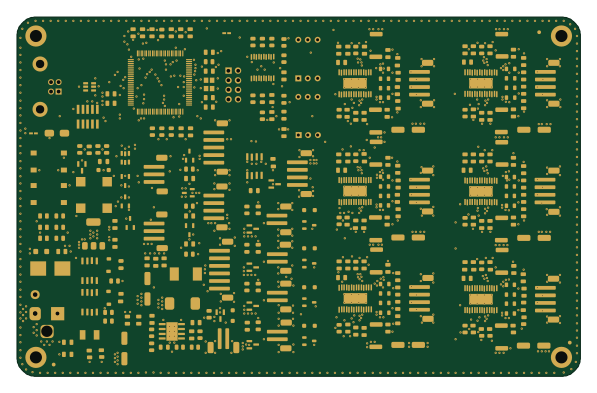 STM32
STM32LumenPnP Motherboard
opulo-inc
149 × 95 mm296 parts4LCC-BY-SA-4.03.7k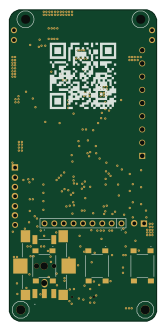 STM32
STM32AxxSolder
AxxAxx
39 × 82.5 mm122 parts2LGPL-3.01.7k STM32
STM32AIOC
skuep
21 × 31.5 mm47 parts2LMIT1.4k STM32
STM32Ferris
pierrechevalier83
208.8 × 86.8 mm102 parts2LSHL-2.11.3k STM32
STM32Module 16S
stuartpittaway
71.1 × 89.6 mm113 parts4LCC-BY-NC-4.01.1k STM32
STM32Djinn
tzarc
192.3 × 150.5 mm216 parts2LCERN-OHL-S-2.0988