
Zeub

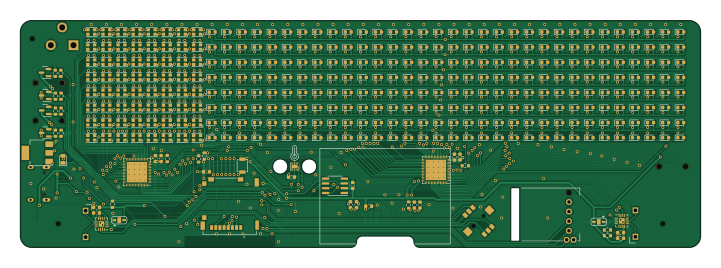
About the Zeub PCB
Zeub is an open source PCB design by crides, published on GitHub. It is a 2-layer board measuring 180 × 60 mm, with 402 components from 40 distinct parts.
Other key parts include the IS31FL3741, DS3231MZ, HOLYIOT-18010-NO-UNDERSIDE, W25Q128JVS and TLV1117-50. By type, the board carries 324 diodes, 23 resistors, 20 capacitors, 12 ICs, 7 connectors and 5 transistors.
It belongs with the iot & wireless, audio and displays & leds designs in this gallery.
From the project
A pixel clock and IoT hub
zeub is meant to be a pixel clock and a IoT hub. The name comes from a smooshed version of zeit (German for time) and hub.
It currently has: - a 8x8 RGB LED matrix and a 32x8 white LED matrix - 2 2-channel LED strip controllers (for controlling LED strips with warm and cool white lights in my room) - a 128x64 OLED screen - a TMP117 precision temperature sensor - 2 front facing speakers, using 2 MAX98357 DACs - a DS3212 battery backed RTC - a EVQWGD001 rotary encoder, and a 5-way joystick - a nRF52840 microcontroller, which supports USB, BLE and 802.15.4 (ZigBee etc.) protocols
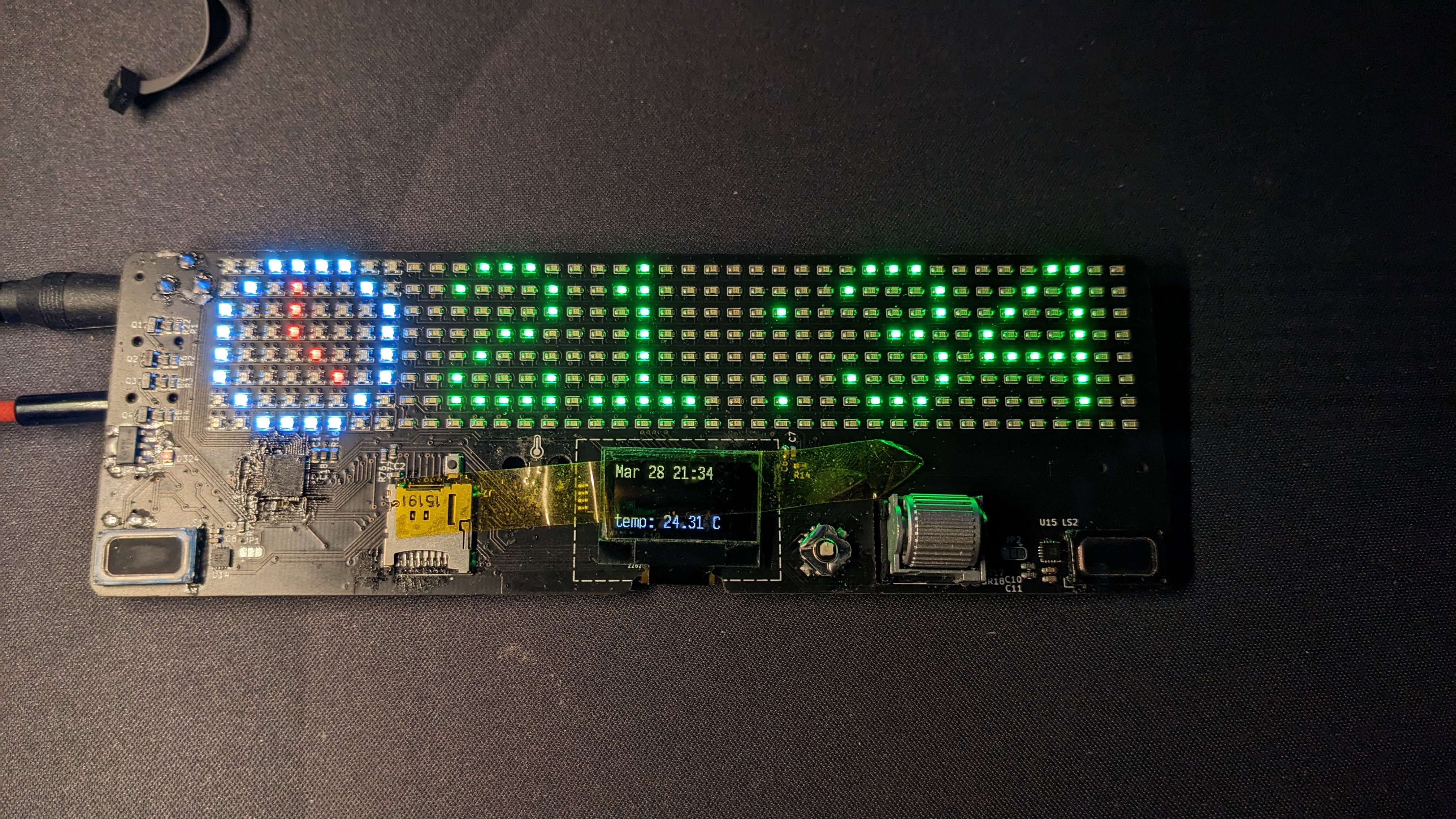
Main components on the Zeub
Zeub bill of materials (BOM)
402 components, 40 distinct parts — part numbers from the project's BOM.
| Qty | Part | Footprint | Refs |
|---|---|---|---|
| 2 | IS31FL3741 | QFN-60-1EP_7x7mm_P0.4mm_EP5.4x5.4mm_ThermalVias | U1, U2 |
| 1 | DS3231MZ | SOIC-8_3.9x4.9mm_P1.27mm | U3 |
| 1 | HOLYIOT-18010-NO-UNDERSIDE holyiot-18010-no-underside | holyiot-18010-no-underside | U5 |
| 1 | W25Q128JVS | SOIC-8_5.23x5.23mm_P1.27mm | U6 |
| 1 | TLV1117-50 | SOT-223 | U7 |
| 1 | XC6206PXXXMR XC6206PxxxMR | SOT-23-3 | U8 |
| 1 | SRV05-4 | SOT-23-6 | U9 |
| 1 | LTC4054ES5-4.2 | TSOT-23-5 | U10 |
| 1 | TMP117 | WSON-6-1EP_2x2mm_P0.65mm_EP1x1.6mm | U11 |
| 2 | MAX98357A | QFN-16-1EP_3x3mm_P0.5mm_EP1.45x1.45mm | U14, U15 |
| 5 | AO3400A | SOT-23 | Q1, Q2, Q3, Q4, Q5 |
| 1 | jlink | PinHeader_2x05_P1.27mm_Vertical_SMD | J1 |
| 3 | AUDIOJACK4 AudioJack4 | Jack_3.5mm_PJ320D_Horizontal | J2, J5, J6 |
| 1 | USB_C_RECEPTACLE_USB2.0 USB_C_Receptacle_USB2.0 | USB_C_Receptacle_HRO_TYPE-C-31-M-12 | J3 |
| 1 | Barrel_Jack_Switch | BarrelJack_CUI_PJ-102AH_Horizontal | J4 |
| 1 | Micro_SD_Card_Det | molex-503182-1852 | J7 |
| 1 | Battery_Cell | JST_PH_S2B-PH-SM4-TB_1x02-1MP_P2.00mm_Horizontal | BT1 |
| 2 | SOLDERJUMPER_3_OPEN SolderJumper_3_Open | SolderJumper-3_P1.3mm_Open_RoundedPad1.0x1.5mm | JP1, JP2 |
| 2 | SOLDERJUMPER_2_OPEN SolderJumper_2_Open | SolderJumper-2_P1.3mm_Open_TrianglePad1.0x1.5mm | JP3, JP4 |
| 2 | Speaker | CMS1609 | LS1, LS2 |
Show 20 more
| Qty | Part | Footprint | Refs |
|---|---|---|---|
| 1 | SKRHA | SKRHA-boss | SW1 |
| 1 | RotaryEncoder_Switch | EVQWGD001 | SW2 |
| 1 | SW_Push | SW_SPST_B3U-1000P | SW3 |
| 1 | OLED-128O064D | OLED-128O064D | DS1 |
| 256 | white | D_0603_1608Metric | D1, D2, D3, D4, D5, D6, D7, D8 +248 |
| 64 | LED_BGRA | LED_ASMB-KTF0-0A306 | D257, D258, D259, D260, D261, D262, D263, D264 +56 |
| 3 | D_Schottky | D_SOD-123 | D321, D322, D323 |
| 1 | LED | D_0805_2012Metric | D324 |
| 1 | 4.7UF 4.7uF | C_0603_1608Metric | C1 |
| 8 | 1UF 1uF | C_0603_1608Metric | C2, C4, C7, C12, C15, C17, C18, C19 |
| 8 | 0.1UF 0.1uF | C_0603_1608Metric | C3, C5, C6, C8, C10, C13, C14, C20 |
| 2 | 10UF 10uF | C_0603_1608Metric | C9, C11 |
| 1 | 2.2UF 2.2uF | C_0603_1608Metric | C16 |
| 4 | 100 | R_0603_1608Metric | R1, R2, R3, R4 |
| 10 | 100K 100k | R_0603_1608Metric | R5, R6, R7, R8, R17, R18, R22, R73 +2 |
| 2 | 5.1K 5.1k | R_0603_1608Metric | R9, R10 |
| 1 | 1k | R_0603_1608Metric | R11 |
| 3 | 10K 10k | R_0603_1608Metric | R12, R14, R16 |
| 1 | 390K 390k | R_0603_1608Metric | R13 |
| 2 | 2.2K 2.2k | R_0603_1608Metric | R76, R77 |
Zeub design files
The KiCad project lives in the crides/zeub repository on GitHub; these links point at the commit this page was built from.
- Layoutpcb/zeub.kicad_pcb
- Schematicpcb/zeub.kicad_sch
- BOMpcb/zeub-bom.csv
Zeub: common questions
How big is the Zeub PCB?
The Zeub measures 180 × 60 mm, has 2 copper layers and is 1.6 mm thick.
How many components are on the Zeub?
402 components, from 40 distinct parts, with part numbers taken from the project's own BOM. The full bill of materials is listed on this page.
Where can I download the Zeub design files?
From the crides/zeub repository on GitHub, which has the KiCad layout, the schematic and the BOM; the links under Design files point to each one.
Can I use the Zeub design in my own project?
The repository has no license, so all rights stay with crides. Use it as a reference, and ask the author before reusing the design.
Similar boards
BM28B0.6-24DSBreakout
scottbez1
15.2 × 35.6 mm3 parts2LApache-2.022.2k
LevelShifterBreakout
15.2 × 20.3 mm5 parts2LApache-2.022.2k
View base
81.2 × 81.2 mm81 parts2LApache-2.022.2k
View screen
35 × 35 mm12 parts2LApache-2.022.2k
Display eval
byrantech
52.1 × 22.6 mm12 parts4LMIT4.3k
ChainlinkBase
98.4 × 190.5 mm119 parts2LApache-2.04.2k