
Atmega16m1-breakout

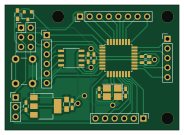
About the Atmega16m1-breakout
Atmega16m1-breakout is an open source AVR/Arduino PCB design by formicidae-tracker, published on GitHub. It is a 2-layer board measuring 46 × 33 mm, with 22 components from 15 distinct parts.
Its main chip is the ATMEGA16M1-AU, from the AVR/Arduino family. Other key parts include the NCP1117-5.0_SOT223 and MCP2561-E/SN. By type, the board carries 9 capacitors, 6 connectors, 3 ICs, 1 crystal, 1 switch and 1 diode.
It belongs with the dev boards & breakouts designs in this gallery.
From the project
Hardware repository for the FORT system
Helios : illumination system, synchronized with framegrabber. Consist of several PCB, the LED boards with an aluminium core, the LED driver to drive the first one , and the Master to dispatch power and connect to the CAN bus Arke: RS-232 board to interface with the can bus. libarke is used to specify the protocol between all boards Zeus: Climate control board that monitor environmental and perform the climate control loop. Celaeno : Nebulizer control board Anemoi : Generic Sensor board with different versions Prometheus: Electric Dispatch board for the FORT * Notus: Heater ofb the ant boxes.
Main components on the Atmega16m1-breakout
Atmega16m1-breakout bill of materials (BOM)
22 components, 15 distinct parts.
| Qty | Part | Footprint | Refs |
|---|---|---|---|
| 1 | ATMEGA16M1-AU | TQFP-32_7x7mm_Pitch0.8mm | U1 |
| 1 | NCP1117-5.0_SOT223 | SOT-223-3Lead_TabPin2 | U2 |
| 1 | MCP2561-E/SN | SOIC-8_3.9x4.9mm_Pitch1.27mm | U3 |
| 1 | 16MHz | Crystal_SMD_SeikoEpson_FA238-4pin_3.2x2.5mm_HandSoldering | Y1 |
| 1 | Conn_01x08 | Pin_Header_Straight_1x08_Pitch2.54mm | J1 |
| 1 | Conn_01x03 | Pin_Header_Straight_1x03_Pitch2.54mm | J2 |
| 1 | Conn_02x03_Odd_Even | Pin_Header_Straight_2x03_Pitch2.54mm | J3 |
| 2 | Conn_01x06 | Pin_Header_Straight_1x06_Pitch2.54mm | J4, J6 |
| 1 | Conn_01x05 | Pin_Header_Straight_1x05_Pitch2.54mm | J5 |
| 1 | SW_Push | SW_PUSH_6mm | SW1 |
| 1 | D_Schottky | D_SOT-23_ANK | D1 |
| 6 | 100nF | C_0603_HandSoldering | C1, C2, C3, C6, C7, C9 |
| 2 | 18pF | C_0603_HandSoldering | C4, C5 |
| 1 | 22uF | C_0805_HandSoldering | C8 |
| 1 | 100K | R_0603_HandSoldering | R1 |
Atmega16m1-breakout design files
The KiCad project lives in the formicidae-tracker/hardware repository on GitHub; these links point at the commit this page was built from.
Atmega16m1-breakout: common questions
What microcontroller does the Atmega16m1-breakout use?
The Atmega16m1-breakout is built around the ATMEGA16M1-AU, from the AVR/Arduino family.
How big is the Atmega16m1-breakout?
The Atmega16m1-breakout measures 46 × 33 mm, has 2 copper layers and is 1.6 mm thick.
How many components are on the Atmega16m1-breakout?
22 components, from 15 distinct parts. The full bill of materials is listed on this page.
Where can I download the Atmega16m1-breakout design files?
From the formicidae-tracker/hardware repository on GitHub, which has the KiCad layout; the links under Design files point to each one.
Can I use the Atmega16m1-breakout design in my own project?
The repository has no license, so all rights stay with formicidae-tracker. Use it as a reference, and ask the author before reusing the design.
Can I test firmware for the Atmega16m1-breakout without the hardware?
Yes. HardLabs builds a simulation of the board from its netlist and BOM, so you can run and debug AVR/Arduino firmware against it before you order a PCB.
More boards in hardware
 AVR/Arduino
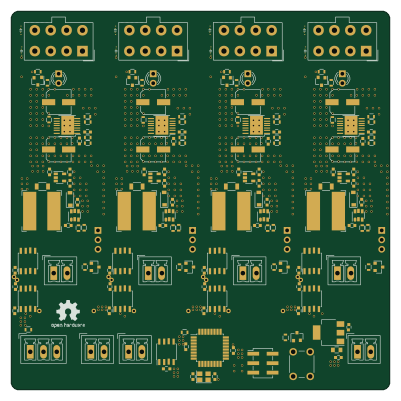
Master old
100 × 100 mm182 parts2LNo license1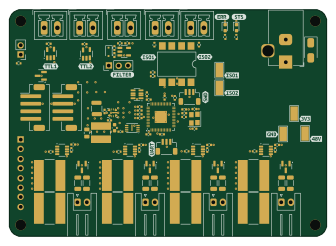 RP2040/RP2350
Helios
84 × 60 mm119 parts2LNo license1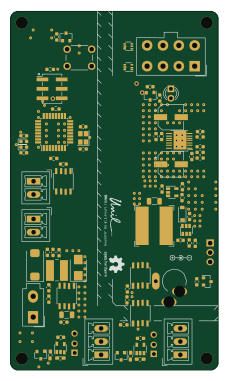 AVR/Arduino
Master
55 × 95 mm84 parts2LNo license1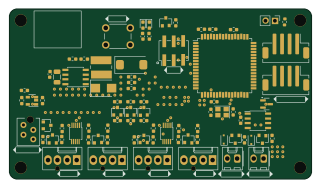 AVR/Arduino
Zeus
80 × 45 mm81 parts2LNo license1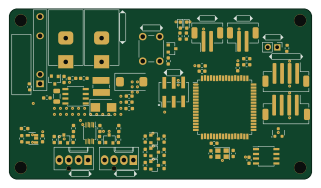 AVR/Arduino
Celaeno
80 × 45 mm69 parts2LNo license1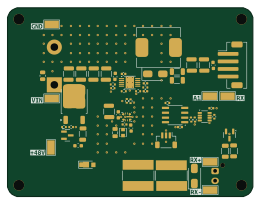 AVR/Arduino
Nyx
65 × 50 mm63 parts2LNo license1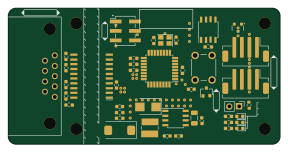 AVR/Arduino
Arke
72 × 36 mm44 parts2LNo license1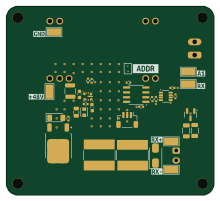 AVR/Arduino
Phaeton
55 × 50 mm37 parts2LNo license1
12V5VDCDC LDO
24.4 × 13.2 mm15 parts2LNo license1
12V5VDCDC
21.8 × 7.8 mm11 parts2LNo license1
Similar boards
 AVR/Arduino
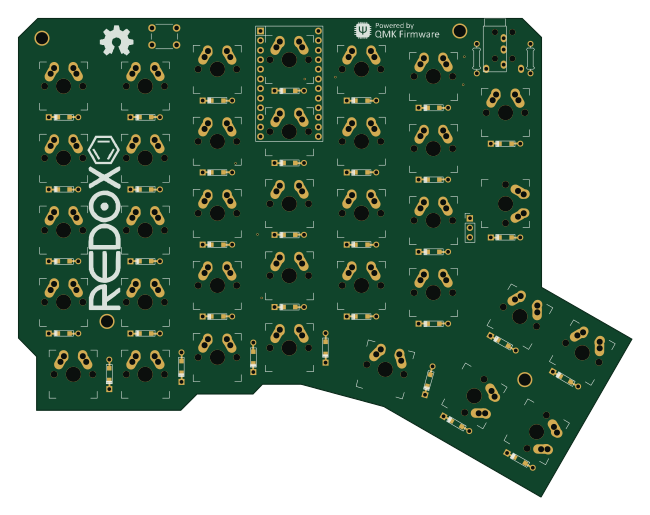
Redox keyboard
mattdibi
162.2 × 126.5 mm77 parts2LMIT2.0k AVR/Arduino
ModuleV450
stuartpittaway
30 × 61.4 mm39 parts2LCC-BY-NC-4.01.1k AVR/Arduino
V4
30 × 50 mm38 parts2LCC-BY-NC-4.01.1k AVR/Arduino
Discipline
coseyfannitutti
304.9 × 122.8 mm170 parts2LCC-BY-NC-4.01.0k AVR/Arduino
Megadesk
gcormier
41.7 × 32.2 mm23 parts2LGPL-3.0818 AVR/Arduino
Easyduino Atmega Nano
Hanqaqa
43.4 × 18 mm30 parts4LCERN-OHL-P-2.0746