
Mesh phone

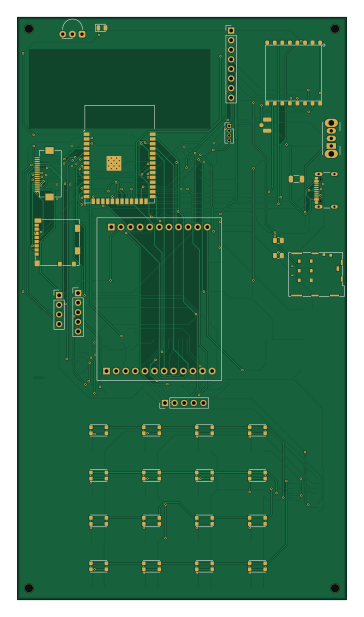
About the Mesh phone PCB
Mesh phone is an open source ESP32 PCB design by JeremyLakeyJr, published on GitHub. It is a 2-layer board measuring 87 × 154 mm, with 95 components from 80 distinct parts.
Its main chip is the ESP32-S3-WROOM-1-N16R8, from the ESP32 family. Other key parts include the PCF8574T-keypad-expander, TP4056-charger, DW01A-protection, 3V3-LDO and MAX17048-fuel-gauge. By type, the board carries 21 resistors, 19 switches, 17 diodes, 13 connectors, 12 capacitors and 10 ICs.
It belongs with the rf & radio and power & battery designs in this gallery.
From the project
OWASSO-1 DIY ESP32-S3 phone KiCad revF PCB project
Open mesh-phone.kicadpro in this directory. The project in ../main/` is the preserved original, not this corrected revision.
- MAX-M10S GPS with passive-antenna U.FL, UART, PPS and bypass capacitors. - Rear keyed 10-pin JST-GH expansion interface, with a current-limited 3.3 V supply and shared SPI/I²C. Switch off and disconnect USB before swapping. - MCU EN/BOOT support, usable SPI pin assignments, keypad expander pin-order corrections, display controls and I²C pull-ups. - Removal of the switch connection that directly joined USB 5 V to the battery. - Reconciled schematic/PCB pad contracts…
Main components on the Mesh phone
Mesh phone bill of materials (BOM)
95 components, 80 distinct parts — part numbers from the project's BOM.
| Qty | Part | Footprint | Refs |
|---|---|---|---|
| 1 | ESP32-S3-WROOM-1-N16R8 | ESP32-S3-WROOM-1 | U1 |
| 1 | PCF8574T-keypad-expander | SOIC-16_4.55x10.3mm_P1.27mm | U2 |
| 1 | TP4056-charger | HSOP-8-1EP_3.9x4.9mm_P1.27mm_EP2.3x2.3mm | U3 |
| 1 | DW01A-protection | SOT-23-6 | U4 |
| 1 | 3V3-LDO | SOT-23-5 | U5 |
| 1 | MAX17048-fuel-gauge | PinHeader_1x04_P1.27mm_Vertical | U6 |
| 1 | TSOP38238-IR-receiver | Vishay_MINIMOLD-3Pin | U7 |
| 1 | TPS61023DRLR-5V-BOOST | SOT-563 | U8 |
| 1 | MAX-M10S-00B-01 | ublox_MAX | U9 |
| 1 | TPS2553DBVR | SOT-23-6 | U10 |
| 1 | FS8205A-PROTECTION-FET | SOT-23-6 | Q1 |
| 1 | A7670E-LASE-23P-12+11 | A7670E_LASE_23P_12+11 | J1 |
| 1 | CC1101-module | PinHeader_1x08_P2.54mm_Vertical | J2 |
| 1 | Ra-01SH-SX1262-915MHz | Ra-01SH | J3 |
| 1 | PN532-NFC-module | PinHeader_1x04_P2.54mm_Vertical | J4 |
| 1 | RDM6300-RFID-module | PinHeader_1x05_P2.54mm_Vertical | J5 |
| 1 | Pimoroni-PIM447-Trackball | PinHeader_1x05_P2.54mm_Vertical | J6 |
| 1 | Waveshare-3.5in-18pin-FPC | Hirose_FH12-18S-0.5SH_1x18-1MP_P0.50mm_Horizontal | J7 |
| 1 | MicroSD-SPI | microSD_HC_Molex_104031-0811 | J9 |
| 1 | Nano-SIM | JAE_SIM_Card_SF72S006 | J10 |
Show 60 more
| Qty | Part | Footprint | Refs |
|---|---|---|---|
| 1 | LiPo-BATTERY-MICRO-JST-1.25 | JST_GH_SM02B-GHS-TB_1x02-1MP_P1.25mm_Horizontal | J13 |
| 1 | LoRa-UFL-Antenna | U.FL_Hirose_U.FL-R-SMT-1_Vertical | J14 |
| 1 | U.FL-R-SMT-1(10) GPS PASSIVE ANTENNA | U.FL_Hirose_U.FL-R-SMT-1_Vertical | J15 |
| 1 | BM10B-GHS-TBT(LF)(SN) REAR EXPANSION - POWER OFF TO SWAP | JST_GH_BM10B-GHS-TBT_1x10-1MP_P1.25mm_Vertical | J16 |
| 1 | Power-switch | SW_Slide_SPDT_Angled_CK_OS102011MA1Q | SW1 |
| 1 | KEY-1 | SW_Push_1P1T_NO_CK_KMR2 | SW2 |
| 1 | KEY-2 | SW_Push_1P1T_NO_CK_KMR2 | SW3 |
| 1 | KEY-3 | SW_Push_1P1T_NO_CK_KMR2 | SW4 |
| 1 | KEY-4 | SW_Push_1P1T_NO_CK_KMR2 | SW5 |
| 1 | KEY-5 | SW_Push_1P1T_NO_CK_KMR2 | SW6 |
| 1 | KEY-6 | SW_Push_1P1T_NO_CK_KMR2 | SW7 |
| 1 | KEY-7 | SW_Push_1P1T_NO_CK_KMR2 | SW8 |
| 1 | KEY-8 | SW_Push_1P1T_NO_CK_KMR2 | SW9 |
| 1 | KEY-9 | SW_Push_1P1T_NO_CK_KMR2 | SW10 |
| 1 | KEY-10 | SW_Push_1P1T_NO_CK_KMR2 | SW11 |
| 1 | KEY-11 | SW_Push_1P1T_NO_CK_KMR2 | SW12 |
| 1 | KEY-12 | SW_Push_1P1T_NO_CK_KMR2 | SW13 |
| 1 | KEY-13 | SW_Push_1P1T_NO_CK_KMR2 | SW14 |
| 1 | KEY-14 | SW_Push_1P1T_NO_CK_KMR2 | SW15 |
| 1 | KEY-15 | SW_Push_1P1T_NO_CK_KMR2 | SW16 |
| 1 | KEY-16 | SW_Push_1P1T_NO_CK_KMR2 | SW17 |
| 1 | BOOT | SW_Push_1P1T_NO_CK_KMR2 | SW18 |
| 1 | RESET | SW_Push_1P1T_NO_CK_KMR2 | SW19 |
| 1 | USB-C-charge-and-data | USB_C_Receptacle_GCT_USB4105-xx-A_16P_TopMnt_Horizontal | USB1 |
| 1 | TSAL6200-IR-LED | LED_0805_2012Metric | D1 |
| 1 | 1N4148W-KEY-1 | D_SOD-123 | D2 |
| 1 | 1N4148W-KEY-2 | D_SOD-123 | D3 |
| 1 | 1N4148W-KEY-3 | D_SOD-123 | D4 |
| 1 | 1N4148W-KEY-4 | D_SOD-123 | D5 |
| 1 | 1N4148W-KEY-5 | D_SOD-123 | D6 |
| 1 | 1N4148W-KEY-6 | D_SOD-123 | D7 |
| 1 | 1N4148W-KEY-7 | D_SOD-123 | D8 |
| 1 | 1N4148W-KEY-8 | D_SOD-123 | D9 |
| 1 | 1N4148W-KEY-9 | D_SOD-123 | D10 |
| 1 | 1N4148W-KEY-10 | D_SOD-123 | D11 |
| 1 | 1N4148W-KEY-11 | D_SOD-123 | D12 |
| 1 | 1N4148W-KEY-12 | D_SOD-123 | D13 |
| 1 | 1N4148W-KEY-13 | D_SOD-123 | D14 |
| 1 | 1N4148W-KEY-14 | D_SOD-123 | D15 |
| 1 | 1N4148W-KEY-15 | D_SOD-123 | D16 |
| 1 | 1N4148W-KEY-16 | D_SOD-123 | D17 |
| 1 | 1uH-BOOST-INDUCTOR | L_1210_3225Metric | L1 |
| 1 | 1000uF-MODEM-BULK | C_1206_3216Metric | C1 |
| 1 | 100uF-VBAT-BULK | C_1206_3216Metric | C2 |
| 1 | 10uF-3V3-BULK | C_1206_3216Metric | C3 |
| 1 | 10uF-USB-IN | C_1206_3216Metric | C4 |
| 2 | 10uF 10V X5R | C_0603_1608Metric | C5, C9 |
| 2 | 100nF 10V X7R | C_0603_1608Metric | C6, C10 |
| 2 | 1uF 10V X7R | C_0603_1608Metric | C7, C8 |
| 2 | GRM155R71C104KA88D 100nF 10V X7R | C_0603_1608Metric | C11, C12 |
| 1 | 1.2k-TP4056-PROG | R_0805_2012Metric | R1 |
| 1 | 180k-BOOST-FB | R_0805_2012Metric | R2 |
| 1 | 27k-BOOST-FB | R_0805_2012Metric | R3 |
| 1 | 5.1k-USB-C-CC1-Rd | R_0805_2012Metric | R4 |
| 1 | 5.1k-USB-C-CC2-Rd | R_0805_2012Metric | R5 |
| 2 | 1k | R_0603_1608Metric | R6, R7 |
| 4 | 10k | R_0603_1608Metric | R8, R9, R12, R13 |
| 2 | 4.7k | R_0603_1608Metric | R10, R11 |
| 1 | 232k 1% | R_0603_1608Metric | R14 |
| 7 | 33 | R_0603_1608Metric | R15, R16, R17, R18, R19, R20, R21 |
Mesh phone design files
The KiCad project lives in the JeremyLakeyJr/mesh-phone repository on GitHub; these links point at the commit this page was built from.
Mesh phone: common questions
What microcontroller does the Mesh phone use?
The Mesh phone is built around the ESP32-S3-WROOM-1-N16R8, from the ESP32 family.
How big is the Mesh phone PCB?
The Mesh phone measures 87 × 154 mm, has 2 copper layers and is 1.6 mm thick.
How many components are on the Mesh phone?
95 components, from 80 distinct parts, with part numbers taken from the project's own BOM. The full bill of materials is listed on this page.
Where can I download the Mesh phone design files?
From the JeremyLakeyJr/mesh-phone repository on GitHub, which has the KiCad layout, the schematic and the BOM; the links under Design files point to each one.
Can I use the Mesh phone design in my own project?
The repository has no license, so all rights stay with JeremyLakeyJr. Use it as a reference, and ask the author before reusing the design.
Can I test firmware for the Mesh phone without the hardware?
Yes. HardLabs builds a simulation of the board from its netlist and BOM, so you can run and debug ESP32 firmware against it before you order a PCB.
More boards in mesh-phone
Similar boards
 ESP32
ESP32Open Book Abridged Edition
joeycastillo
85 × 115 mm65 parts2LCC-BY-SA-4.08.1k ESP32
ESP32Badge
atopile
56.3 × 39 mm239 parts4LMIT4.0k ESP32
ESP32Esp32 minimal
36.2 × 26.8 mm20 parts2LMIT4.0k ESP32
ESP32Racer
StuckAtPrototype
36 × 50.2 mm70 parts4LApache-2.03.8k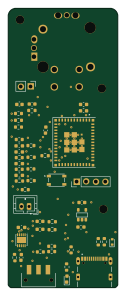 ESP32
ESP32Controller
29 × 74 mm58 parts4LApache-2.03.8k ESP32
ESP32Bitaxe
skot
56.5 × 99.8 mm86 parts4LCERN-OHL-S-2.01.4k