
Universal nixie display

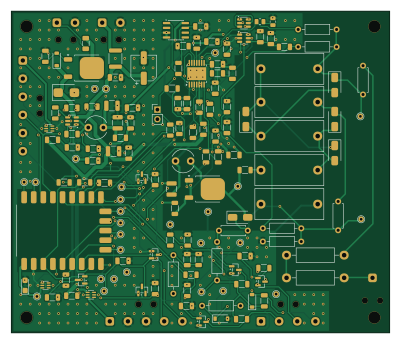
About the Universal nixie display PCB
Universal nixie display is an open source RP2040/RP2350 PCB design by kuvychko, published on GitHub under the MIT license. It is a 2-layer board measuring 100 × 85 mm, with 155 components from 100 distinct parts.
Its main chip is the RP2040-Zero, from the RP2040/RP2350 family. Other key parts include the TPS54302DDCR, LM66100DCKR, LP2951ACDR2G, LM5156HPWPR and TLV3011AIDBVR. By type, the board carries 46 resistors, 38 capacitors, 27 test points, 13 diodes, 9 ICs and 6 connectors.
It belongs with the displays & leds designs in this gallery.
From the project
Six IN-14 Nixie tubes, an A101 dekatron and an ESP32 touchscreen in one desktop display: a clock, timer and toy, and a numeric display for a computer over USB. Open hardware (KiCad) and firmware, with a site that explains how the tubes work.
A programmable desktop display: six IN-14 Nixie tubes in a row, one A101 dekatron, a 2.8" ESP32 touchscreen and a rotary encoder, in a matte PLA enclosure on a tilt base. It is meant to be an enjoyable object on its own (clock, timer, demo) and a numeric output device for a computer, Raspberry Pi or experiment, driven over USB serial with a small SCPI-style command set.
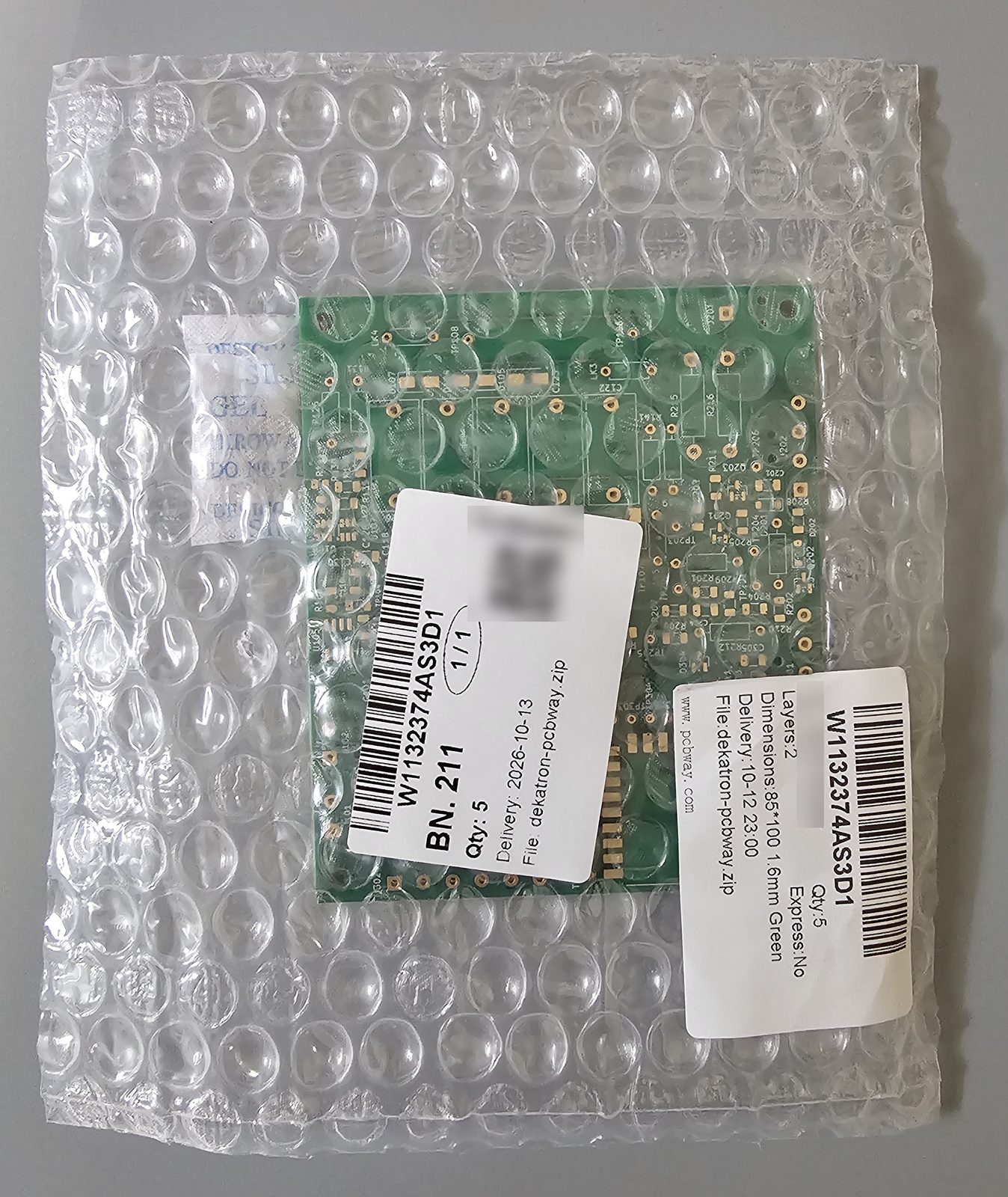
Main components on the Universal nixie display
Universal nixie display bill of materials (BOM)
155 components, 100 distinct parts — part numbers from the project's BOM.
| Qty | Part | Footprint | Refs |
|---|---|---|---|
| 1 | TPS54302DDCR TPS54302 Texas Instruments | SOT-23-6 | U101 |
| 3 | LM66100DCKR LM66100 Texas Instruments | SOT-363_SC-70-6 | U102, U103, U104 |
| 1 | LP2951ACDR2G LP2951 (adj. 10 V) onsemi | SOIC-8_3.9x4.9mm_P1.27mm | U105 |
| 1 | LM5156HPWPR LM5156H Texas Instruments | Texas_HTSSOP-14-1EP_4.4x5mm_P0.65mm_EP3.4x5mm_Mask3.155x3.255mm | U106 |
| 2 | TLV3011AIDBVR TLV3011 Texas Instruments | SOT-23-6 | U107, U108 |
| 1 | RP2040-Zero Waveshare | RP2040-Zero_Castellated | U301 |
| 1 | IPD50P04P4L11ATMA2 IPD50P04P4L-11 Infineon | TO-252-2 | Q101 |
| 1 | IPD70R1K4P7SAUMA1 IPD70R1K4P7S Infineon | TO-252-2 | Q102 |
| 2 | MMBTA42 Diotec Semiconductor | SOT-23 | Q201, Q202 |
| 1 | MMBTA92 Diotec Semiconductor | SOT-23 | Q203 |
| 1 | PWR_IN | SolderWire-0.5sqmm_1x02_P4.8mm_D0.9mm_OD2.3mm | J101 |
| 1 | NIX_12V | SolderWire-0.5sqmm_1x02_P4.8mm_D0.9mm_OD2.3mm | J102 |
| 1 | TUBE_ANODE | SolderWire-0.5sqmm_1x01_D0.9mm_OD2.3mm | J201 |
| 1 | TUBE | SolderWire-0.5sqmm_1x04_P4.8mm_D0.9mm_OD2.3mm | J202 |
| 1 | DISP | SolderWire-0.5sqmm_1x05_P4.8mm_D0.9mm_OD2.3mm | J301 |
| 1 | NIX_LV | SolderWire-0.5sqmm_1x06_P4.8mm_D0.9mm_OD2.3mm | J302 |
| 1 | 0468002.NRHF 2A Slo-Blo Littelfuse | Fuse_1206_3216Metric | F101 |
| 1 | 1812L075/33DR 0.75A Littelfuse | Fuse_1812_4532Metric | F102 |
| 1 | HV_INHIBIT | PinHeader_1x02_P2.54mm_Vertical | JP101 |
| 3 | 0 | R_1206_3216Metric | LK1, LK2, LK15 |
Show 80 more
| Qty | Part | Footprint | Refs |
|---|---|---|---|
| 3 | LINK | R_Axial_DIN0207_L6.3mm_D2.5mm_P7.62mm_Horizontal | LK3, LK4, LK5 |
| 1 | VIN_PROT | TestPoint_THTPad_D1.5mm_Drill0.7mm | TP101 |
| 4 | GND | TestPoint_THTPad_D1.5mm_Drill0.7mm | TP102, TP107, TP206, TP311 |
| 1 | +5V | TestPoint_THTPad_D1.5mm_Drill0.7mm | TP103 |
| 1 | VDRV | TestPoint_THTPad_D1.5mm_Drill0.7mm | TP104 |
| 1 | SW | TestPoint_THTPad_D1.5mm_Drill0.7mm | TP105 |
| 1 | V_B | TestPoint_THTPad_D1.5mm_Drill0.7mm | TP106 |
| 1 | HV_STACK | TestPoint_THTPad_D1.5mm_Drill0.7mm | TP108 |
| 1 | GPLUS | TestPoint_THTPad_D1.5mm_Drill0.7mm | TP201 |
| 1 | RTN | TestPoint_THTPad_D1.5mm_Drill0.7mm | TP202 |
| 1 | TUBE_G1 | TestPoint_THTPad_D1.5mm_Drill0.7mm | TP203 |
| 1 | TUBE_G2 | TestPoint_THTPad_D1.5mm_Drill0.7mm | TP204 |
| 1 | NDX | TestPoint_THTPad_D1.5mm_Drill0.7mm | TP205 |
| 1 | UART_TX | TestPoint_THTPad_D1.5mm_Drill0.7mm | TP301 |
| 1 | UART_RX | TestPoint_THTPad_D1.5mm_Drill0.7mm | TP302 |
| 1 | GP9 | TestPoint_THTPad_D1.5mm_Drill0.7mm | TP303 |
| 1 | GP10 | TestPoint_THTPad_D1.5mm_Drill0.7mm | TP304 |
| 1 | GP11 | TestPoint_THTPad_D1.5mm_Drill0.7mm | TP305 |
| 1 | GP13 | TestPoint_THTPad_D1.5mm_Drill0.7mm | TP306 |
| 1 | GP14 | TestPoint_THTPad_D1.5mm_Drill0.7mm | TP307 |
| 1 | GP15 | TestPoint_THTPad_D1.5mm_Drill0.7mm | TP308 |
| 1 | +3V3 | TestPoint_THTPad_D1.5mm_Drill0.7mm | TP309 |
| 1 | 5V_MCU | TestPoint_THTPad_D1.5mm_Drill0.7mm | TP310 |
| 1 | SDA | TestPoint_THTPad_D1.5mm_Drill0.7mm | TP312 |
| 1 | SCL | TestPoint_THTPad_D1.5mm_Drill0.7mm | TP313 |
| 1 | BZT52C10 Diotec Semiconductor | D_SOD-123 | D101 |
| 1 | SMBJ15A Semtech | D_SMB | D102 |
| 5 | ES1J Diotec Semiconductor | D_SMA | D103, D104, D105, D106, D107 |
| 1 | MMSZ5259BH RHG 39V Taiwan Semiconductor | D_SOD-123 | D201 |
| 1 | MMSZ5262BT1G 51V onsemi | D_SOD-123 | D202 |
| 4 | BAT54S RFG BAT54S Taiwan Semiconductor | SOT-23 | D301, D302, D303, D304 |
| 1 | (kit, 6 x 8 mm radial) 15uH | L_Radial_D6.0mm_P4.00mm | L101 |
| 1 | (kit, 6 x 8 mm radial) 100uH | L_Radial_D6.0mm_P4.00mm | L102 |
| 1 | EEE-FK1V101XP 100uF 35V Panasonic | CP_Elec_6.3x7.7 | C101 |
| 11 | CC1206JPX7R9BB104 0.1uF Yageo | C_1206_3216Metric | C102, C104, C105, C109, C110, C111, C115, C121 +3 |
| 2 | CC1210KKX7RGBB106 10uF 35V Yageo | C_1210_3225Metric | C103, C120 |
| 2 | MBAST32MSB7226KPNA18 22uF 25V Taiyo Yuden | C_1210_3225Metric | C106, C107 |
| 1 | 12065A750JAT2A 75pF KYOCERA AVX | C_1206_3216Metric | C108 |
| 1 | 1206DC105MAT2A 1uF 35V KYOCERA AVX | C_1206_3216Metric | C112 |
| 1 | CS1206KKX7R8BB225 2.2uF Yageo | C_1206_3216Metric | C113 |
| 1 | 1206DC105MAT2A 1uF KYOCERA AVX | C_1206_3216Metric | C114 |
| 1 | CC1206KRX7R8BB473 47nF Yageo | C_1206_3216Metric | C116 |
| 2 | 12063C103JAT2A 10nF KYOCERA AVX | C_1206_3216Metric | C117, C304 |
| 1 | C1206C101K5GAC7210 100pF KEMET | C_1206_3216Metric | C118 |
| 1 | 1206B471K500CT 470pF Walsin | C_1206_3216Metric | C119 |
| 5 | MKS4G034704F00MSSD 0.47uF 400V WIMA | C_Rect_L18.0mm_W8.0mm_P15.00mm_FKS3_FKP3 | C122, C123, C124, C125, C126 |
| 3 | 1206N102K501CT 1nF Walsin | C_1206_3216Metric | C127, C129, C204 |
| 1 | AC1206KKX7R0BB104 0.1uF 100V Yageo | C_1206_3216Metric | C201 |
| 1 | C1206C105M1RACAUTO 1uF 100V KEMET | C_1206_3216Metric | C202 |
| 1 | F911C106MAAAJ6 10uF KYOCERA AVX | CP_EIA-3216-18_Kemet-A | C301 |
| 2 | CC1206JPX7R9BB104 100nF Yageo | C_1206_3216Metric | C303, C305 |
| 7 | 10K 10k | R_1206_3216Metric | R101, R109, R113, R114, R204, R206, R209 |
| 1 | RT1206FRE07511KL 511k Yageo | R_1206_3216Metric | R102 |
| 1 | CR1206-FX-1053ELF 105k Bourns | R_1206_3216Metric | R103 |
| 1 | RCC120649R9FKEA 49.9 Vishay | R_1206_3216Metric | R104 |
| 4 | 100K 100k | R_1206_3216Metric | R105, R110, R116, R301 |
| 2 | CR1206-FX-1372ELF 13.7k Bourns | R_1206_3216Metric | R106, R143 |
| 1 | CR1206-FX-1433ELF 143k Bourns | R_1206_3216Metric | R107 |
| 1 | RK73H2BLTD2002F 20.0k KOA Speer | R_1206_3216Metric | R108 |
| 1 | CRCW1206147KFKTA 147k Vishay | R_1206_3216Metric | R111 |
| 1 | 0 | R_1206_3216Metric | R112 |
| 1 | 2.2 | R_1206_3216Metric | R115 |
| 1 | RNCL1206FTR220 0.22 SEI Stackpole | R_1206_3216Metric | R117 |
| 1 | 100 | R_1206_3216Metric | R118 |
| 2 | HHV-25FT-52-2M2 2.2M Yageo | R_Axial_DIN0207_L6.3mm_D2.5mm_P10.16mm_Horizontal | R119, R141 |
| 1 | 47 | R_1206_3216Metric | R121 |
| 2 | HHV-25FR-52-2M7 2.7M Yageo | R_Axial_DIN0207_L6.3mm_D2.5mm_P10.16mm_Horizontal | R126, R131 |
| 2 | 292-3.0K-RC 3.0k Xicon | R_0805_2012Metric | R130, R144 |
| 1 | ERJ-8ENF7871V 7.87k Panasonic | R_1206_3216Metric | R135 |
| 1 | CRCW12066K20FKEAC 6.2k Vishay | R_1206_3216Metric | R140 |
| 1 | MRS25000C4022FCT00 40.2k Vishay | R_Axial_DIN0207_L6.3mm_D2.5mm_P10.16mm_Horizontal | R201 |
| 1 | HHV-25FR-52-200K 200k Yageo | R_Axial_DIN0207_L6.3mm_D2.5mm_P10.16mm_Horizontal | R202 |
| 2 | 470K 470k | R_1206_3216Metric | R205, R208 |
| 2 | 47K 47k | R_1206_3216Metric | R207, R210 |
| 1 | 220K 220k | R_1206_3216Metric | R211 |
| 1 | HHV-25FR-52-220K 220k Yageo | R_Axial_DIN0207_L6.3mm_D2.5mm_P10.16mm_Horizontal | R212 |
| 1 | CR1206-FX-1302ELF 13k Bourns | R_1206_3216Metric | R214 |
| 2 | HHV-50FR-52-330K 330k Yageo | R_Axial_DIN0411_L9.9mm_D3.6mm_P15.24mm_Horizontal | R215, R216 |
| 1 | ERJ-8ENF1202V 12k Panasonic | R_1206_3216Metric | R302 |
| 2 | 4.7K 4.7k | R_1206_3216Metric | R303, R304 |
Universal nixie display design files
The KiCad project lives in the kuvychko/universal-nixie-display repository on GitHub; these links point at the commit this page was built from.
Universal nixie display: common questions
What microcontroller does the Universal nixie display use?
The Universal nixie display is built around the RP2040-Zero, from the RP2040/RP2350 family.
How big is the Universal nixie display PCB?
The Universal nixie display measures 100 × 85 mm, has 2 copper layers and is 1.6 mm thick.
How many components are on the Universal nixie display?
155 components, from 100 distinct parts, with part numbers taken from the project's own BOM. The full bill of materials is listed on this page.
Where can I download the Universal nixie display design files?
From the kuvychko/universal-nixie-display repository on GitHub, which has the KiCad layout, the schematic and the BOM; the links under Design files point to each one.
Can I use the Universal nixie display design in my own project?
Yes, under the terms of its MIT license, which kuvychko chose for the repository.
Can I test firmware for the Universal nixie display without the hardware?
Yes. HardLabs builds a simulation of the board from its netlist and BOM, so you can run and debug RP2040/RP2350 firmware against it before you order a PCB.
Similar boards
 RP2040/RP2350
Open Book Abridged Edition
joeycastillo
85 × 115 mm29 parts2LCC-BY-SA-4.08.1k RP2040/RP2350
Corne
foostan
277.2 × 107.5 mm164 parts2LCC-BY-4.07.7k RP2040/RP2350
Corne
277.2 × 107.5 mm164 parts2LCC-BY-4.07.7k RP2040/RP2350
Jitx design
gusmanb
55.5 × 65 mm26 parts4LGPL-3.05.0k RP2040/RP2350
LogicAnalyzer
57 × 55.2 mm6 parts2LGPL-3.05.0k RP2040/RP2350
Main
google
98 × 71 mm102 parts2LApache-2.02.9k