
Arduino nano

About the Arduino nano PCB
Arduino nano is an open source AVR/Arduino PCB design by lhondareyte, published on GitHub under the CC-BY-4.0 license. It is a 2-layer board, with 6 components from 6 distinct parts.
Its main chip is the ATmega328P-A, from the AVR/Arduino family. Other key parts include the LM1117MP-5.0 and FT232RL. By type, the board carries 3 ICs and 3 connectors.
From the project
Generic Schematic KiCad Templates
Main components on the Arduino nano
Arduino nano bill of materials (BOM)
6 components, 6 distinct parts.
| Qty | Part | Footprint | Refs |
|---|---|---|---|
| 1 | ATmega328P-A | TQFP-32_7x7mm_P0.8mm | U1 |
| 1 | LM1117MP-5.0 | SOT-223-3_TabPin2 | U2 |
| 1 | FT232RL | SSOP-28_5.3x10.2mm_P0.65mm | U3 |
| 1 | 1-15 Header | J1 | |
| 1 | 16-30 Header | J2 | |
| 1 | USB_B_Micro | J3 |
Arduino nano design files
The KiCad project lives in the lhondareyte/KiCad-Templates repository on GitHub; these links point at the commit this page was built from.
Arduino nano: common questions
What microcontroller does the Arduino nano use?
The Arduino nano is built around the ATmega328P-A, from the AVR/Arduino family.
How big is the Arduino nano PCB?
The Arduino nano has 2 copper layers and is 1.6 mm thick.
How many components are on the Arduino nano?
6 components, from 6 distinct parts. The full bill of materials is listed on this page.
Where can I download the Arduino nano design files?
From the lhondareyte/KiCad-Templates repository on GitHub, which has the KiCad layout and the schematic; the links under Design files point to each one.
Can I use the Arduino nano design in my own project?
Yes, under the terms of its CC-BY-4.0 license, which lhondareyte chose for the repository.
Can I test firmware for the Arduino nano without the hardware?
Yes. HardLabs builds a simulation of the board from its netlist and BOM, so you can run and debug AVR/Arduino firmware against it before you order a PCB.
More boards in KiCad-Templates
- schematic only · 35 partsSTM32
Blue pill
35 parts2LCC-BY-4.01 - schematic only · 7 parts
Micro sd card
7 parts2LCC-BY-4.01 - schematic only · 6 parts
Psu
6 parts2LCC-BY-4.01 - schematic only · 6 partsAVR/Arduino
Atmega32u4
6 parts2LCC-BY-4.01 - schematic only · 5 partsAVR/Arduino
Attiny2313
5 parts2LCC-BY-4.01 
Discovery-F4 base board
53.3 × 30.5 mm4 parts2LCC-BY-4.01- schematic only · 4 partsAVR/Arduino
Atmega8
4 parts2LCC-BY-4.01
Similar boards
 AVR/Arduino
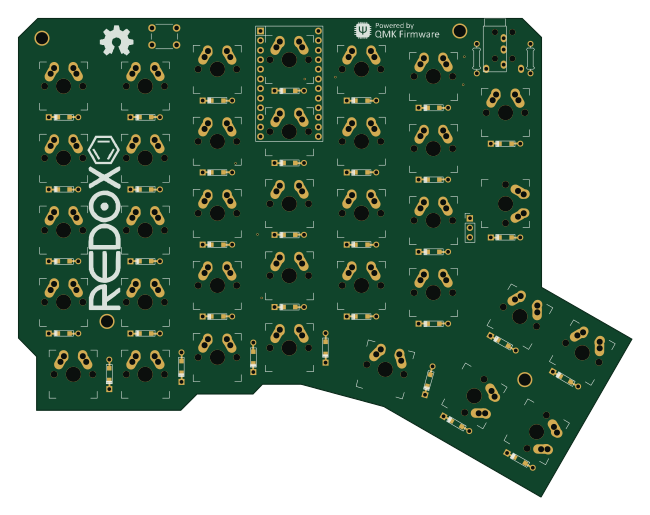
Redox keyboard
mattdibi
162.2 × 126.5 mm77 parts2LMIT2.0k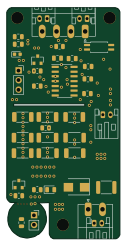 AVR/Arduino
ModuleV450
stuartpittaway
30 × 61.4 mm39 parts2LCC-BY-NC-4.01.1k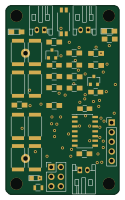 AVR/Arduino
V4
30 × 50 mm38 parts2LCC-BY-NC-4.01.1k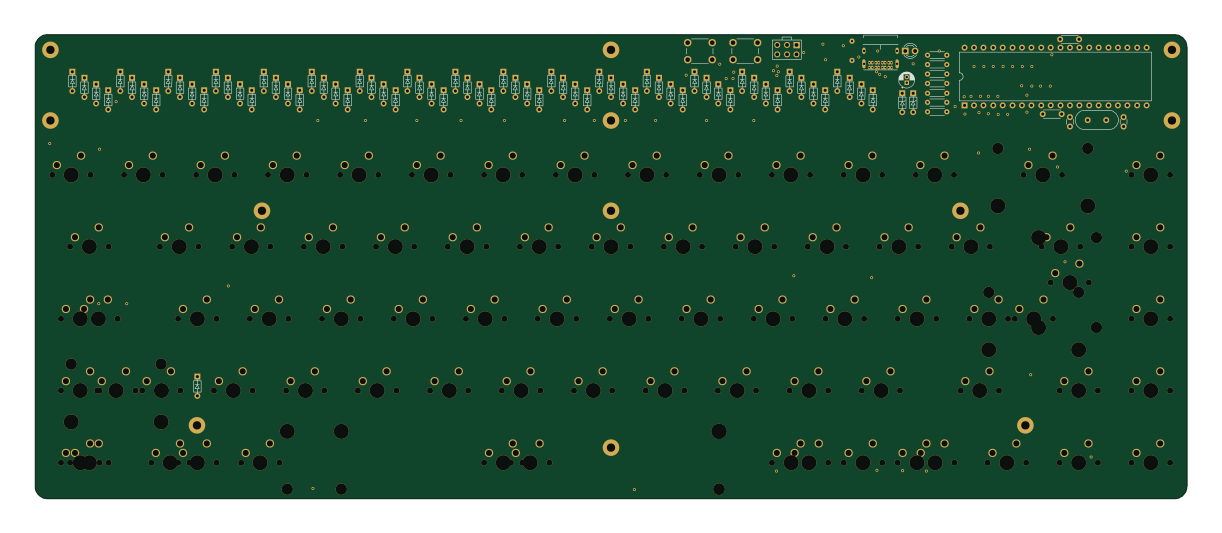 AVR/Arduino
Discipline
coseyfannitutti
304.9 × 122.8 mm170 parts2LCC-BY-NC-4.01.0k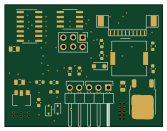 AVR/Arduino
Megadesk
gcormier
41.7 × 32.2 mm23 parts2LGPL-3.0818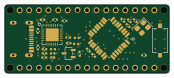 AVR/Arduino
Easyduino Atmega Nano
Hanqaqa
43.4 × 18 mm30 parts4LCERN-OHL-P-2.0746