
Edu ciaa nxp micropython

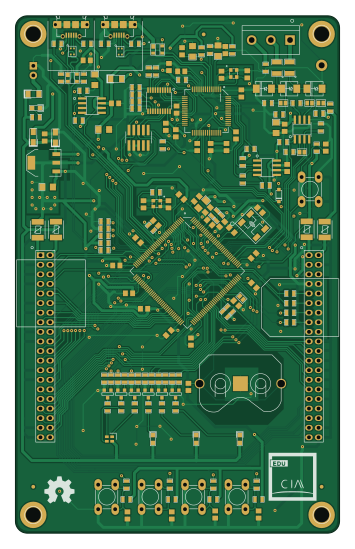
About the Edu ciaa nxp micropython PCB
Edu ciaa nxp micropython is an open source NXP PCB design by lmtreser, published on GitHub under the MIT license. It is a 2-layer board measuring 85.8 × 137 mm, with 183 components from 59 distinct parts.
Its main chip is the LPC4337JBD144, from the NXP family. Other key parts include the SN65HVD1176DR, PRTR5V0U2X, NCP1117ST33T3G, 93C46 and FT2232H. By type, the board carries 65 resistors, 51 capacitors, 11 diodes, 10 inductors, 9 ICs and 7 connectors.
It belongs with the displays & leds designs in this gallery.
From the project
Desarrollos en MicroPython con la placa EDU-CIAA-NXP, basada en el LPC4337 (dual core ARM Cortex-M4F y Cortex-M0)
Desarrollos en MicroPython con la placa EDU-CIAA-NXP, basada en el LPC4337 (dual core ARM Cortex-M4F y Cortex-M0).
El repositorio es una colección de recursos extraídos del sitio oficial del Proyecto CIAA, excepto el directorio /scripts/ejemplos que contiene diversos scripts de ejemplo.
La EDU-CIAA-NXP es una versión de bajo costo de la CIAA-NXP pensada para la enseñanza universitaria, terciaria y secundaria.
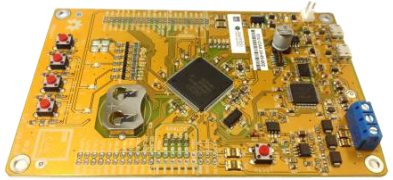
Main components on the Edu ciaa nxp micropython
Edu ciaa nxp micropython bill of materials (BOM)
183 components, 59 distinct parts — part numbers from the project's BOM.
| Qty | Part | Footprint | Refs |
|---|---|---|---|
| 1 | SN65HVD1176DR | -SOIC8 | U1 |
| 2 | PRTR5V0U2X | sot143B | U2, U8 |
| 1 | NCP1117ST33T3G | SOT223 | U3 |
| 1 | LPC4337JBD144 | LQFP144-M05 | U4 |
| 1 | 93C46 | -SOIC8 | U5 |
| 1 | FT2232H | LQFP64-M05 | U6 |
| 1 | TXB0108 | tssop-20 | U7 |
| 1 | MIC2025 | -SOIC8 | U9 |
| 6 | 2N7002 | SOT23GDS | Q1, Q3, Q4, Q5, Q9, Q10 |
| 1 | 32.768K | 4SOJ | X1 |
| 2 | 12MHz | FA238V-XTAL | X2, X3 |
| 1 | TB_1X3 | bornier3 | J1 |
| 2 | ZX62D-AB-5P8 | USB_microAB_ZX62-AB-5P8 | J2, J3 |
| 2 | CONN_20X2 | PIN_ARRAY_20X2 | P1, P2 |
| 1 | Cortex-Debug | Pin_Array_5x2_1.27mm_SMD | P3 |
| 1 | 5Vcc Input | Con_2P | P4 |
| 1 | BK-913 | BK-913-ND | BT1 |
| 4 | 4mm | 1pin | H1, H2, H3, H4 |
| 2 | USMF020 | SM1210 | PS1, PS2 |
| 1 | TEC_1 | PUSH_SWITCH_THT | SW1 |
Show 39 more
| Qty | Part | Footprint | Refs |
|---|---|---|---|
| 1 | TEC_2 | PUSH_SWITCH_THT | SW2 |
| 1 | TEC_3 | PUSH_SWITCH_THT | SW3 |
| 1 | TEC_4 | PUSH_SWITCH_THT | SW4 |
| 1 | RESET | PUSH_SWITCH_THT | SW5 |
| 4 | MF-MSMF030-2 | MF-MSMF | TH1, TH2, TH3, TH4 |
| 1 | 4mm | GNDpin | TP1 |
| 2 | DLW21HN900SQ2 | SRF2012 | TR1, TR2 |
| 1 | SMAZ5V6 | SOD123F | ZA1 |
| 1 | LED_ARBG | PLCC-4 | LED1 |
| 3 | PSD12C | DO-214AA(SMB) | D1, D2, D3 |
| 3 | PMEG3020EH | SOD123F | D4, D5, D10 |
| 1 | LED red | LED-0805 | D6 |
| 3 | LED | LED-0805 | D7, D8, D9 |
| 1 | LL4148 | SOD-123 | D11 |
| 5 | MI0805M221R-10 | SM0805 | FB1, FB5, FB6, FB9, FB10 |
| 5 | HZ0805E601R-10 | SM0805 | FB2, FB3, FB4, FB7, FB8 |
| 1 | 10uF | c_1206_tantalio | C1 |
| 37 | 100nF | c_0805 | C2, C4, C7, C8, C9, C10, C17, C18 +29 |
| 6 | 10uF | c_1206_tantalio_1 | C3, C5, C6, C33, C37, C39 |
| 6 | 20p | c_0805 | C11, C12, C13, C14, C15, C16 |
| 1 | 3.3uF | c_0805 | C35 |
| 3 | 4K7 | SM0805 | R1, R2, R3 |
| 3 | 100K | SM0805 | R4, R5, R90 |
| 2 | 390 | SM0805 | R6, R8 |
| 1 | 200 | SM0805 | R7 |
| 1 | 100 | SM0805 | R9 |
| 6 | 330k | SM0805 | R10, R12, R13, R14, R18, R19 |
| 6 | 0 | SM0805 | R11, R15, R107, R108, R109, R110 |
| 18 | 10k | SM0805 | R16, R17, R62, R63, R64, R65, R66, R70 +10 |
| 1 | 470 | SM0805 | R20 |
| 3 | 1k2 | SM0805 | R21, R22, R23 |
| 6 | 1k | SM0805 | R57, R58, R59, R60, R61, R104 |
| 6 | 680 | SM0805 | R68, R72, R73, R76, R84, R85 |
| 1 | 10M | SM0805 | R91 |
| 1 | 12K | SM0805 | R92 |
| 3 | 2.2k | SM0805 | R95, R97, R101 |
| 2 | 15K | SM0805 | R96, R98 |
| 1 | 12K 1% | SM0805 | R103 |
| 1 | 270 | SM0805 | R105 |
Edu ciaa nxp micropython design files
The KiCad project lives in the lmtreser/edu-ciaa-nxp-micropython repository on GitHub; these links point at the commit this page was built from.
Edu ciaa nxp micropython: common questions
What microcontroller does the Edu ciaa nxp micropython use?
The Edu ciaa nxp micropython is built around the LPC4337JBD144, from the NXP family.
How big is the Edu ciaa nxp micropython PCB?
The Edu ciaa nxp micropython measures 85.8 × 137 mm, has 2 copper layers and is 1.6 mm thick.
How many components are on the Edu ciaa nxp micropython?
183 components, from 59 distinct parts, with part numbers taken from the project's own BOM. The full bill of materials is listed on this page.
Where can I download the Edu ciaa nxp micropython design files?
From the lmtreser/edu-ciaa-nxp-micropython repository on GitHub, which has the KiCad layout and the BOM; the links under Design files point to each one.
Can I use the Edu ciaa nxp micropython design in my own project?
Yes, under the terms of its MIT license, which lmtreser chose for the repository.
Can I test firmware for the Edu ciaa nxp micropython without the hardware?
Yes. HardLabs builds a simulation of the board from its netlist and BOM, so you can run and debug NXP firmware against it before you order a PCB.
Similar boards
 NXP
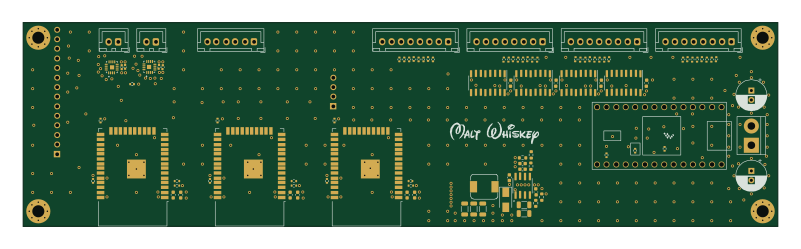
NXPMega-Cube-Board
MaltWhiskey
200 × 54 mm100 parts4LNo license763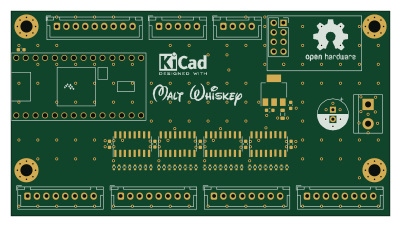 NXP
NXP32Bit shift register
100 × 54 mm56 parts4LNo license763 NXP
NXPICED-R
kiibohd
175.4 × 145 mm163 partsCERN-OHL-1.2415 NXP
NXPWhiteFox
304.8 × 101.1 mm296 partsCERN-OHL-1.2415 NXP
NXPICED-L
175.4 × 145 mm163 partsCERN-OHL-1.2415 NXP
NXPK-Type
357.5 × 131.8 mm361 partsCERN-OHL-1.2415