
OpenSourcedMiners

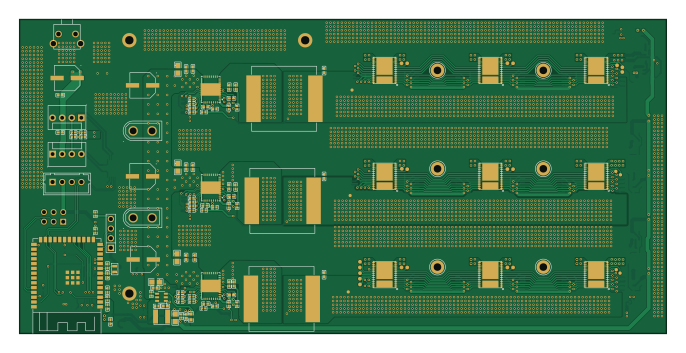
About the OpenSourcedMiners PCB
OpenSourcedMiners is an open source ESP32 PCB design by Luckst4r, published on GitHub under the CERN-OHL-S-2.0 license. It is a 6-layer board measuring 171.1 × 83.1 mm, with 378 components from 62 distinct parts.
Its main chip is the ESP32-S3-WROOM-1(N16R8), from the ESP32 family. Other key parts include the TPS546D24ARVFR, RT9080-33GJ5, TPMIC5504-1_8YM5, SN74AVC4T774PWR and EMC2302-1-AIZL-TR. By type, the board carries 236 capacitors, 89 resistors, 26 ICs, 10 inductors, 7 connectors and 6 modules.
From the project
Designs of Miners I have personally open sourced. Some are still WIP so MFG at your own risk.
This repo contains various hardware design files that I’ve chosen to publish. Some projects are open, some are closed — I don’t have a philosophy about it. I release things when I feel like it.
Depending on the project, expect things like:
In many cases, these files are enough to manufacture a board end-to-end.
- No warranty - No guarantee that anything is correct - No support or hand-holding
Main components on the OpenSourcedMiners
OpenSourcedMiners bill of materials (BOM)
378 components, 62 distinct parts.
| Qty | Part | Footprint | Refs |
|---|---|---|---|
| 3 | TPS546D24ARVFR | LQFN-40_L7.0-W5.0-P0.50-BL-EP | U1, U2, U4 |
| 1 | RT9080-33GJ5 | TSOT-23-5_L2.9-W1.6-P0.95-LS2.8-BL | U3 |
| 1 | TPMIC5504-1_8YM5 | SOT-23-5_L3.0-W1.5-P0.95-LS2.8-BL | U6 |
| 1 | ESP32-S3-WROOM-1(N16R8) | WIRELM-SMD_ESP32-S3-WROOM-1 | U7 |
| 1 | SN74AVC4T774PWR | TSSOP-16_L5.0-W4.4-P0.65-LS6.4-BL | U8 |
| 1 | EMC2302-1-AIZL-TR | MSOP-10_L3.0-W3.0-P0.50-LS4.9-BL | U9 |
| 2 | TMP1075NDRLR | SOT-563_L1.6-W1.2-P0.50-LS1.6-BR | U10, U11 |
| 9 | BM1366_mode1 | BM1366 | U12, U13, U14, U15, U16, U17, U22, U23 +1 |
| 6 | ETA3496S2F | SOT-23-5_L2.9-W1.6-P0.95-LS2.8-BR | U18, U19, U20, U21, U25, U26 |
| 1 | TMI3252SH | SOT-23-6_L2.9-W1.6-P0.95-LS2.8-BL | U27 |
| 6 | TestPoint | TestPoint_Loop_D3.80mm_Drill2.0mm | M1, M2, M3, M4, M5, M6 |
| 1 | SC-20S32_768kHz20PPM7pF | OSC-SMD_L2.0-W1.2 | Y1 |
| 1 | G201625MUBCE2O | CRYSTAL-SMD_4P-L2.0-W1.6-BL-1 | Y2 |
| 2 | XT30UPB-M | CONN-TH_XT30UPB-M | J2, J10 |
| 1 | A2541WV-2X3P | HDR-TH_6P-P2.54-V-R2-C3-S2.54_A2541WV-2X3P | J3 |
| 1 | B4B-XH-AM(LF)(SN) | CONN-TH_B4B-XH-AM-LF-SN | J4 |
| 2 | 22-11-2042 | CONN-TH_22112042 | J6, J7 |
| 1 | A2541WV-4P_C5346656 | HDR-TH_4P-P2.54-V-M | J9 |
| 1 | K2-1102AQ-C4CW-01 | SW-TH_K2-1102AQ-C4CW-01 | K1 |
| 1 | SS310 | SMA_L4.3-W2.6-LS5.0-FD | D1 |
Show 42 more
| Qty | Part | Footprint | Refs |
|---|---|---|---|
| 3 | 680nH | IND-SMD_L17.2-W17.2 | L1, L2, L4 |
| 6 | 2.2uH | L0805 | L5, L6, L7, L8, L9, L10 |
| 1 | SWPA4030S3R3MT | IND-SMD_L4.0-W4.0_SMNR4012 | L11 |
| 4 | 220uF | CAP-SMD_BD6.3-L6.6-W6.6-FD | C1, C23, C50, C85 |
| 14 | 22uF | C0805 | C2, C3, C4, C5, C20, C24, C25, C26 +6 |
| 131 | 1uF | C0402 | C6, C10, C19, C28, C33, C48, C49, C56 +123 |
| 3 | 4.7nF | C0402 | C7, C29, C55 |
| 6 | 2.2nF | C0402 | C8, C12, C30, C41, C57, C68 |
| 3 | 1nF | C0402 | C9, C32, C65 |
| 26 | 100nF | C0402 | C11, C17, C21, C22, C31, C40, C58, C67 +18 |
| 3 | 47uF | C1206 | C13, C42, C69 |
| 6 | 100uF | CASE-B_3528 | C14, C15, C43, C44, C70, C71 |
| 3 | 4.7uF | C0603 | C16, C45, C72 |
| 3 | 100pF | C0402 | C18, C46, C73 |
| 2 | 6.8pF | C0402 | C77, C78 |
| 22 | 10uF | C0402 | C81, C164, C165, C166, C167, C177, C178, C179 +14 |
| 9 | 330uF | CASE-D_7343 | C180, C181, C182, C205, C206, C207, C255, C256 +1 |
| 1 | 33pF | C0402 | C264 |
| 3 | 10Ω | R0402 | R1, R20, R36 |
| 3 | 12.7kΩ | R0402 | R2, R21, R37 |
| 6 | 1.37kΩ | R0402 | R3, R5, R22, R24, R38, R41 |
| 4 | 1Ω | R0402 | R4, R23, R40, R145 |
| 6 | NC | R0402 | R6, R9, R129, R131, R137, R139 |
| 3 | 48.7kΩ | R0402 | R7, R130, R138 |
| 3 | 49.9Ω | R0402 | R8, R27, R44 |
| 6 | 8.25kΩ | R0402 | R10, R17, R132, R136, R140, R144 |
| 11 | 0Ω | R0402 | R11, R12, R14, R16, R18, R56, R133, R135 +3 |
| 7 | 10kΩ | R0402 | R13, R30, R47, R52, R60, R62, R69 |
| 3 | 31.6kΩ | R0402 | R15, R134, R142 |
| 3 | 0Ω | R0805 | R19, R98, R99 |
| 1 | 5.1kΩ | R0402 | R54 |
| 1 | 7.87kΩ | R0402 | R55 |
| 1 | 22.1kΩ | R0402 | R57 |
| 1 | 20kΩ | R0402 | R58 |
| 2 | 5.6kΩ | R0402 | R59, R61 |
| 8 | 2kΩ | R0402 | R76, R77, R78, R91, R92, R100, R117, R118 |
| 3 | 200kΩ | R0402 | R94, R101, R121 |
| 7 | 100kΩ | R0402 | R95, R96, R102, R103, R122, R123, R146 |
| 3 | 300kΩ | R0402 | R97, R104, R124 |
| 2 | 33Ω | R0402 | R119, R150 |
| 1 | 40.2kΩ | R0603 | R147 |
| 1 | 5.49kΩ | R0402 | R148 |
OpenSourcedMiners design files
The KiCad project lives in the Luckst4r/OpenSourcedMiners repository on GitHub; these links point at the commit this page was built from.
- LayoutLuckyMinerLV08/LV08.kicad_pcb
- SchematicLuckyMinerLV08/LV08.kicad_sch
OpenSourcedMiners: common questions
What microcontroller does the OpenSourcedMiners use?
The OpenSourcedMiners is built around the ESP32-S3-WROOM-1(N16R8), from the ESP32 family.
How big is the OpenSourcedMiners PCB?
The OpenSourcedMiners measures 171.1 × 83.1 mm, has 6 copper layers and is 1.6 mm thick.
How many components are on the OpenSourcedMiners?
378 components, from 62 distinct parts. The full bill of materials is listed on this page.
Where can I download the OpenSourcedMiners design files?
From the Luckst4r/OpenSourcedMiners repository on GitHub, which has the KiCad layout and the schematic; the links under Design files point to each one.
Can I use the OpenSourcedMiners design in my own project?
Yes, under the terms of its CERN-OHL-S-2.0 license, which Luckst4r chose for the repository.
Can I test firmware for the OpenSourcedMiners without the hardware?
Yes. HardLabs builds a simulation of the board from its netlist and BOM, so you can run and debug ESP32 firmware against it before you order a PCB.
Similar boards
 ESP32
ESP32Open Book Abridged Edition
joeycastillo
85 × 115 mm65 parts2LCC-BY-SA-4.08.1k ESP32
ESP32Badge
atopile
56.3 × 39 mm239 parts4LMIT4.0k ESP32
ESP32Esp32 minimal
36.2 × 26.8 mm20 parts2LMIT4.0k ESP32
ESP32Racer
StuckAtPrototype
36 × 50.2 mm70 parts4LApache-2.03.8k ESP32
ESP32Controller
29 × 74 mm58 parts4LApache-2.03.8k ESP32
ESP32Bitaxe
skot
56.5 × 99.8 mm86 parts4LCERN-OHL-S-2.01.4k