
Finder puck

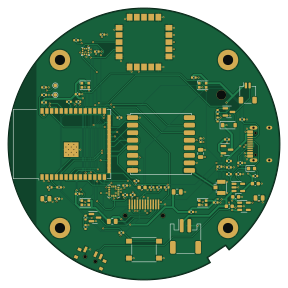
About the Finder puck PCB
Finder puck is an open source ESP32 PCB design by lucy-chapar, published on GitHub. It is a 4-layer board measuring 72 × 72 mm, with 70 components from 35 distinct parts.
Its main chip is the ESP32-S3-WROOM-1-N8, from the ESP32 family. Other key parts include the RFM95W-915S2, SAM-M10Q, LIS3DH, LIS2MDL and MCP73831-2-OT. By type, the board carries 26 resistors, 22 capacitors, 7 ICs, 4 connectors, 4 LEDs and 3 transistors.
It belongs with the rf & radio and power & battery designs in this gallery.
From the project
Two pocket pucks that find each other without phones: GPS, LoRa, compass and a round screen. KiCad board, printed case, build guide and ESP32-S3 firmware.
A pocket puck so two people can find each other in a loud, crowded place without phones. Each puck has GPS, a compass and a LoRa radio (915 MHz, no cell service needed); the two swap positions and each shows a radar-style arrow and the distance to the other on a round screen. A vibration motor pulses faster as you get closer, four LEDs on the face strobe a "beacon me" pattern for the last few metres, and there is exactly one button.
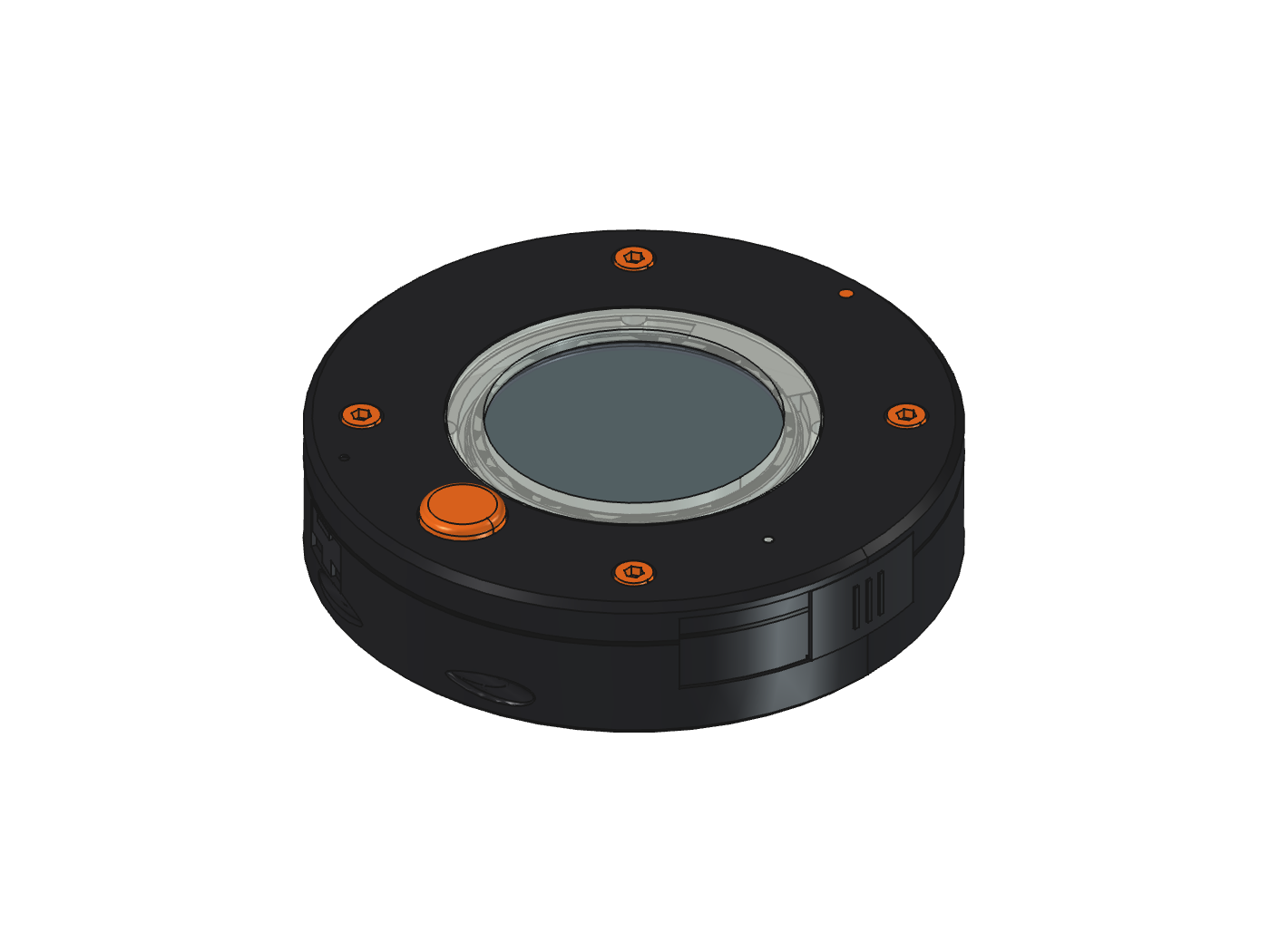
Main components on the Finder puck
Finder puck bill of materials (BOM)
70 components, 35 distinct parts — part numbers from the project's BOM.
| Qty | Part | Footprint | Refs |
|---|---|---|---|
| 1 | ESP32-S3-WROOM-1-N8 | ESP32-S3-WROOM-1 | U1 |
| 1 | RFM95W-915S2 | HOPERF_RFM9XW_SMD | U2 |
| 1 | SAM-M10Q | ublox_SAM-M8Q | U3 |
| 1 | LIS3DH | LGA-16_3x3mm_P0.5mm_LayoutBorder3x5y | U4 |
| 1 | LIS2MDL | LGA-12_2x2mm_P0.5mm | U5 |
| 1 | MCP73831-2-OT | SOT-23-5 | U6 |
| 1 | AP2112K-3.3 | SOT-23-5 | U7 |
| 2 | AO3400A | SOT-23 | Q1, Q2 |
| 1 | AO3401A | SOT-23 | Q3 |
| 1 | C165948 USB-C | USB_C_Receptacle_HRO_TYPE-C-31-M-12 | J1 |
| 1 | C295747 LiPo 1S | JST_PH_S2B-PH-SM4-TB_1x02-1MP_P2.00mm_Horizontal | J2 |
| 1 | C88373 U.FL 915MHz | U.FL_Hirose_U.FL-R-SMT-1_Vertical | J4 |
| 1 | C160402 Vibration motor | JST_SH_SM02B-SRSS-TB_1x02-1MP_P1.00mm_Horizontal | J5 |
| 1 | C221877 Button (top, 5 mm stem) | SW_SPST_PTS645 | SW1 |
| 1 | C221841 Power | SW_SPDT_PCM12 | SW2 |
| 4 | WS2812B-2020 | LED_WS2812B-2020_PLCC4_2.0x2.0mm | LED1, LED2, LED3, LED4 |
| 1 | 1N4148W | D_SOD-123 | D1 |
| 1 | C2286 Red charge | LED_0603_1608Metric | D2 |
| 1 | C52923 1uF 10V X5R | C_0402_1005Metric | C1 |
| 4 | C15850 10uF 10V X5R | C_0805_2012Metric | C2, C7, C9, C15 |
Show 15 more
| Qty | Part | Footprint | Refs |
|---|---|---|---|
| 12 | C1525 100nF 16V X7R | C_0402_1005Metric | C3, C8, C10, C11, C12, C14, C16, C18 +4 |
| 3 | C19666 4.7uF 10V X5R | C_0603_1608Metric | C4, C5, C6 |
| 1 | C16772 220nF 16V X7R | C_0402_1005Metric | C13 |
| 1 | C15849 1uF 10V X5R | C_0603_1608Metric | C17 |
| 5 | 10K 10k | R_0402_1005Metric | R1, R2, R16, R17, R23 |
| 2 | 4.7K 4.7k | R_0402_1005Metric | R3, R4 |
| 2 | 5.1K 5.1k | R_0402_1005Metric | R5, R6 |
| 1 | 3.3K 3.3k | R_0402_1005Metric | R7 |
| 2 | 1k | R_0402_1005Metric | R8, R14 |
| 7 | 100K 100k | R_0402_1005Metric | R9, R10, R12, R15, R20, R22, R25 |
| 1 | 100 | R_0402_1005Metric | R11 |
| 1 | 27 | R_0805_2012Metric | R13 |
| 2 | 33 | R_0402_1005Metric | R18, R19 |
| 2 | 150K 150k | R_0402_1005Metric | R21, R26 |
| 1 | 220 | R_0402_1005Metric | R24 |
Finder puck design files
The KiCad project lives in the lucy-chapar/finder-puck repository on GitHub; these links point at the commit this page was built from.
- Layoutfinder_puck.kicad_pcb
- Schematicfinder_puck.kicad_sch
- BOMfab/finder_puck_bom.csv
Finder puck: common questions
What microcontroller does the Finder puck use?
The Finder puck is built around the ESP32-S3-WROOM-1-N8, from the ESP32 family.
How big is the Finder puck PCB?
The Finder puck measures 72 × 72 mm, has 4 copper layers and is 1.6 mm thick.
How many components are on the Finder puck?
70 components, from 35 distinct parts, with part numbers taken from the project's own BOM. The full bill of materials is listed on this page.
Where can I download the Finder puck design files?
From the lucy-chapar/finder-puck repository on GitHub, which has the KiCad layout, the schematic and the BOM; the links under Design files point to each one.
Can I use the Finder puck design in my own project?
The repository has no license, so all rights stay with lucy-chapar. Use it as a reference, and ask the author before reusing the design.
Can I test firmware for the Finder puck without the hardware?
Yes. HardLabs builds a simulation of the board from its netlist and BOM, so you can run and debug ESP32 firmware against it before you order a PCB.
Similar boards
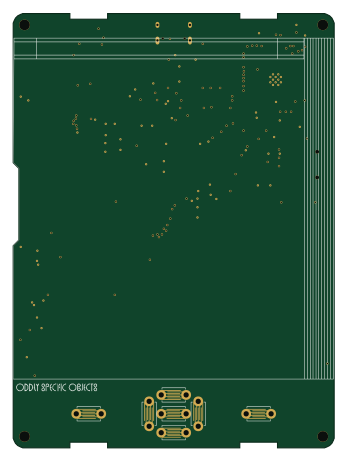 ESP32
OSO-BOOK-B1
joeycastillo
85 × 115 mm65 parts2LCC-BY-SA-4.08.1k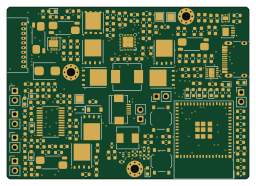 ESP32
Powertrain
byrantech
64 × 45.4 mm171 parts4LMIT4.3k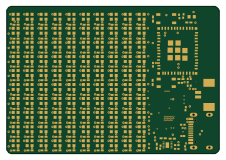 ESP32
Badge
atopile
56.3 × 39 mm239 parts4LMIT4.0k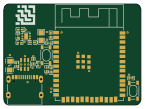 ESP32
Esp32 minimal
36.2 × 26.8 mm20 parts2LMIT4.0k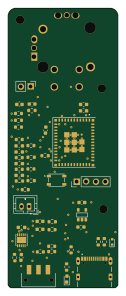 ESP32
Controller
StuckAtPrototype
29 × 74 mm58 parts4LApache-2.03.8k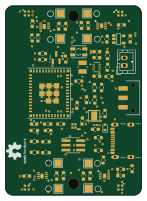 ESP32
Racer
36 × 50.2 mm70 parts4LApache-2.03.8k