
Velocity-Based-Training

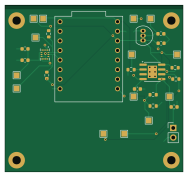
About the Velocity-Based-Training PCB
Velocity-Based-Training is an open source ESP32 PCB design by m351351, published on GitHub. It is a 2-layer board measuring 47 × 44 mm, with 18 components from 12 distinct parts.
Its main chip is the ESP32-C3_SUPERMINI_TH, from the ESP32 family. Other key parts include the BMI270, MCP1700x-330xxTO and TP4056-42-ESOP8. By type, the board carries 7 resistors, 6 capacitors, 4 ICs and 1 connector.
It belongs with the iot & wireless and sensors designs in this gallery.
From the project
An ESP32-based device for weightlifting analysis. Processes analog accelerometer data to visualize velocity-displacement curves for athletic performance optimization.
Tämä projekti on osa Oulun ammattikorkeakoulun tieto- ja viestintätekniikan toisen vuoden kevään elektroniikan sovellusprojekti-kurssia (2026). Projektin kesto on 7 viikkoa.
Laite kiinnitetään tankoon, ja se lähettää kiihtyvyysdataa langattomasti Android-puhelimeen, joka visualisoi tiedon käyttäjälle graafisessa muodossa.
Vastukset: R1, R4 (4,7kΩ), R2, R3 (100kΩ), R5 (2,4kΩ), R6, R7 (10kΩ) Kondensaattorit: C1, C2 (1µF), C3, C4 (100nF), C5, C6 (10µF) Akku: 3,7V litiumpolymeeriakku (Li-Po) Älypuhelin Huawei Honor View 20 (testikäyttöpuhelin)
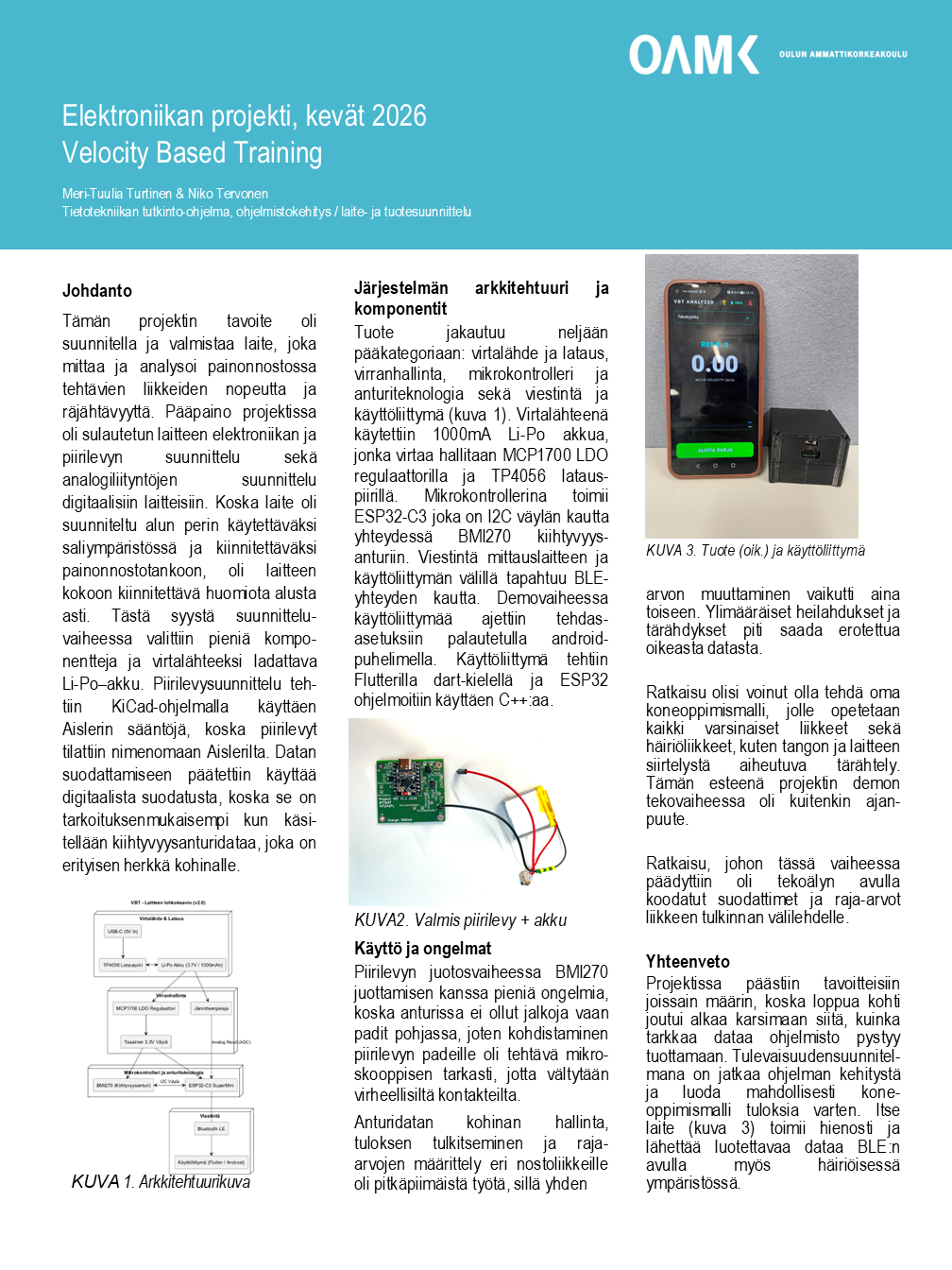
Main components on the Velocity-Based-Training
Velocity-Based-Training bill of materials (BOM)
18 components, 12 distinct parts.
| Qty | Part | Footprint | Refs |
|---|---|---|---|
| 1 | BMI270 | XDCR_BMI270 | U2 |
| 1 | MCP1700x-330xxTO | TO-92_Inline | U3 |
| 1 | ESP32-C3_SUPERMINI_TH | MODULE_ESP32-C3_SUPERMINI_TH | U4 |
| 1 | TP4056-42-ESOP8 | SOIC-8-1EP_3.9x4.9mm_P1.27mm_EP2.41x3.3mm_ThermalVias | U5 |
| 1 | Conn_01x02_Pin | PinHeader_1x02_P2.54mm_Vertical | J1 |
| 2 | 1µF | C_0603_1608Metric | C1, C2 |
| 2 | 100nF | C_0603_1608Metric | C3, C4 |
| 2 | 10µF | C_0603_1608Metric | C5, C6 |
| 2 | 4.7k | R_0603_1608Metric | R1, R4 |
| 2 | 100k | R_0603_1608Metric | R2, R3 |
| 1 | 2.4K | R_0603_1608Metric | R5 |
| 2 | 10k | R_0603_1608Metric | R6, R7 |
Velocity-Based-Training design files
The KiCad project lives in the m351351/Velocity-Based-Training repository on GitHub; these links point at the commit this page was built from.
Velocity-Based-Training: common questions
What microcontroller does the Velocity-Based-Training use?
The Velocity-Based-Training is built around the ESP32-C3_SUPERMINI_TH, from the ESP32 family.
How big is the Velocity-Based-Training PCB?
The Velocity-Based-Training measures 47 × 44 mm, has 2 copper layers and is 1.6 mm thick.
How many components are on the Velocity-Based-Training?
18 components, from 12 distinct parts. The full bill of materials is listed on this page.
Where can I download the Velocity-Based-Training design files?
From the m351351/Velocity-Based-Training repository on GitHub, which has the KiCad layout and the schematic; the links under Design files point to each one.
Can I use the Velocity-Based-Training design in my own project?
The repository has no license, so all rights stay with m351351. Use it as a reference, and ask the author before reusing the design.
Can I test firmware for the Velocity-Based-Training without the hardware?
Yes. HardLabs builds a simulation of the board from its netlist and BOM, so you can run and debug ESP32 firmware against it before you order a PCB.
Similar boards
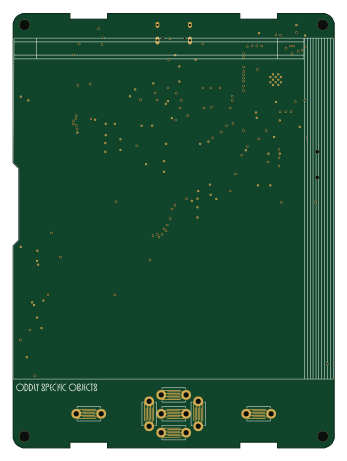 ESP32
ESP32Open Book Abridged Edition
joeycastillo
85 × 115 mm65 parts2LCC-BY-SA-4.08.1k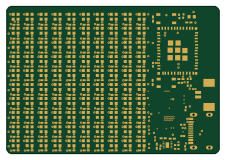 ESP32
ESP32Badge
atopile
56.3 × 39 mm239 parts4LMIT4.0k ESP32
ESP32Esp32 minimal
36.2 × 26.8 mm20 parts2LMIT4.0k ESP32
ESP32Racer
StuckAtPrototype
36 × 50.2 mm70 parts4LApache-2.03.8k ESP32
ESP32Controller
29 × 74 mm58 parts4LApache-2.03.8k ESP32
ESP32Bitaxe
skot
56.5 × 99.8 mm86 parts4LCERN-OHL-S-2.01.4k