
Pilot Oriented Navigation System

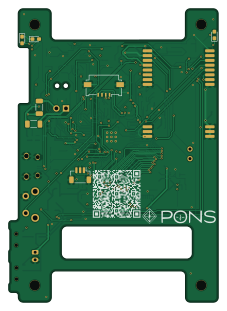
About the Pilot Oriented Navigation System PCB
Pilot Oriented Navigation System is an open source RP2040/RP2350 PCB design by MasaoC, published on GitHub under the MIT license. It is a 4-layer board measuring 55.4 × 77.6 mm, with 120 components from 46 distinct parts.
Its main chip is the RP2350_80QFN, from the RP2040/RP2350 family. Other key parts include the PAM8302AADCR, W25Q128JVS, MCP73831-2-OT, TPS63031DSK and MS5611-01BA. By type, the board carries 51 resistors, 45 capacitors, 7 ICs, 4 connectors, 4 diodes and 4 inductors.
It belongs with the rf & radio and displays & leds designs in this gallery.
From the project
鳥人間コンテストに特化したGNSS誘導システム。人力飛行機のパイロットが使いやすいことを目標にした航法装置です。ハードとソフトをオープンソースで開発しています。
人力飛行機のパイロットが使いやすいことを目標とした航法装置です。琵琶湖の鳥人間コンテストに特化しています。 GPS/GNSS navigation for human-powered aircraft, specialized for the Japan International Birdman Rally at Lake Biwa, Japan.
飛んでいる間の道具であり、飛んだあとの計測器でもあります。 当日の誘導と、次の機体の設計の両方に活用できます。
SD に残るログを tools/ の解析にかけると、機体特性の分析やパイロット証言の裏付けができます (→ ツール (tools/))。実際に分かったことの例:
縦の癖 フゴイド運動の周期、操縦によるものか機体によるものか。 横の癖 2026 機体「陽還」には周期 12.5 秒のはっきりした揺れがあり、 2025 機体「白夜」には無かった。上反角とラダーの違いが癖として出ていた → 上反角や尾翼まわりの見直しへ 構造の設計荷重。** 巡航中の鉛直加速度は実測で最大 +0.18 / −0.25 G(荷重倍数 1.17 / 0.77) → 桁の設計荷重の裏取りへ
Main components on the Pilot Oriented Navigation System
Pilot Oriented Navigation System bill of materials (BOM)
120 components, 46 distinct parts.
| Qty | Part | Footprint | Refs |
|---|---|---|---|
| 1 | PAM8302AADCR | SO-8_3.9x4.9mm_P1.27mm | U1 |
| 1 | W25Q128JVS | SOIC-8_5.3x5.3mm_P1.27mm | U2 |
| 1 | RP2350_80QFN | RP2350-QFN-80-1EP_10x10_P0.4mm_EP3.4x3.4mm_ThermalVias | U3 |
| 1 | MCP73831-2-OT | SOT-23-5 | U4 |
| 1 | TPS63031DSK | WSON-10-1EP_2.5x2.5mm_P0.5mm_EP1.2x2mm | U5 |
| 1 | MS5611-01BA | LGA-8_3x5mm_P1.25mm | U8 |
| 1 | BNO085 | bno085 | U10 |
| 1 | AO3401A | SOT-23 | Q1 |
| 1 | X322512MSB4SI | Crystal_SMD_3225-4Pin_3.2x2.5mm | Y1 |
| 1 | 32.768k | Crystal_SMD_3215-2Pin_3.2x1.5mm | Y2 |
| 1 | 54132-4062 | MOLEX_54132-4062 | J2 |
| 1 | 2005280040 | Molex_200528-0040_1x04-1MP_P1.00mm_Horizontal | J3 |
| 1 | Micro_SD_Card_Det2 | microSD_HC_Hirose_DM3AT-SF-PEJM5 | J4 |
| 1 | USB_B_Micro | USB_Micro-B_Amphenol_10103594-0001LF_Horizontal | J6 |
| 2 | SW_TS-1088 | TS-1088-AR02016 | SW2, SW3 |
| 1 | VBUS_LED_W | LED_0603_1608Metric_Pad1.05x0.95mm_HandSolder | D1 |
| 2 | LED_R | LED_0603_1608Metric_Pad1.05x0.95mm_HandSolder | D2, D4 |
| 1 | 1N5819WS | D_SOD-323 | D3 |
| 2 | 390 | L_1206_3216Metric_Pad1.22x1.90mm_HandSolder | FB1, FB2 |
| 1 | 3.3u | L_pol_2016 | L1 |
Show 26 more
| Qty | Part | Footprint | Refs |
|---|---|---|---|
| 1 | 1.5u | L_APV_ANR3015 | L2 |
| 5 | 1u | C_0402_1005Metric_small_pads | C2, C3, C6, C12, C27 |
| 3 | 100u | C_1206_3216Metric | C4, C9, C46 |
| 20 | 100n | C_0402_1005Metric_small_pads | C5, C11, C14, C19, C22, C24, C25, C26 +12 |
| 2 | 47u | C_0805_2012Metric | C7, C13 |
| 2 | 220p | C_0402_1005Metric_small_pads | C8, C10 |
| 6 | 4.7u | C_0402_1005Metric_small_pads | C15, C18, C20, C21, C23, C31 |
| 2 | 33p | C_0402_1005Metric_small_pads | C16, C17 |
| 3 | 10u | C_0402_1005Metric_small_pads | C36, C37, C45 |
| 2 | 15p | C_0402_1005Metric_small_pads | C41, C42 |
| 6 | 1k | R_0402_1005Metric | R1, R3, R8, R24, R25, R28 |
| 3 | 10k | R_0402_1005Metric | R2, R36, R44 |
| 4 | 100 | R_0402_1005Metric | R4, R5, R27, R29 |
| 2 | 100K | R_0402_1005Metric | R6, R33 |
| 1 | 10k | R_0603_1608Metric_Pad0.98x0.95mm_HandSolder | R7 |
| 1 | 1 | R_0603_1608Metric | R9 |
| 2 | 470 | R_0402_1005Metric | R10, R11 |
| 7 | 33 | R_0402_1005Metric | R12, R13, R14, R15, R16, R17, R26 |
| 3 | 200 | R_0402_1005Metric | R18, R30, R42 |
| 9 | 4.7k | R_0402_1005Metric | R19, R20, R21, R22, R23, R40, R41, R48 +1 |
| 2 | 22 | R_0402_1005Metric | R31, R32 |
| 1 | 51K | R_0402_1005Metric | R34 |
| 1 | 5K1 | R_0402_1005Metric | R35 |
| 2 | 4.7k | R_0603_1608Metric_Pad0.98x0.95mm_HandSolder | R37, R38 |
| 1 | 2.2k | R_0402_1005Metric | R39 |
| 6 | 0 | R_0603_1608Metric_Pad0.98x0.95mm_HandSolder | R46, R47, R50, R51, R52, R53 |
Pilot Oriented Navigation System design files
The KiCad project lives in the MasaoC/GPS-TFT-Map_PONS repository on GitHub; these links point at the commit this page was built from.
Pilot Oriented Navigation System: common questions
What microcontroller does the Pilot Oriented Navigation System use?
The Pilot Oriented Navigation System is built around the RP2350_80QFN, from the RP2040/RP2350 family.
How big is the Pilot Oriented Navigation System PCB?
The Pilot Oriented Navigation System measures 55.4 × 77.6 mm, has 4 copper layers and is 0.8 mm thick.
How many components are on the Pilot Oriented Navigation System?
120 components, from 46 distinct parts. The full bill of materials is listed on this page.
Where can I download the Pilot Oriented Navigation System design files?
From the MasaoC/GPS-TFT-Map_PONS repository on GitHub, which has the KiCad layout and the schematic; the links under Design files point to each one.
Can I use the Pilot Oriented Navigation System design in my own project?
Yes, under the terms of its MIT license, which MasaoC chose for the repository.
Can I test firmware for the Pilot Oriented Navigation System without the hardware?
Yes. HardLabs builds a simulation of the board from its netlist and BOM, so you can run and debug RP2040/RP2350 firmware against it before you order a PCB.
More boards in GPS-TFT-Map_PONS
Similar boards
 RP2040/RP2350
Open Book Abridged Edition
joeycastillo
85 × 115 mm29 parts2LCC-BY-SA-4.08.1k RP2040/RP2350
Corne
foostan
277.2 × 107.5 mm164 parts2LCC-BY-4.07.7k RP2040/RP2350
Corne
277.2 × 107.5 mm164 parts2LCC-BY-4.07.7k RP2040/RP2350
LogicAnalyzer
gusmanb
57 × 55.2 mm6 parts2LGPL-3.05.0k RP2040/RP2350
Jitx design
55.5 × 65 mm26 parts4LGPL-3.05.0k RP2040/RP2350
Pro V2
kata0510
290.1 × 130 mm270 parts2LMIT2.3k