
OpenRower

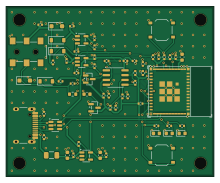
About the OpenRower PCB
OpenRower is an open source ESP32 PCB design by naibaf7, published on GitHub under the MIT license. It is a 2-layer board measuring 55 × 45 mm, with 65 components from 31 distinct parts.
Its main chip is the ESP32-C3-MINI-1-H4X, from the ESP32 family. Other key parts include the AP2112K-3.3TRG1, LM393DR, USBLC6-2SC6 and SY6280AAC. By type, the board carries 28 resistors, 16 capacitors, 7 diodes, 6 ICs, 3 LEDs and 2 connectors.
It belongs with the sensors and iot & wireless designs in this gallery.
From the project
Android rowing monitor
An open-source rowing monitor for any rowing machine. A sensor on the flywheel sends the timing of each pulse to an Android app. The app works out pace, power, stroke rate and distance, draws a live force curve and records your workouts.
- Workout modes: free rowing, set distance, set time, target pace, and custom interval workouts built from segments. - Live display: - pace per 500 m (current and average), stroke rate, power in watts or calories; - time and distance, elapsed and remaining, and the projected finish; - heart rate. - Charts: a force curve for every stroke, and a…
Main components on the OpenRower
OpenRower bill of materials (BOM)
65 components, 31 distinct parts.
| Qty | Part | Footprint | Refs |
|---|---|---|---|
| 1 | ESP32-C3-MINI-1-H4X | ESP32-C3-MINI-1 | U1 |
| 1 | AP2112K-3.3TRG1 AP2112K-3.3 | SOT-23-5 | U2 |
| 1 | LM393DR | SOIC-8_3.9x4.9mm_P1.27mm | U3 |
| 1 | USBLC6-2SC6 | SOT-23-6 | U4 |
| 2 | SY6280AAC | SOT-23-5 | U5, U6 |
| 1 | TYPE-C-31-M-12 USB-C | USB_C_Receptacle_HRO_TYPE-C-31-M-12_Edge | J1 |
| 1 | PJ-242 | Jack_2.5mm_SHOUHAN_PJ-242 | J2 |
| 1 | nSMD050-33V 500mA PPTC | Fuse_1206_3216Metric | F1 |
| 1 | TS-1187A-B-A-B RESET | SW_Push_1P1T_XKB_TS-1187A | SW1 |
| 1 | TS-1187A-B-A-B BOOT | SW_Push_1P1T_XKB_TS-1187A | SW2 |
| 1 | XL-1608UGC-04 Green | LED_0603_1608Metric | LED1 |
| 1 | XL-1608UBC-04 Blue | LED_0603_1608Metric | LED2 |
| 1 | KT-0603R Red | LED_0603_1608Metric | LED3 |
| 2 | SMF24CA | D_SOD-123F | D1, D2 |
| 3 | B5819W SL B5819W | D_SOD-123 | D3, D6, D7 |
| 2 | BAT54S,215 BAT54S | SOT-23 | D4, D5 |
| 3 | CL10A106KP8NNNC 10uF | C_0603_1608Metric | C1, C3, C5 |
| 4 | CL05B104KO5NNNC 100nF | C_0402_1005Metric | C2, C4, C6, C10 |
| 5 | CL05A105KA5NQNC 1uF | C_0402_1005Metric | C7, C12, C13, C14, C15 |
| 3 | CL05B103KB5NNNC 10nF | C_0402_1005Metric | C8, C11, C16 |
Show 11 more
| Qty | Part | Footprint | Refs |
|---|---|---|---|
| 1 | CL10A105KB8NNNC 1uF | C_0603_1608Metric | C9 |
| 2 | 0402WGF5101TCE 5.1k | R_0402_1005Metric | R1, R2 |
| 8 | 0402WGF1002TCE 10k | R_0402_1005Metric | R3, R4, R5, R6, R10, R15, R22, R28 |
| 1 | 0402WGF1001TCE 1k | R_0402_1005Metric | R7 |
| 1 | 0402WGF1000TCE 100R | R_0402_1005Metric | R8 |
| 1 | 0402WGF3300TCE 330R | R_0402_1005Metric | R9 |
| 8 | 0402WGF1003TCE 100k | R_0402_1005Metric | R11, R12, R13, R17, R18, R24, R26, R27 |
| 2 | 0402WGF1004TCE 1M | R_0402_1005Metric | R14, R21 |
| 1 | 0603WAF1002T5E 10k | R_0603_1608Metric | R16 |
| 2 | 0402WGF2202TCE 22k | R_0402_1005Metric | R19, R20 |
| 2 | 0402WGF1502TCE 15k | R_0402_1005Metric | R23, R25 |
OpenRower design files
The KiCad project lives in the naibaf7/OpenRower repository on GitHub; these links point at the commit this page was built from.
OpenRower: common questions
What microcontroller does the OpenRower use?
The OpenRower is built around the ESP32-C3-MINI-1-H4X, from the ESP32 family.
How big is the OpenRower PCB?
The OpenRower measures 55 × 45 mm, has 2 copper layers and is 1.6 mm thick.
How many components are on the OpenRower?
65 components, from 31 distinct parts. The full bill of materials is listed on this page.
Where can I download the OpenRower design files?
From the naibaf7/OpenRower repository on GitHub, which has the KiCad layout and the schematic; the links under Design files point to each one.
Can I use the OpenRower design in my own project?
Yes, under the terms of its MIT license, which naibaf7 chose for the repository.
Can I test firmware for the OpenRower without the hardware?
Yes. HardLabs builds a simulation of the board from its netlist and BOM, so you can run and debug ESP32 firmware against it before you order a PCB.
Similar boards
 ESP32
OSO-BOOK-B1
joeycastillo
85 × 115 mm65 parts2LCC-BY-SA-4.08.1k ESP32
Powertrain
byrantech
64 × 45.4 mm171 parts4LMIT4.3k ESP32
Badge
atopile
56.3 × 39 mm239 parts4LMIT4.0k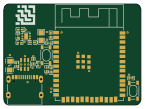 ESP32
Esp32 minimal
36.2 × 26.8 mm20 parts2LMIT4.0k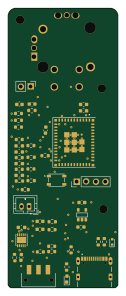 ESP32
Controller
StuckAtPrototype
29 × 74 mm58 parts4LApache-2.03.8k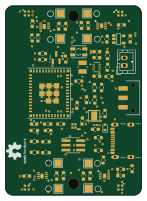 ESP32
Racer
36 × 50.2 mm70 parts4LApache-2.03.8k