
Picoarc

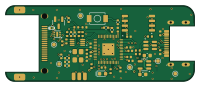
About the Picoarc PCB
Picoarc is an open source RP2040/RP2350 PCB design by naorunaoru, published on GitHub under the MIT license. It is a 4-layer board measuring 50 × 20 mm, with 51 components from 31 distinct parts.
Its main chip is the RP2040, from the RP2040/RP2350 family. Other key parts include the PCA9306DCUR, AP2112K-3.3TRG1, USBLC6-2SC6 and W25Q16JVSSIQ. By type, the board carries 23 resistors, 15 capacitors, 5 ICs, 3 diodes, 2 connectors and 1 transistor.
It belongs with the dev boards & breakouts designs in this gallery.
From the project
Use your HDMI ARC capable soundbar with your computer
The fab-ready PicoARC PCB design lives in this directory. The circuit is authored with the Zener toolchain from Diode, and the physical board layout is kept as a generated/synced KiCad project.
Zener is a Starlark-based hardware description language for PCB schematics. The pcb CLI evaluates the .zen design, manages dependencies from pcb.toml, assigns reference designators, validates the netlist, and generates/syncs KiCad layout files.
Main components on the Picoarc
Picoarc bill of materials (BOM)
51 components, 31 distinct parts — part numbers from the project's BOM.
| Qty | Part | Footprint | Refs |
|---|---|---|---|
| 1 | PCA9306DCUR Texas Instruments | VSSOP-8_2.3x2mm_P0.5mm | U1 |
| 1 | AP2112K-3.3TRG1 Diodes Incorporated | SOT-23-5 | U2 |
| 1 | USBLC6-2SC6 STMicroelectronics | SOT-23-6 | U3 |
| 1 | W25Q16JVSSIQ Winbond | SOIC-8_5.3x5.3mm_P1.27mm | U4 |
| 1 | RP2040 Raspberry Pi | QFN-56-1EP_7x7mm_P0.4mm_EP3.2x3.2mm | U5 |
| 1 | 2N7002 Jiangsu Changjing Electronics Technology (CJ) | SOT-23 | Q1 |
| 1 | X322512MSB4SI YXC | Crystal_SMD_3225-4Pin_3.2x2.5mm | Y1 |
| 1 | HC-HDMI0019T-3 Shenzhen Hongcheng Electronics | HDMI-SMD_HC-HDMI0019T-3_PicoARC_R6 | J1 |
| 1 | GT-USB-7014G G-Switch | USB-C-SMD_GT-USB-7014D | J2 |
| 1 | TS-1088-AR02016 XUNPU | SW-SMD_L3.9-W3.0-P4.45 | SW1 |
| 1 | KT-0603R Hubei KENTO Elec | LED_0603_1608Metric | D1 |
| 1 | D5V0M5B6LP16-7 Diodes Incorporated | DFN1616-6_L1.6-W1.6-P0.50-BL-EP | D2 |
| 1 | H7VH10U hongjiacheng | SOD-882_L1.0-W0.6-BI | D3 |
| 1 | CL05B103KB5NNNC Samsung Electro-Mechanics | C_0402_1005Metric | C1 |
| 1 | 0402CG101J500NT FH (Guangdong Fenghua Advanced Tech) | C_0402_1005Metric | C2 |
| 2 | CL10A106MA8NRNC Samsung Electro-Mechanics | C_0603_1608Metric | C3, C4 |
| 7 | CL05B104KB54PNC Samsung Electro-Mechanics | C_0402_1005Metric | C5, C8, C9, C10, C11, C12, C13 |
| 2 | CL05A105KA5NQNC Samsung Electro-Mechanics | C_0402_1005Metric | C6, C7 |
| 2 | 0402CG330J500NT FH (Guangdong Fenghua Advanced Tech) | C_0402_1005Metric | C14, C15 |
| 1 | 0402WGF2202TCE UNI-ROYAL(Uniroyal Elec) | R_0402_1005Metric | R1 |
Show 11 more
| Qty | Part | Footprint | Refs |
|---|---|---|---|
| 1 | 0402WGF2200TCE UNI-ROYAL(Uniroyal Elec) | R_0402_1005Metric | R2 |
| 1 | 0402WGF3300TCE UNI-ROYAL(Uniroyal Elec) | R_0402_1005Metric | R3 |
| 4 | 0402WGF1001TCE UNI-ROYAL(Uniroyal Elec) | R_0402_1005Metric | R4, R5, R16, R23 |
| 3 | 0402WGF1003TCE UNI-ROYAL(Uniroyal Elec) | R_0402_1005Metric | R6, R7, R13 |
| 4 | 0402WGF2201TCE UNI-ROYAL(Uniroyal Elec) | R_0402_1005Metric | R8, R9, R10, R11 |
| 1 | 0402WGF2003TCE UNI-ROYAL(Uniroyal Elec) | R_0402_1005Metric | R12 |
| 1 | 0402WGF1000TCE UNI-ROYAL(Uniroyal Elec) | R_0402_1005Metric | R14 |
| 1 | 0402WGF1200TCE UNI-ROYAL(Uniroyal Elec) | R_0402_1005Metric | R15 |
| 2 | 0402WGF5101TCE UNI-ROYAL(Uniroyal Elec) | R_0402_1005Metric | R17, R18 |
| 2 | 0402WGF1002TCE UNI-ROYAL(Uniroyal Elec) | R_0402_1005Metric | R19, R20 |
| 2 | 0402WGF330JTCE UNI-ROYAL(Uniroyal Elec) | R_0402_1005Metric | R21, R22 |
Picoarc design files
The KiCad project lives in the naorunaoru/picoarc repository on GitHub; these links point at the commit this page was built from.
Picoarc: common questions
What microcontroller does the Picoarc use?
The Picoarc is built around the RP2040, from the RP2040/RP2350 family.
How big is the Picoarc PCB?
The Picoarc measures 50 × 20 mm, has 4 copper layers and is 1.2 mm thick.
How many components are on the Picoarc?
51 components, from 31 distinct parts, with part numbers taken from the project's own BOM. The full bill of materials is listed on this page.
Where can I download the Picoarc design files?
From the naorunaoru/picoarc repository on GitHub, which has the KiCad layout and the BOM; the links under Design files point to each one.
Can I use the Picoarc design in my own project?
Yes, under the terms of its MIT license, which naorunaoru chose for the repository.
Can I test firmware for the Picoarc without the hardware?
Yes. HardLabs builds a simulation of the board from its netlist and BOM, so you can run and debug RP2040/RP2350 firmware against it before you order a PCB.
Similar boards
 RP2040/RP2350
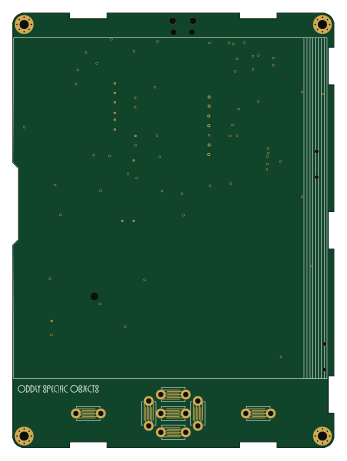
Open Book Abridged Edition
joeycastillo
85 × 115 mm29 parts2LCC-BY-SA-4.08.1k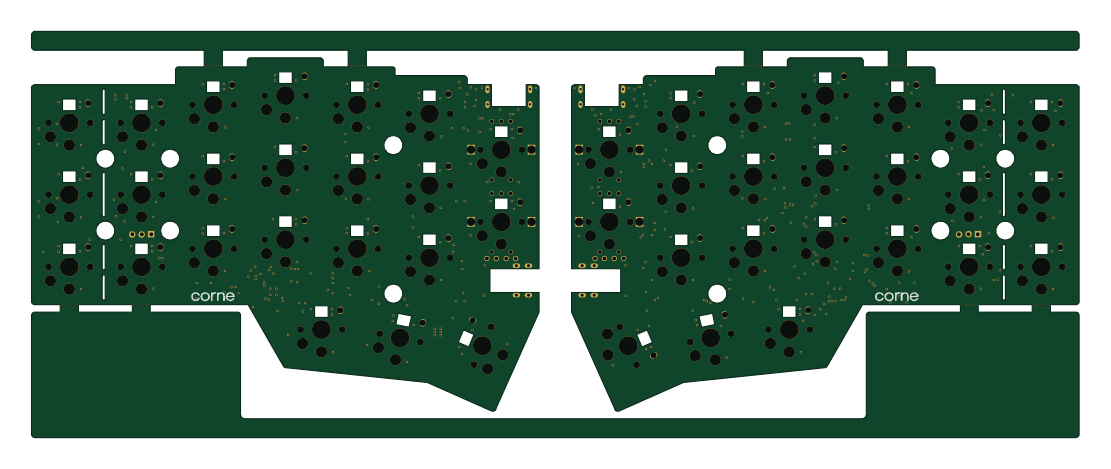 RP2040/RP2350
Corne
foostan
277.2 × 107.5 mm164 parts2LCC-BY-4.07.7k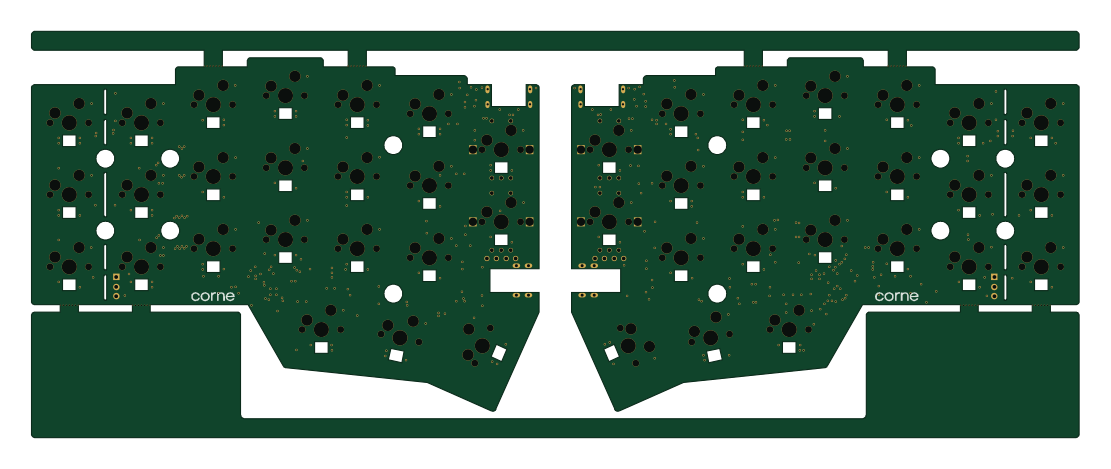 RP2040/RP2350
Corne
277.2 × 107.5 mm164 parts2LCC-BY-4.07.7k RP2040/RP2350
LogicAnalyzer
gusmanb
57 × 55.2 mm6 parts2LGPL-3.05.0k RP2040/RP2350
Jitx design
55.5 × 65 mm26 parts4LGPL-3.05.0k RP2040/RP2350
Pro V2
kata0510
290.1 × 130 mm270 parts2LMIT2.3k