
Cyberboard

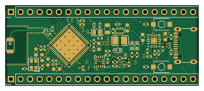
About the Cyberboard PCB
Cyberboard is an open source STM32 PCB design by notaroomba, published on GitHub. It is a 4-layer board measuring 51 × 21 mm, with 64 components from 36 distinct parts.
Its main chip is the STM32WB55RGVX, from the STM32 family. Other key parts include the SZYY0402Y_C434450, TPD2EUSB30, NX2012SA-32.768KHZ-STD-MUB-2, BQ24072RGT and TPS631000DRLR. By type, the board carries 27 capacitors, 16 resistors, 10 ICs, 2 connectors, 2 switches and 2 inductors.
It belongs with the sensors, power & battery and dev boards & breakouts designs in this gallery.
From the project
A cyberpunk-themed STM32 devboard
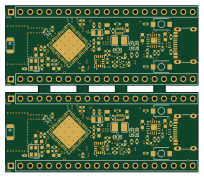
- STM32WB55CG microcontroller with Bluetooth support - Raspberry Pi Pico form factor for compatibility - IMU and Barometer - ICM-42688 (6-axis) and BMP580 pressure sensor for environmental/motion sensing - Battery charging with BQ24072RGTR IC and solder pad for 1S LiPo - Buck-Boost converter (TPS631000) for efficient power management - Multiple Status LEDs for visual feedback - USB-C connectivity - Ceramic Bluetooth antenna with impedance matching - SWD test points on the bottom for easy programming - 4-layer PCB design with optimized RF layout and routing - Panelized design for…

Main components on the Cyberboard
Cyberboard bill of materials (BOM)
64 components, 36 distinct parts — part numbers from the project's BOM.
| Qty | Part | Footprint | Refs |
|---|---|---|---|
| 1 | SZYY0402Y_C434450 | LED0402-FD_YELLOW | U1 |
| 1 | TPD2EUSB30 | Texas_DRT-3 | U2 |
| 1 | NX2012SA-32.768KHZ-STD-MUB-2 | CRYSTAL-SMD_L2.0-W1.2 | U3 |
| 1 | STM32WB55RGVX STM32WB55RGVx | QFN-68-1EP_8x8mm_P0.4mm_EP6.4x6.4mm | U4 |
| 1 | BQ24072RGT | VQFN-16-1EP_3x3mm_P0.5mm_EP1.6x1.6mm | U5 |
| 1 | TPS631000DRLR | SOT-583-8_L2.1-W1.2-P0.50-LS1.6-BL | U6 |
| 1 | ICM-42688-PC | LGA-14_L3.0-W2.5-P0.50-TL | U7 |
| 1 | BMP580 | LGA-10_L2.0-W2.0-P0.50-TL_BMP580 | U8 |
| 1 | C882955 DFE252012P-1R0M=P2 | L1008 | U9 |
| 1 | XL-1005UBC_C22355736 | LED0402-RD | U10 |
| 1 | NX2016SA-32MHZ-STD-CZS-5 | OSC-SMD_4P-L2.0-W1.6-BL | X1 |
| 2 | CONN_01X20 Conn_01x20 | PinHeader_1x20_P2.54mm_Vertical | J1, J2 |
| 1 | 2450AT18A100E | ANT-SMD_L3.2-W1.6 | AE1 |
| 1 | MLPF-WB55-01E3 | FILTER-SMD_6P-L1.6-W1.0-P0.50-BL | FL1 |
| 2 | SW_Push | SW-SMD_L3.9-W3.0-P4.45 | SW1, SW2 |
| 1 | C2765186 TYPE-C 16PIN 2MD(073) | USB-C-SMD_TYPE-C-6PIN-2MD-073 | USB1 |
| 1 | XL-1005UGC | LED0402-RD_GREEN | LED1 |
| 1 | 10UH 10uH | L_0603_1608Metric | L1 |
| 1 | 10NH 10nH | L_0603_1608Metric | L2 |
| 4 | 10PF 10pF | C_0402_1005Metric | C1, C2, C3, C4 |
Show 16 more
| Qty | Part | Footprint | Refs |
|---|---|---|---|
| 11 | 100NF 100nF | C_0402_1005Metric | C5, C6, C8, C10, C11, C13, C15, C16 +3 |
| 5 | 4.7UF 4.7uF | C_0603_1608Metric | C7, C9, C12, C25, C26 |
| 3 | 1UF 1uF | C_0402_1005Metric | C14, C17, C18 |
| 1 | 10NF 10nF | C_0402_1005Metric | C19 |
| 1 | 22UF 22uF | C_0603_1608Metric | C21 |
| 1 | 47UF 47uF | C_0805_2012Metric | C22 |
| 1 | 2.2UF 2.2uF | C_0402_1005Metric | C27 |
| 4 | 10K | R_0402_1005Metric | R1, R5, R6, R13 |
| 2 | 5.1K | R_0402_1005Metric | R2, R3 |
| 1 | 150 | R_0402_1005Metric | R4 |
| 1 | 1.18K | R_0402_1005Metric | R7 |
| 1 | 1.13K | R_0402_1005Metric | R8 |
| 1 | 511K | R_0402_1005Metric | R9 |
| 1 | 91K | R_0402_1005Metric | R10 |
| 3 | 4.7K | R_0402_1005Metric | R11, R12, R16 |
| 2 | 1.5K | R_0402_1005Metric | R14, R15 |
Cyberboard design files
The KiCad project lives in the notaroomba/cyberboard repository on GitHub; these links point at the commit this page was built from.
Cyberboard: common questions
What microcontroller does the Cyberboard use?
The Cyberboard is built around the STM32WB55RGVX, from the STM32 family.
How big is the Cyberboard PCB?
The Cyberboard measures 51 × 21 mm, has 4 copper layers and is 1.5842 mm thick.
How many components are on the Cyberboard?
64 components, from 36 distinct parts, with part numbers taken from the project's own BOM. The full bill of materials is listed on this page.
Where can I download the Cyberboard design files?
From the notaroomba/cyberboard repository on GitHub, which has the KiCad layout, the schematic and the BOM; the links under Design files point to each one.
Can I use the Cyberboard design in my own project?
The repository has no license, so all rights stay with notaroomba. Use it as a reference, and ask the author before reusing the design.
Can I test firmware for the Cyberboard without the hardware?
Yes. HardLabs builds a simulation of the board from its netlist and BOM, so you can run and debug STM32 firmware against it before you order a PCB.
More boards in cyberboard
Similar boards
 STM32
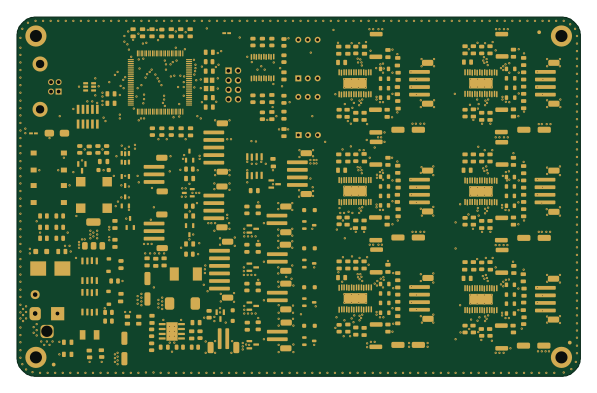
LumenPnP Motherboard
opulo-inc
149 × 95 mm296 parts4LCC-BY-SA-4.03.7k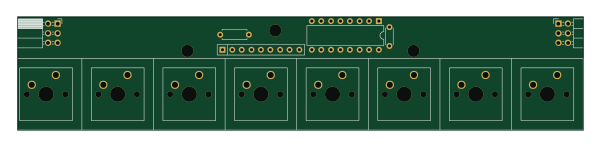 STM32
Type a
google
150 × 30 mm14 parts2LApache-2.02.9k STM32
Type g
169 × 30 mm24 parts2LApache-2.02.9k STM32
Main panel
234 × 84 mm26 parts4LApache-2.02.9k STM32
Base
52.3 × 52.3 mm36 parts2LApache-2.02.9k STM32
Type c
188 × 30 mm17 parts2LApache-2.02.9k