
Pocket 2.66 E-reader

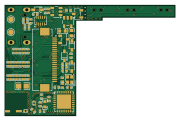
About the Pocket 2.66 E-reader PCB
Pocket 2.66 E-reader is an open source ESP32 PCB design by quintenluyten2, published on GitHub. It is a 4-layer board measuring 45 × 29.2 mm, with 70 components from 32 distinct parts.
Its main chip is the ESP32-C3FH4, from the ESP32 family. Other key parts include the LCK-TF-027H30008-WLG, GX4054, GS2019-33TR5, STC3115AIQT and SRV05-4-P-T7. By type, the board carries 23 capacitors, 21 resistors, 6 ICs, 5 diodes, 4 inductors and 3 connectors.
It belongs with the displays & leds, power & battery and iot & wireless designs in this gallery.
From the project
PCB for 2.13" and 2.66" E-ink displays with ESP32-C3, micro-SD card, battery management, and 3 user buttons
A compact e-reader PCB built around a 2.13"/2.66" e-ink display and the ESP32-C3FH4 microcontroller.
- MCU: ESP32-C3FH4 (RISC-V, 2.4 GHz Wi-Fi + BLE, 4 MB flash) - Display: 2.13"/2.66" e-ink, connected via 24-pin FPC - Power: USB-C input, single-cell Li-Po with GX4054 charger and BQ27220 fuel gauge - Storage: micro-SD card slot - Connectivity: On-board SMD 2.4 GHz antenna (Not yet matched to 35 Ohm) - Form factor: 4-layer 1 mm PCB, min trace 0.12 mm, min via 0.3/0.4 mm (designed for JLCPCB)
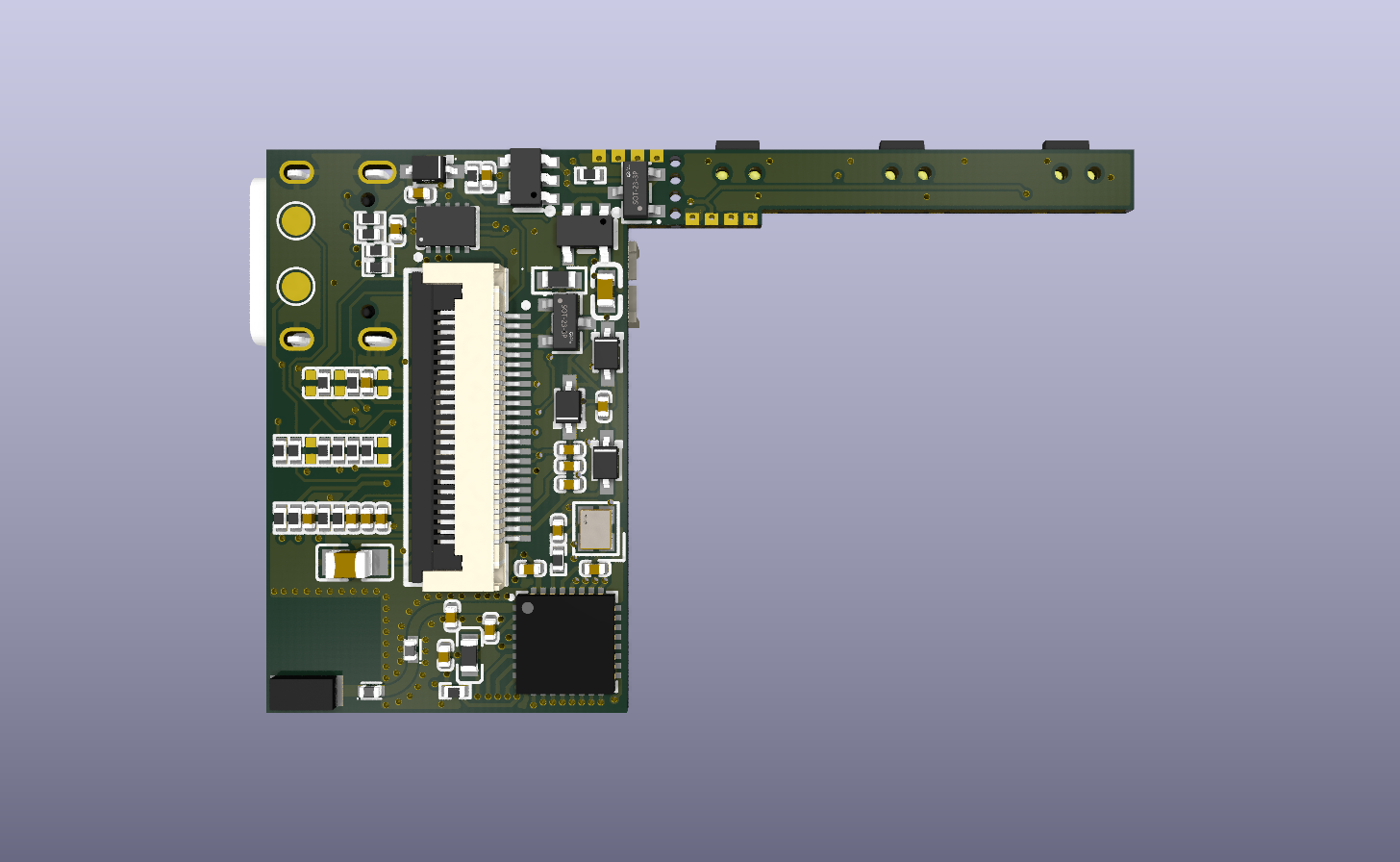
Main components on the Pocket 2.66 E-reader
Pocket 2.66 E-reader bill of materials (BOM)
70 components, 32 distinct parts — part numbers from the project's BOM.
| Qty | Part | Footprint | Refs |
|---|---|---|---|
| 1 | ESP32-C3FH4 ESPRESSIF | C2858491_QFN-32_L5_0-W5_0-P0_50-TL-EP3_7 | U1 |
| 1 | LCK-TF-027H30008-WLG LCKELEC | C50380692_TF-SMD_HYCW104-TF08-375B | U2 |
| 1 | GX4054 GUOXIN JIAPIN SEMICONDUCTOR | SOT-23-5 | U3 |
| 1 | GS2019-33TR5 Gainsil | SOT-23-5 | U4 |
| 1 | STC3115AIQT ST Microelectronics | C2688637_DFN-10_L3_0-W2_0-P0_50-BL | U5 |
| 1 | SRV05-4-P-T7 ESD-USB PROTEK | C85364_SOT-23-6_L2_9-W1_6-P0_95-LS2_8-BR | U6 |
| 1 | HL2300 R+O | SOT23-3 | Q1 |
| 1 | HL2305 R+O | SOT23-3 | Q2 |
| 1 | XL7EL89CLI-111YLC-40M 40MHz 9pF 2016 YXC Crystal Oscillators | C49304717_CRYSTAL-SMD_4P-L2_0-W1_6-BL | X1 |
| 1 | USB-TYPE-C-018 DEALON | C2927038_USB-C_SMD-TYPE-C-31-M-12 | P1 |
| 1 | FPC-05F-24PH20 XUNPU | C2856805_FPC-SMD_24P-P0_50_FPC-05F-24PH20 | P3 |
| 1 | HX-1.25-2AWB hanxia | C52016406_CONN-SMD_2P-P1_25_HX-1_25-2AWB | P4 |
| 1 | H2U38D1E1B0100 2.45 Ghz 1206 Unictron | SMD_ANT_1206 | ANT2 |
| 1 | RL0603FR-070R025L 25mΩ YAGEO | R0603 | SH2 |
| 3 | TS-24CA-S16 JXTCONN | C42420265_SW-SMD_L4_7-W3_5-P3_35-EH | SW1, SW2, SW3 |
| 4 | 1N5819WS Schottky SOD-323 Guangdong Hottech | C191023_SOD-323_L1_8-W1_3-LS2_5-RD | D1, D2, D3, D20 |
| 1 | KT-0603R RED Hubei KENTO Elec | C2286_LED0603-RD | D4 |
| 1 | BLM18PG121SN1D BLM18PG121SN1D_C14709 muRata | C14709_L0603 | FB1 |
| 1 | SRTC.252010.YB220MT00 22uH 600mA SOREDE | C48689518_L1008 | L1 |
| 1 | LQW15AN8N2G00D 8.2nH 0402 muRata | L0402 | L2 |
Show 12 more
| Qty | Part | Footprint | Refs |
|---|---|---|---|
| 1 | LQW15AN1N6C00D 1.6nH 0402 muRata | L0402 | L3 |
| 4 | CL05A475MP5NRNC 4.7uF 10V Samsung Electro-Mechanics | C0402 | C0, C19, C22, C24 |
| 14 | CL05A105KA5NQNC 1uF Samsung Electro-Mechanics | C0402 | C1, C2, C3, C4, C5, C6, C7, C11 +6 |
| 1 | CL21A475KAQNNNE 4.7uF 25V Samsung Electro-Mechanics | C1779_C0805 | C8 |
| 1 | GJM1555C1HR70WB01D 0.7pF 0402 muRata | C0402 | C10 |
| 2 | 0402CG150J500NT 15pF FH | C0402 | C16, C17 |
| 1 | CL10A226MQ8NRNC 22uF Samsung Electro-Mechanics | C59461_C0603 | C21 |
| 1 | 0603WAF220KT5E 2.2Ω UNI-ROYAL | R0603 | R1 |
| 12 | 0402WGF1002TCE 10KΩ UNI-ROYAL | R0402 | R2, R5, R8, R11, R12, R13, R14, R15 +4 |
| 3 | 0402WGF220JTCE 22Ω UNI-ROYAL | R0402 | R6, R7, R18 |
| 2 | 0402WGF5101TCE 5.1KΩ UNI-ROYAL | R0402 | R9, R10 |
| 3 | 0402WGF2001TCE 2KΩ UNI-ROYAL | R0402 | R20, R21, R22 |
Pocket 2.66 E-reader design files
The KiCad project lives in the quintenluyten2/Pocket_2.66_E-reader_PCB repository on GitHub; these links point at the commit this page was built from.
Pocket 2.66 E-reader: common questions
What microcontroller does the Pocket 2.66 E-reader use?
The Pocket 2.66 E-reader is built around the ESP32-C3FH4, from the ESP32 family.
How big is the Pocket 2.66 E-reader PCB?
The Pocket 2.66 E-reader measures 45 × 29.2 mm, has 4 copper layers and is 1.0412 mm thick.
How many components are on the Pocket 2.66 E-reader?
70 components, from 32 distinct parts, with part numbers taken from the project's own BOM. The full bill of materials is listed on this page.
Where can I download the Pocket 2.66 E-reader design files?
From the quintenluyten2/Pocket_2.66_E-reader_PCB repository on GitHub, which has the KiCad layout, the schematic and the BOM; the links under Design files point to each one.
Can I use the Pocket 2.66 E-reader design in my own project?
The repository has no license, so all rights stay with quintenluyten2. Use it as a reference, and ask the author before reusing the design.
Can I test firmware for the Pocket 2.66 E-reader without the hardware?
Yes. HardLabs builds a simulation of the board from its netlist and BOM, so you can run and debug ESP32 firmware against it before you order a PCB.
Similar boards
 ESP32
ESP32Open Book Abridged Edition
joeycastillo
85 × 115 mm65 parts2LCC-BY-SA-4.08.1k ESP32
ESP32Esp32 minimal
atopile
36.2 × 26.8 mm20 parts2LMIT4.0k ESP32
ESP32Badge
56.3 × 39 mm239 parts4LMIT4.0k ESP32
ESP32Controller
StuckAtPrototype
29 × 74 mm58 parts4LApache-2.03.8k ESP32
ESP32Racer
36 × 50.2 mm70 parts4LApache-2.03.8k ESP32
ESP32Bitaxe
skot
56.5 × 99.8 mm86 parts4LCERN-OHL-S-2.01.4k