
PocketBeagleCommandStation

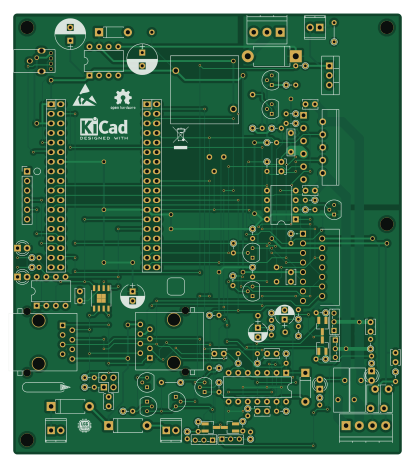
About the PocketBeagleCommandStation PCB
PocketBeagleCommandStation is an open source PCB design by RobertPHeller, published on GitHub under the CC-BY-4.0 license. It is a 2-layer board measuring 102.9 × 116.7 mm, with 112 components from 67 distinct parts.
Other key parts include the LM2574N-5.0, TCAN332DR, LMD18200, L298N and LM358. By type, the board carries 44 resistors, 17 transistors, 17 capacitors, 9 connectors, 9 diodes and 8 ICs.
From the project
Command Stations and Boosters
Through hole version of the PocketBeagle LCC/DCC Command Station. This is a DCC command station that is a LCC node. It implements the OpenLCB train protocol node over LCC and converts that to DCC commands. It includes a booster and puts the DCC signal on the LCC bus (pins 4 and 5). It implements a programming track and implements Railcom. The Command Station uses a PocketBeagle as the processing element and uses the PRUs (Programmable Realtime Units) to generate the DCC signal. (See PocketBeagleCommandStation_SMD for a SMD version.)
Main components on the PocketBeagleCommandStation
PocketBeagleCommandStation bill of materials (BOM)
112 components, 67 distinct parts.
| Qty | Part | Footprint | Refs |
|---|---|---|---|
| 1 | LM2574N-5.0 | DIP-8_W7.62mm | U1 |
| 1 | TCAN332DR | SOIC-8-1EP_3.9x4.9mm_Pitch1.27mm | U2 |
| 1 | LMD18200 | TO220_11PIN_VERT | U3 |
| 1 | L298N | TO127P2020X500X2100-15 | U4 |
| 2 | LM358 | DIP-8_W7.62mm | U5, U8 |
| 1 | LM339 | DIP-14_W7.62mm | U6 |
| 1 | TMP36 | TO-92_Molded_Narrow | U7 |
| 1 | 2N3906 | TO-92_Molded_Narrow | Q1 |
| 1 | TP0606 | TO-92_Molded_Narrow | Q2 |
| 2 | 2N3904 | TO-92_Molded_Narrow | Q3, Q4 |
| 4 | STD12NF06 | TO-251_IPAK_Vertical | Q5, Q12, Q14, Q17 |
| 4 | 2N7000 | TO-92_Molded_Narrow | Q6, Q8, Q10, Q11 |
| 4 | DTC143E | SOT-23_Handsoldering | Q7, Q9, Q15, Q16 |
| 1 | TIP120 | TO-220_Vertical | Q13 |
| 1 | DCC Output to Tracks | TerminalBlock_Pheonix_PT-3.5mm_4pol | J1 |
| 1 | Termination | Pin_Header_Straight_2x02_Pitch2.54mm | J2 |
| 2 | RJ45 | RJ45_8N-S | J3, J4 |
| 1 | Fan | TerminalBlock_Pheonix_MPT-2.54mm_2pol | J5 |
| 1 | Console | Pin_Header_Straight_1x06_Pitch2.54mm | J6 |
| 1 | USB_A | USB-A-UPRIGHT | J101 |
Show 47 more
| Qty | Part | Footprint | Refs |
|---|---|---|---|
| 2 | POCKETBEAGLE-Header | pin_socket_18x2 | P1, P2 |
| 2 | 3A | Fuse_BelFuse_0ZRE0033FF_L11.4mm_W3.8mm | F101, F102 |
| 2 | 300ma | Fuse_Bourns_MF-RG300 | F103, F104 |
| 1 | DCC Power In | TerminalBlock_Pheonix_PT-3.5mm_3pol | T1 |
| 1 | LCC Power Out | TerminalBlock_Pheonix_MPT-2.54mm_2pol | T2 |
| 1 | LCC Power In | TerminalBlock_Pheonix_MPT-2.54mm_2pol | T3 |
| 1 | SB530 | D_DO-201AD_P12.70mm_Horizontal | D1 |
| 1 | SB160 | D_DO-41_SOD81_P7.62mm_Horizontal | D2 |
| 2 | SB240 | D_DO-15_P10.16mm_Horizontal | D3, D4 |
| 1 | CAN Tx | LED_D3.0mm | D5 |
| 1 | CAN Rx | LED_D3.0mm | D6 |
| 1 | 1N5817 | D_DO-41_SOD81_P7.62mm_Horizontal | D7 |
| 2 | DCC Activity | LED_D3.0mm | D8, D9 |
| 1 | 330 mh | PE-LowProfile | L1 |
| 4 | 10 nf | C_Rect_L4.0mm_W2.5mm_P2.50mm | C1, C2, C11, C12 |
| 1 | 220 uf 25V | CP_Radial_D8.0mm_P3.50mm | C3 |
| 1 | 22 uf 100V | CP_Radial_D8.0mm_P3.50mm | C4 |
| 2 | 1 uf | CP_Radial_D5.0mm_P2.50mm | C5, C17 |
| 1 | .1 uf | C_Rect_L4.0mm_W2.5mm_P2.50mm | C6 |
| 1 | 47 nf | C_Rect_L4.0mm_W2.5mm_P2.50mm | C7 |
| 1 | 15 uf 15V | CP_Radial_D6.3mm_P2.50mm | C8 |
| 1 | 1 uf | C_Rect_L7.0mm_W2.0mm_P5.00mm | C9 |
| 2 | 100 nf | C_Rect_L4.0mm_W2.5mm_P2.50mm | C10, C13 |
| 3 | 33pf | C_Rect_L4.0mm_W2.5mm_P2.50mm | C14, C15, C16 |
| 4 | 2.4 Ohms | R_Axial_DIN0204_L3.6mm_D1.6mm_P2.54mm_Vertical | R1, R2, R20, R24 |
| 2 | 4.7K Ohms | R_Axial_DIN0204_L3.6mm_D1.6mm_P2.54mm_Vertical | R3, R7 |
| 1 | 3.24K Ohms, 1% | R_Axial_DIN0204_L3.6mm_D1.6mm_P2.54mm_Vertical | R4 |
| 1 | 19.1 Ohms 1% | R_Axial_DIN0204_L3.6mm_D1.6mm_P2.54mm_Vertical | R5 |
| 1 | 2.7 Ohms | R_Axial_DIN0204_L3.6mm_D1.6mm_P2.54mm_Vertical | R6 |
| 2 | 60 Ohms | R_Axial_DIN0204_L3.6mm_D1.6mm_P2.54mm_Vertical | R8, R9 |
| 5 | 20K Ohms | R_Axial_DIN0204_L3.6mm_D1.6mm_P2.54mm_Vertical | R10, R11, R12, R21, R22 |
| 1 | 1.5K Ohms | R_Axial_DIN0204_L3.6mm_D1.6mm_P2.54mm_Vertical | R13 |
| 4 | 1K Ohms | R_Axial_DIN0204_L3.6mm_D1.6mm_P2.54mm_Vertical | R14, R15, R17, R30 |
| 1 | .15 Ohms | R_Axial_DIN0204_L3.6mm_D1.6mm_P2.54mm_Vertical | R16 |
| 4 | 10K Ohms | R_Axial_DIN0204_L3.6mm_D1.6mm_P2.54mm_Vertical | R18, R19, R23, R26 |
| 1 | 1.5K Ohms 1/2W | R_Axial_DIN0204_L3.6mm_D1.6mm_P5.08mm_Vertical | R25 |
| 3 | 2.4K Ohms | R_Axial_DIN0204_L3.6mm_D1.6mm_P2.54mm_Vertical | R27, R28, R29 |
| 1 | 56 Ohms 1/2 watt | R_Axial_DIN0204_L3.6mm_D1.6mm_P5.08mm_Vertical | R31 |
| 1 | 24.9 | R_Axial_DIN0204_L3.6mm_D1.6mm_P1.90mm_Vertical | R32 |
| 2 | 24.9 Ohms | R_Axial_DIN0204_L3.6mm_D1.6mm_P2.54mm_Vertical | R33, R35 |
| 1 | 10K Ohms | R_Axial_DIN0204_L3.6mm_D1.6mm_P1.90mm_Vertical | R34 |
| 1 | 24.9 Ohms | R_Axial_DIN0204_L3.6mm_D1.6mm_P1.90mm_Vertical | R36 |
| 1 | 3.24K Ohms, 1% | R_Axial_DIN0204_L3.6mm_D1.6mm_P1.90mm_Vertical | R37 |
| 1 | 102 Ohms 1% | R_Axial_DIN0204_L3.6mm_D1.6mm_P1.90mm_Vertical | R38 |
| 2 | 160 Ohms | R_Axial_DIN0204_L3.6mm_D1.6mm_P1.90mm_Vertical | R39, R40 |
| 2 | 3K Ohms | R_Axial_DIN0204_L3.6mm_D1.6mm_P1.90mm_Vertical | R41, R42 |
| 2 | 1K | R_Axial_DIN0204_L3.6mm_D1.6mm_P2.54mm_Vertical | R501, R502 |
PocketBeagleCommandStation design files
The KiCad project lives in the RobertPHeller/CommandStationsAndBoosters repository on GitHub; these links point at the commit this page was built from.
PocketBeagleCommandStation: common questions
How big is the PocketBeagleCommandStation PCB?
The PocketBeagleCommandStation measures 102.9 × 116.7 mm, has 2 copper layers and is 1.6 mm thick.
How many components are on the PocketBeagleCommandStation?
112 components, from 67 distinct parts. The full bill of materials is listed on this page.
Where can I download the PocketBeagleCommandStation design files?
From the RobertPHeller/CommandStationsAndBoosters repository on GitHub, which has the KiCad layout; the links under Design files point to each one.
Can I use the PocketBeagleCommandStation design in my own project?
Yes, under the terms of its CC-BY-4.0 license, which RobertPHeller chose for the repository.
More boards in CommandStationsAndBoosters
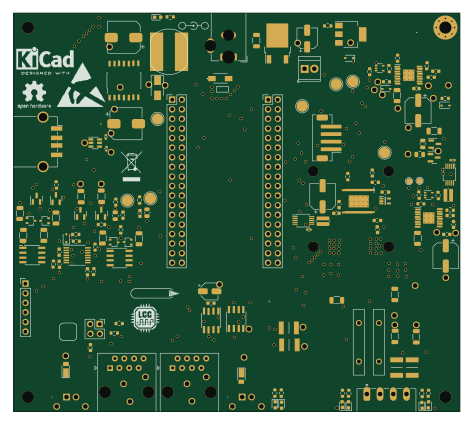
PocketBeagleCommandStation SMD
118.1 × 105.4 mm131 parts4LCC-BY-4.00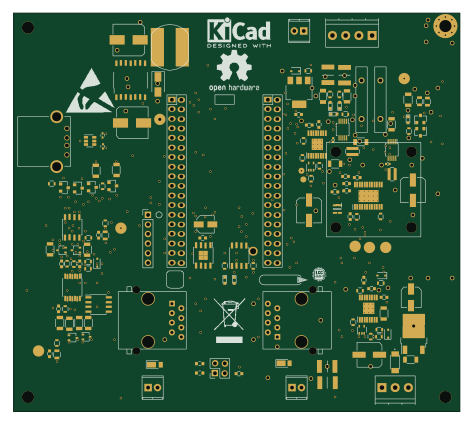
PocketBeagleCommandStation SMD RevB 2L
118.1 × 105.4 mm128 parts2LCC-BY-4.00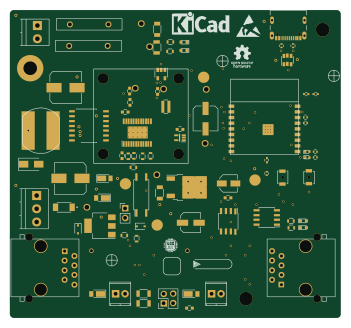 ESP32
ESP32ESP32-C3-Booster
87.6 × 81.5 mm80 parts2LCC-BY-4.00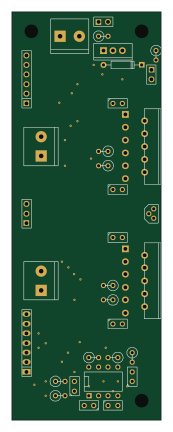
BBBCommandStation
39.4 × 108 mm68 parts2LCC-BY-4.00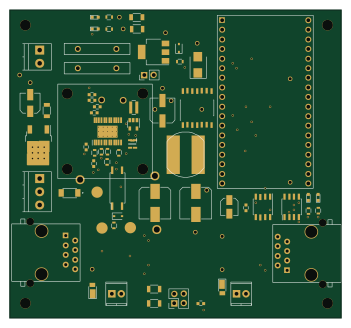
TTGO-T1-Booster
87.6 × 81.5 mm62 parts2LCC-BY-4.00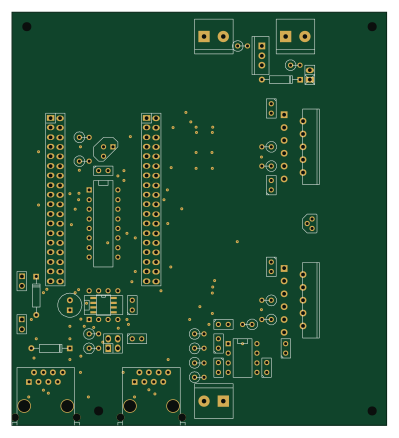
PBCommandStation
99.1 × 109.2 mm50 parts2LCC-BY-4.00