
Boardroom

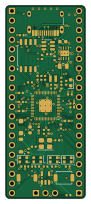
About the Boardroom PCB
Boardroom is an open source RP2040/RP2350 PCB design by sequoia-hope, published on GitHub under the MIT license. It is a 4-layer board measuring 21 × 51 mm, with 54 components from 27 distinct parts.
Its main chip is the RP2350A, from the RP2040/RP2350 family. Other key parts include the USBLC6-2SC6, AP7361C-33FGE-7, SN74LV1T125DBVR and W25Q128JVSIQ. By type, the board carries 25 capacitors, 12 resistors, 7 diodes, 5 ICs, 2 switches and 1 crystal.
It belongs with the dev boards & breakouts designs in this gallery.
From the project
Start a KiCad board project with Claude Code: a phased design skill with independent review gates, and a schematic/PCB/3D viewer (pcbview)
An RP2350A development board (USB-C, 16 MB flash, all 30 GPIO on breadboard headers, 21 × 51 mm; Pico-sized but not Pico pin-compatible: a Pico carrier would put 5 V on GPIO29), designed with this template's pcb-design skill from phase 0 to fab outputs. Read it gate by gate:
Fab files: hw/easy2350/a/fab/ (gerbers, JLC BOM and CPL, STEP). Bring-up: design/bringup.md. Board scripts: scripts/board.py (placement, routing, finish, silk), scripts/fab.py.
Main components on the Boardroom
Boardroom bill of materials (BOM)
54 components, 27 distinct parts — part numbers from the project's BOM.
| Qty | Part | Footprint | Refs |
|---|---|---|---|
| 1 | RP2350A Raspberry Pi | RP2350-QFN-60-1EP_7x7_P0.4mm_EP3.4x3.4mm_ThermalVias | U1 |
| 1 | USBLC6-2SC6 STMicroelectronics | SOT-23-6 | U2 |
| 1 | AP7361C-33FGE-7 AP7361C-33FGE Diodes Incorporated | DFN-8-1EP_3x3mm_P0.65mm_EP1.5x2.25mm_ThermalVias | U3 |
| 1 | SN74LV1T125DBVR Texas Instruments | SOT-23-5 | U4 |
| 1 | W25Q128JVSIQ Winbond | SOIC-8_5.3x5.3mm_P1.27mm | U5 |
| 1 | ABM8-272-T3 12MHz Abracon | Crystal_SMD_3225-4Pin_3.2x2.5mm | Y1 |
| 1 | TYPE-C-31-M-12 USB-C Korean Hroparts Elec | USB_C_Receptacle_HRO_TYPE-C-31-M-12 | J1 |
| 1 | TS-1088-AR02016 BOOTSEL XUNPU | SW_SPST_TS-1088-xR020 | SW1 |
| 1 | TS-1088-AR02016 RESET XUNPU | SW_SPST_TS-1088-xR020 | SW2 |
| 1 | KT-0603R RED Hubei KENTO Elec | LED_0603_1608Metric | D1 |
| 1 | SM4007PL MDD | D_SOD-123F_MDD | D2 |
| 4 | WS2812B-2020-V6 Worldsemi | LED_WS2812B-2020_PLCC4_2.0x2.0mm | D3, D4, D5, D6 |
| 1 | BZT52B5V1 R+O | D_SOD-123 | D7 |
| 1 | AOTA-B201610S3R3-101-T 3.3u Abracon | L_pol_2016 | L1 |
| 16 | CL05B104KO5NNNC 100n Samsung Electro-Mechanics | C_0402_1005Metric | C1, C4, C5, C6, C7, C8, C9, C11 +8 |
| 1 | CL10A225KO8NNNC 2.2u Samsung Electro-Mechanics | C_0603_1608Metric | C2 |
| 1 | CL21A106KAYNNNE 10u Samsung Electro-Mechanics | C_0805_2012Metric | C3 |
| 2 | CL05A475MP5NRNC 4.7u Samsung Electro-Mechanics | C_0402_1005Metric | C13, C16 |
| 2 | CL05A475MP5NRNC 4.7u Samsung Electro-Mechanics | C_0402_1005Metric_small_pads | C14, C15 |
| 2 | 0402CG150J500NT 15p FH | C_0402_1005Metric | C20, C21 |
Show 7 more
| Qty | Part | Footprint | Refs |
|---|---|---|---|
| 1 | CL10A475KO8NNNC 4.7u Samsung Electro-Mechanics | C_0603_1608Metric | C23 |
| 2 | 0402WGF5101TCE 5.1k UNI-ROYAL | R_0402_1005Metric | R1, R2 |
| 2 | 0402WGF330JTCE 33R UNI-ROYAL | R_0402_1005Metric | R3, R10 |
| 2 | 0402WGF270JTCE 27R UNI-ROYAL | R_0402_1005Metric | R4, R5 |
| 4 | 0402WGF1001TCE 1k UNI-ROYAL | R_0402_1005Metric | R6, R7, R8, R9 |
| 1 | 0402WGF4701TCE 4.7k UNI-ROYAL | R_0402_1005Metric | R11 |
| 1 | 0402WGF1003TCE 100k UNI-ROYAL | R_0402_1005Metric | R12 |
Boardroom design files
The KiCad project lives in the sequoia-hope/boardroom repository on GitHub; these links point at the commit this page was built from.
Boardroom: common questions
What microcontroller does the Boardroom use?
The Boardroom is built around the RP2350A, from the RP2040/RP2350 family.
How big is the Boardroom PCB?
The Boardroom measures 21 × 51 mm, has 4 copper layers and is 1.6 mm thick.
How many components are on the Boardroom?
54 components, from 27 distinct parts, with part numbers taken from the project's own BOM. The full bill of materials is listed on this page.
Where can I download the Boardroom design files?
From the sequoia-hope/boardroom repository on GitHub, which has the KiCad layout, the schematic and the BOM; the links under Design files point to each one.
Can I use the Boardroom design in my own project?
Yes, under the terms of its MIT license, which sequoia-hope chose for the repository.
Can I test firmware for the Boardroom without the hardware?
Yes. HardLabs builds a simulation of the board from its netlist and BOM, so you can run and debug RP2040/RP2350 firmware against it before you order a PCB.
Similar boards
 RP2040/RP2350
OSO-BOOK-C1
joeycastillo
85 × 115 mm29 parts2LCC-BY-SA-4.08.1k RP2040/RP2350
Corne cherry
foostan
277.2 × 107.5 mm164 parts2LCC-BY-4.07.7k RP2040/RP2350
Corne chocolate
277.2 × 107.5 mm164 parts2LCC-BY-4.07.7k RP2040/RP2350
Jitx design
gusmanb
55.5 × 65 mm26 parts4LGPL-3.05.0k RP2040/RP2350
LogicAnalyzer
57 × 55.2 mm6 parts2LGPL-3.05.0k RP2040/RP2350
Main
google
98 × 71 mm102 parts2LApache-2.02.9k