
PCB-Drone

About the PCB-Drone
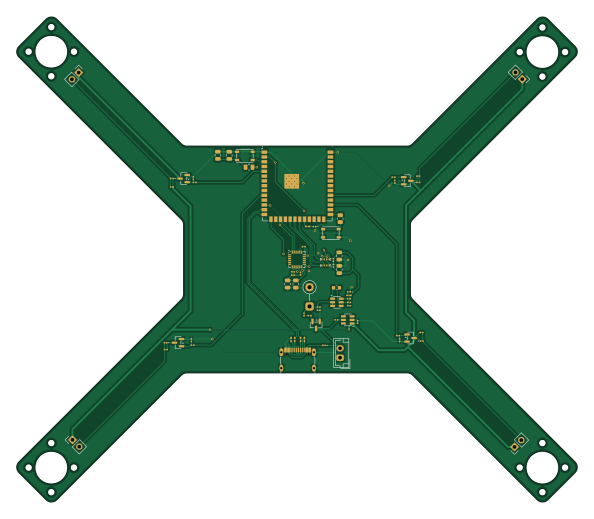
PCB-Drone is an open source ESP32 PCB design by shourya2007mittal-hub, published on GitHub. It is a 2-layer board measuring 148.3 × 128.3 mm, with 68 components from 35 distinct parts.
Its main chip is the ESP32-S3-WROOM-1, from the ESP32 family. Other key parts include the MT3608, AP63203WU, MPU-6050 and BMP280. By type, the board carries 23 capacitors, 16 resistors, 8 diodes, 5 ICs, 5 transistors and 4 modules.
It belongs with the robotics & motion, sensors and iot & wireless designs in this gallery.
From the project
So I made a custom PCB based on Esp32 . It holds an IMU and a Barometer for control . It has a normal 4 Motor Layout 2 motors will move clock wise and 2 will be anti-clock wise direction. Same direction motor will be diagonally apposite to each other. It have used a 3.7V battery
So I made a custom PCB based on Esp32 . It holds an IMU and a Barometer for control . It has a normal 4 Motor Layout 2 motors will move clock wise and 2 will be anti-clock wise direction. Same direction motor will be diagonally apposite to each other. It have used a 3.7V battery for power and a boot converter so that I can provide 5V to the Motors as we are using ESP32 so we could controle it by our phone through bluetooth .I have also design a web based controller , So that you could connect and controle the Bionic-Bird through your phone.
Main components on the PCB-Drone
PCB-Drone bill of materials (BOM)
68 components, 35 distinct parts.
| Qty | Part | Footprint | Refs |
|---|---|---|---|
| 1 | MT3608 | SOT-23-6 | U1 |
| 1 | AP63203WU | TSOT-23-6 | U2 |
| 1 | MPU-6050 | InvenSense_QFN-24_4x4mm_P0.5mm | U3 |
| 1 | BMP280 | Bosch_LGA-8_2x2.5mm_P0.65mm_ClockwisePinNumbering | U4 |
| 1 | ESP32-S3-WROOM-1 | ESP32-S3-WROOM-1 | U5 |
| 4 | Motor_DC | PinHeader_1x02_P2.54mm_Vertical | M1, M2, M3, M4 |
| 1 | AO3401A | SOT-23 | Q1 |
| 4 | AO3400A | SOT-23 | Q2, Q3, Q4, Q5 |
| 1 | USB_C_Receptacle_USB2.0_16P | USB_C_Receptacle_G-Switch_GT-USB-7010ASV | J1 |
| 1 | Conn_01x02_Pin | JST_EH_B2B-EH-A_1x02_P2.50mm_Vertical | J2 |
| 1 | Polyfuse | C_0201_0603Metric | F1 |
| 2 | SW_Push | SW_SPST_PTS810 | SW1, SW2 |
| 2 | LED | LED_0201_0603Metric | D1, D3 |
| 1 | D | D_0201_0603Metric | D2 |
| 4 | D_Schottky | D_0201_0603Metric | D4, D5, D6, D7 |
| 1 | 1N4001 | D_DO-41_SOD81_P5.08mm_Vertical_KathodeUp | D8 |
| 1 | 2.2uh | L_0201_0603Metric | L1 |
| 1 | 4.7uf | L_0603_1608Metric | L2 |
| 6 | C | C_0805_2012Metric | C1x1, C2x1, C3x1, C4x1, C5(1uf)1, C6(100nf)1 |
| 1 | 47uf | C_0201_0603Metric | C2 |
Show 15 more
| Qty | Part | Footprint | Refs |
|---|---|---|---|
| 1 | 10uf | C_0201_0603Metric | C3 |
| 1 | 100nf | C_0201_0603Metric | C4 |
| 1 | 22u | C_0201_0603Metric | C5 |
| 1 | 22uf | C_0201_0603Metric | C6 |
| 4 | 50nf | C_0201_0603Metric | C7, C8, C15, C16 |
| 2 | 0.1uf | C_0201_0603Metric | C9, C10 |
| 3 | 10 uf | C_0201_0603Metric | C11, C18, C19 |
| 1 | 0.1 uf | C_0201_0603Metric | C12 |
| 2 | 100 nf | C_0201_0603Metric | C13, C14 |
| 2 | 33 R | R_0201_0603Metric_Pad0.64x0.40mm_HandSolder | R1, R2 |
| 2 | R | R_0805_2012Metric | R1(10k)1, R2(100R)1 |
| 2 | 50K | R_0201_0603Metric_Pad0.64x0.40mm_HandSolder | R3, R4 |
| 2 | 1K | R_0201_0603Metric_Pad0.64x0.40mm_HandSolder | R6, R7 |
| 4 | 100R | R_0201_0603Metric | R8, R10, R12, R14 |
| 4 | 10K R | R_0201_0603Metric | R9, R11, R13, R15 |
PCB-Drone design files
The KiCad project lives in the shourya2007mittal-hub/PCB-Drone repository on GitHub; these links point at the commit this page was built from.
- LayoutPCB/PCB-DRONE.kicad_pcb
- SchematicPCB/PCB-DRONE.kicad_sch
PCB-Drone: common questions
What microcontroller does the PCB-Drone use?
The PCB-Drone is built around the ESP32-S3-WROOM-1, from the ESP32 family.
How big is the PCB-Drone?
The PCB-Drone measures 148.3 × 128.3 mm, has 2 copper layers and is 1.6 mm thick.
How many components are on the PCB-Drone?
68 components, from 35 distinct parts. The full bill of materials is listed on this page.
Where can I download the PCB-Drone design files?
From the shourya2007mittal-hub/PCB-Drone repository on GitHub, which has the KiCad layout and the schematic; the links under Design files point to each one.
Can I use the PCB-Drone design in my own project?
The repository has no license, so all rights stay with shourya2007mittal-hub. Use it as a reference, and ask the author before reusing the design.
Can I test firmware for the PCB-Drone without the hardware?
Yes. HardLabs builds a simulation of the board from its netlist and BOM, so you can run and debug ESP32 firmware against it before you order a PCB.
Similar boards
 ESP32
ESP32Open Book Abridged Edition
joeycastillo
85 × 115 mm65 parts2LCC-BY-SA-4.08.1k ESP32
ESP32Powertrain
byrantech
64 × 45.4 mm171 parts4LMIT4.3k ESP32
ESP32Esp32 minimal
atopile
36.2 × 26.8 mm20 parts2LMIT4.0k ESP32
ESP32Badge
56.3 × 39 mm239 parts4LMIT4.0k ESP32
ESP32Controller
StuckAtPrototype
29 × 74 mm58 parts4LApache-2.03.8k ESP32
ESP32Racer
36 × 50.2 mm70 parts4LApache-2.03.8k