
SAVITAR-V2

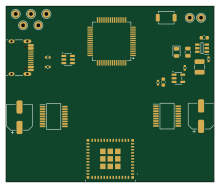
About the SAVITAR-V2 PCB
SAVITAR-V2 is an open source ESP32 PCB design by alexandru-mot, published on GitHub. It is a 4-layer board measuring 54.9 × 46.3 mm, with 135 components from 45 distinct parts.
Its main chip is the ESP32-C3-MINI-1-H4X, from the ESP32 family. Other key parts include the MT2492, USBLC6-2SC6, TLV75733PDBV and QRE1113GR. By type, the board carries 54 resistors, 29 capacitors, 21 ICs, 9 transistors, 4 diodes and 2 test points.
It belongs with the robotics & motion and iot & wireless designs in this gallery.
From the project
KiCad Project of the SAVITAR V2 LFR
Line-follower robot mainboard, designed in KiCad 10.
- MCU: ATSAMD51J19A (main), ESP32-C3-MINI-1 (wireless/telemetry) - USB: USB-C input with USBLC6-2 ESD protection and an FSUSB42 USB mux - Power: MT2492 buck converter + TLV75733 LDO - Motor drive: dual DRV8874 H-bridges with INA240 current sensing (see the "Motor" netclass in the project settings) - Line sensing: QRE1113GR IR-reflectance array, muxed through 74HC4051/74HC238, driven via a TBD62083 array, connected over FFC to the main board
Main components on the SAVITAR-V2
SAVITAR-V2 bill of materials (BOM)
135 components, 45 distinct parts — part numbers from the project's BOM.
| Qty | Part | Footprint | Refs |
|---|---|---|---|
| 1 | MT2492 | SOT95P280X145-6N | IC1 |
| 1 | USBLC6-2SC6 | SOT-23-6 | U1 |
| 1 | ESP32-C3-MINI-1-H4X ATSAMD51J19A-A | TQFP-64_10x10mm_P0.5mm | U2 |
| 1 | ESP32-C3-MINI-1-H4X | ESP32C3MINI1H4X | U3 |
| 1 | TLV75733PDBV | SOT-23-5 | U4 |
| 16 | QRE1113GR | OnSemi_CASE100CY | U5, U6, U7, U8, U9, U10, U11, U12 +8 |
| 1 | MMBT3904 | SOT-23 | Q1 |
| 8 | BSS138 | SOT-23 | Q2, Q3, Q4, Q5, Q6, Q7, Q8, Q9 |
| 1 | 74HC238D,653 | 74HC238D653 | DEMUX1 |
| 2 | DRV8874PWPR | SOP65P640X155-18N | DRV1, DRV2 |
| 1 | TS-1088-AR02016 | SW_SPST_TS-1088-xR020 | SW1 |
| 5 | TestPoint | TestPoint_THTPad_D2.0mm_Drill1.0mm | SWD_CLK1, SWD_GND1, SWD_IO1, SWD_PWR1, SWD_RST1 |
| 2 | TestPoint | TestPoint_THTPad_D2.0mm_Drill1.0mm | TP1, TP2 |
| 4 | TestPoint | TestPoint_THTPad_2.0x2.0mm_Drill1.0mm | TPA1, TPA2, TPB1, TPB2 |
| 1 | USB_C_Receptacle_USB2.0_16P | USB_C_Receptacle_HRO_TYPE-C-31-M-12 | USBC1 |
| 4 | SML-D12D8WT86 | LED_0603_1608Metric | D1, D2, D3, D4 |
| 1 | 380mΩ 500mA | L_0603_1608Metric | FB1 |
| 1 | 6.8uH | L_1210_3225Metric | L1 |
| 1 | 10uF (X7R) | C_0603_1608Metric | C1 |
| 2 | 100nF/16V | C_0402_1005Metric | C2, C13 |
Show 25 more
| Qty | Part | Footprint | Refs |
|---|---|---|---|
| 6 | 100nF/50V | C_0402_1005Metric | C3, C7, C14, C18, C25, C28 |
| 3 | 22nF/50V | C_0402_1005Metric | C4, C15, C19 |
| 1 | 1uF (X7R) | C_0402_1005Metric | C5 |
| 2 | 100uF/25V | CP_Elec_6.3x5.8 | C6, C17 |
| 1 | 100nF (X7R) | C_0402_1005Metric | C8 |
| 3 | 100nF | C_0402_1005Metric | C9, C10, C11 |
| 3 | 22uF/16V | C_0805_2012Metric | C12, C20, C23 |
| 1 | 22uF/25V | C_0805_2012Metric | C16 |
| 2 | 1uF/16V | C_0402_1005Metric | C21, C29 |
| 1 | 22pF | C_0603_1608Metric | C22 |
| 1 | 22uF/16V | LED_0805_2012Metric | C24 |
| 1 | 10uF/16V | C_0603_1608Metric | C26 |
| 1 | 2.2uF/16V | C_0402_1005Metric | C27 |
| 2 | 2.87kΩ(1%) | R_0402_1005Metric | R1, R8 |
| 10 | 10kΩ | R_0402_1005Metric | R2, R3, R4, R9, R12, R20, R23, R24 +2 |
| 2 | 10kΩ(1%) | R_0402_1005Metric | R5, R17 |
| 2 | 5.1kΩ | R_0402_1005Metric | R6, R7 |
| 4 | 510Ω | R_0402_1005Metric | R10, R11, R31, R32 |
| 2 | 100kΩ(1%) | R_0402_1005Metric | R13, R18 |
| 1 | 33kΩ(1%) | R_0402_1005Metric | R14 |
| 4 | 0Ω | R_0402_1005Metric | R15, R16, R25, R26 |
| 1 | 18.7kΩ(1%) | R_0402_1005Metric | R19 |
| 2 | 470Ω | R_0402_1005Metric | R21, R22 |
| 8 | 33Ω | R_0402_1005Metric | R27, R28, R29, R30, R33, R34, R35, R36 |
| 16 | 47kΩ | R_0402_1005Metric | R41, R42, R43, R44, R45, R46, R47, R48 +8 |
SAVITAR-V2 design files
The KiCad project lives in the alexandru-mot/SAVITAR-V2-PCB repository on GitHub; these links point at the commit this page was built from.
- LayoutSAVITAR_V2.kicad_pcb
- SchematicSAVITAR_V2.kicad_sch
- BOMBOM/SAVITAR_V2_BOM.csv
SAVITAR-V2: common questions
What microcontroller does the SAVITAR-V2 use?
The SAVITAR-V2 is built around the ESP32-C3-MINI-1-H4X, from the ESP32 family.
How big is the SAVITAR-V2 PCB?
The SAVITAR-V2 measures 54.9 × 46.3 mm, has 4 copper layers and is 1.6 mm thick.
How many components are on the SAVITAR-V2?
135 components, from 45 distinct parts, with part numbers taken from the project's own BOM. The full bill of materials is listed on this page.
Where can I download the SAVITAR-V2 design files?
From the alexandru-mot/SAVITAR-V2-PCB repository on GitHub, which has the KiCad layout, the schematic and the BOM; the links under Design files point to each one.
Can I use the SAVITAR-V2 design in my own project?
The repository has no license, so all rights stay with alexandru-mot. Use it as a reference, and ask the author before reusing the design.
Can I test firmware for the SAVITAR-V2 without the hardware?
Yes. HardLabs builds a simulation of the board from its netlist and BOM, so you can run and debug ESP32 firmware against it before you order a PCB.
Similar boards
 ESP32
ESP32Open Book Abridged Edition
joeycastillo
85 × 115 mm65 parts2LCC-BY-SA-4.08.1k ESP32
ESP32Badge
atopile
56.3 × 39 mm239 parts4LMIT4.0k ESP32
ESP32Esp32 minimal
36.2 × 26.8 mm20 parts2LMIT4.0k ESP32
ESP32Racer
StuckAtPrototype
36 × 50.2 mm70 parts4LApache-2.03.8k ESP32
ESP32Controller
29 × 74 mm58 parts4LApache-2.03.8k ESP32
ESP32Bitaxe
skot
56.5 × 99.8 mm86 parts4LCERN-OHL-S-2.01.4k