
ESP-Hiro

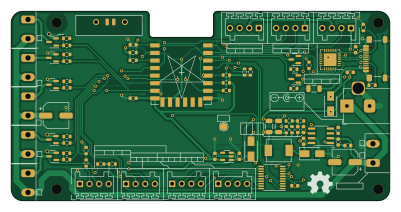
About the ESP-Hiro PCB
ESP-Hiro is an open source ESP8266 PCB design by Chrismettal, published on GitHub under the GPL-3.0 license. It is a 2-layer board measuring 100 × 50 mm, with 79 components from 34 distinct parts.
Its main chip is the ESP-12E, from the ESP8266 family. Other key parts include the CP2102N-A01-GQFN28, TPS54331D, TLV75533PDBVR and PCF8574A. By type, the board carries 30 resistors, 18 capacitors, 15 connectors, 7 transistors, 5 ICs and 3 diodes.
It belongs with the iot & wireless, sensors and power & battery designs in this gallery.
From the project
ESP-8266 Smart home dev board / general purpose IO for your home!
You can find the mostly assembled kit as well as 3D printed parts over at my tindie store!
If you like my work please consider supporting my caffeine addiction!
- Contents - What is this? - Pin tables - Devices - Defined I/O - MOSFETs - IR - Relays - I²C - PCF8574 - Temperature Sensors - 433MHz - ADC - Other - Software - Tasmota - Other - Build / aquire / use - Buying - Building my own - 3D printing - Mechanical - Power supply - Jumpers - V-USB -\> +5V - PCF8574 - IR resistor - Deep sleep - Uploading the Firmware - Templates - Tools used - Other boards - CP2102 USB - serial converter - 24 -…
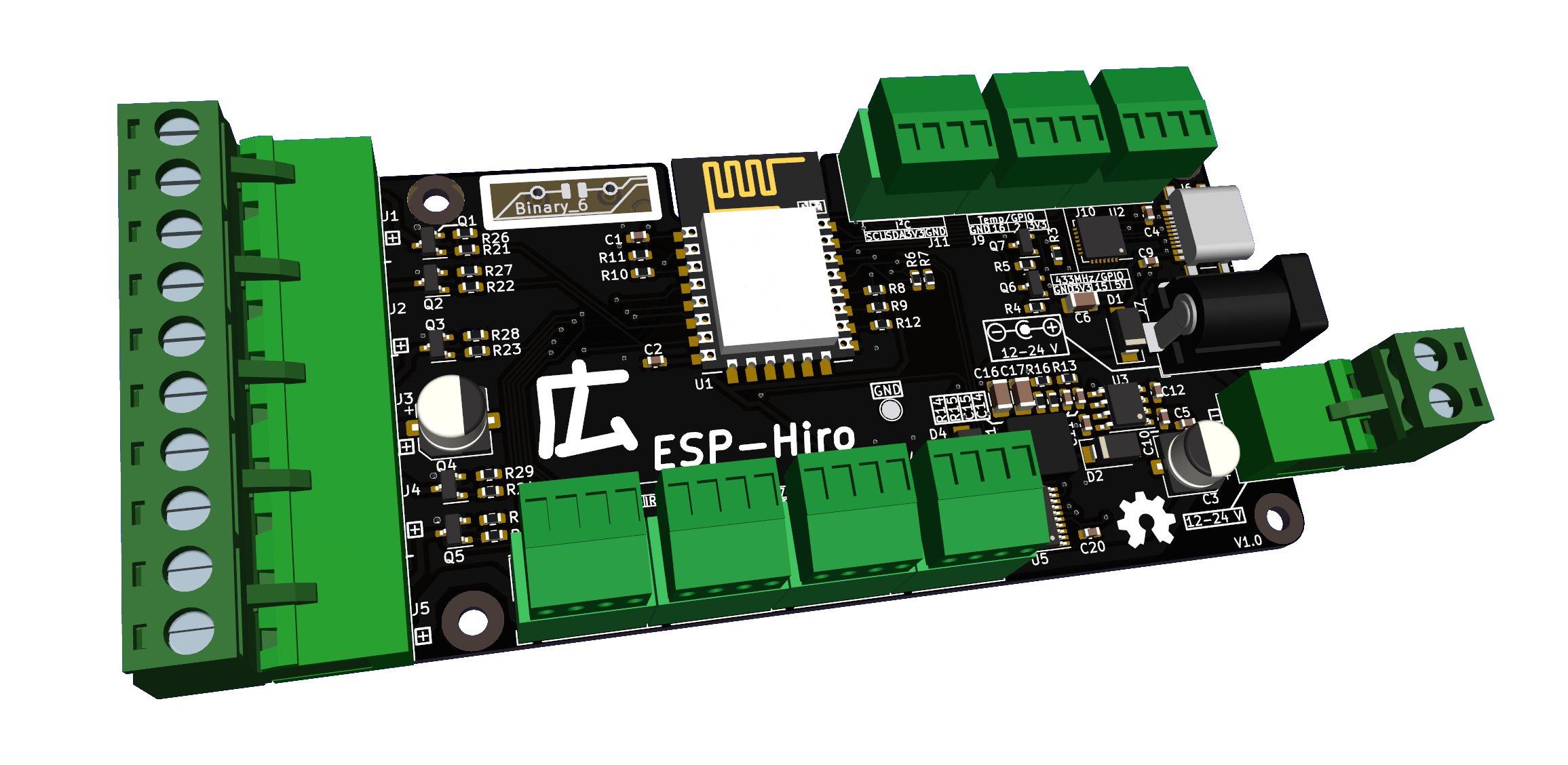
Main components on the ESP-Hiro
ESP-Hiro bill of materials (BOM)
79 components, 34 distinct parts — part numbers from the project's BOM.
| Qty | Part | Footprint | Refs |
|---|---|---|---|
| 1 | ESP-12E | ESP-12E_SMD | U1 |
| 1 | CP2102N-A01-GQFN28 | QFN-28-1EP_5x5mm_P0.5mm_EP3.35x3.35mm | U2 |
| 1 | TPS54331D | SOIC-8_3.9x4.9mm_P1.27mm | U3 |
| 1 | TLV75533PDBVR SE5218ALG-LF | SOT-23-5 | U4 |
| 1 | PCF8574A PCF8574APWR | TSSOP-20_4.4x6.5mm_P0.65mm | U5 |
| 5 | AO3400A | SOT-23 | Q1, Q2, Q3, Q4, Q5 |
| 2 | S8050_CORRECTPINS S8050_correctpins | SOT-23 | Q6, Q7 |
| 6 | CIKE2PINSOCK CiKe2PinSock | Cixi_Kefa_Elec_KF2EDGR-5.08-2P | J1, J2, J3, J4, J5, J8 |
| 1 | C720630 XUNPU TYPEC-304S-ACP16 | USB_C_Receptacle_XUNPU_TYPEC-304S-ACP16 | J6 |
| 1 | C381116 Barrel_Jack_Switch | BarrelJack_Horizontal | J7 |
| 7 | CIKE4PINSOCK CiKe4pinSock | CixiKefa_KF2EDGV_2.54_4xSocket | J9, J10, J11, J12, J13, J14, J15 |
| 2 | SS14 | D_SMA | D1, D2 |
| 1 | SS14 | D_SMA | D4 |
| 1 | 6.8UH 6.8uH | Sunltech_SLO0630H | L1 |
| 6 | 100NF 100nF | C_0603_1608Metric | C1, C2, C4, C5, C9, C20 |
| 1 | 100UF 100uF | CP_Elec_6.3x5.8 | C3 |
| 1 | 10UF 10uF | C_1206_3216Metric | C6 |
| 1 | 4.7UF 100uF | CP_Elec_6.3x5.8 | C7 |
| 3 | 10NF 10nF | C_0603_1608Metric | C10, C11, C12 |
| 1 | 4.7NF 4.7nF | C_0603_1608Metric | C14 |
Show 14 more
| Qty | Part | Footprint | Refs |
|---|---|---|---|
| 1 | 33PF 33pF | C_0603_1608Metric | C15 |
| 2 | 47UF 47uF | C_1206_3216Metric | C16, C17 |
| 2 | 1UF 1uF | C_0603_1608Metric | C18, C19 |
| 2 | 5.1K | R_0603_1608Metric | R1, R2 |
| 1 | 470R | R_0603_1608Metric | R3 |
| 15 | 12K 12k | R_0603_1608Metric | R4, R5, R6, R7, R8, R9, R10, R11 +7 |
| 1 | 47K | R_0603_1608Metric | R13 |
| 1 | 10K 10k | R_0603_1608Metric | R14 |
| 1 | 1.8K 1.5k | R_0603_1608Metric | R15 |
| 1 | 100R 220R | R_0603_1608Metric | R16 |
| 1 | 180R | R_0603_1608Metric | R17 |
| 1 | 3k | R_0603_1608Metric | R19 |
| 1 | 33R | R_0603_1608Metric | R20 |
| 5 | 100R | R_0603_1608Metric | R21, R22, R23, R24, R25 |
ESP-Hiro design files
The KiCad project lives in the Chrismettal/ESP-Hiro repository on GitHub; these links point at the commit this page was built from.
ESP-Hiro: common questions
What microcontroller does the ESP-Hiro use?
The ESP-Hiro is built around the ESP-12E, from the ESP8266 family.
How big is the ESP-Hiro PCB?
The ESP-Hiro measures 100 × 50 mm, has 2 copper layers and is 1.6 mm thick.
How many components are on the ESP-Hiro?
79 components, from 34 distinct parts, with part numbers taken from the project's own BOM. The full bill of materials is listed on this page.
Where can I download the ESP-Hiro design files?
From the Chrismettal/ESP-Hiro repository on GitHub, which has the KiCad layout, the schematic and the BOM; the links under Design files point to each one.
Can I use the ESP-Hiro design in my own project?
Yes, under the terms of its GPL-3.0 license, which Chrismettal chose for the repository.
Can I test firmware for the ESP-Hiro without the hardware?
Yes. HardLabs builds a simulation of the board from its netlist and BOM, so you can run and debug ESP8266 firmware against it before you order a PCB.
More boards in ESP-Hiro
Similar boards
 ESP8266
ESP8266ControllerCircuit
stuartpittaway
75 × 30 mm20 parts2LCC-BY-NC-4.01.1k ESP8266
HASwitchPlate
aderusha
60 × 40 mm8 parts2LMIT738 ESP8266
Goatgdo
Kaldek
32.9 × 53.3 mm23 parts2LMIT506 ESP8266
RatGDO-OpenSource-D1Mini-ESP8266
47.8 × 63.3 mm12 parts2LMIT506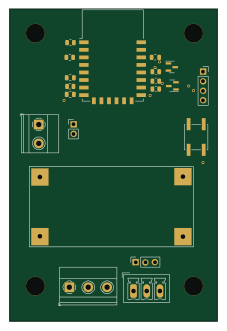 ESP8266
RatGDO-OpenSource-Bare-ESP8266
55 × 82.7 mm20 parts2LMIT506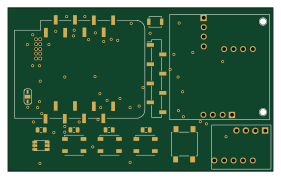 ESP8266
Iaq board
nkitanov
70.1 × 43.2 mm17 parts2LNo license398