
Badge dc24

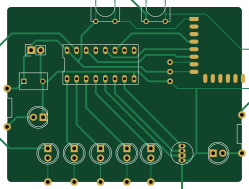
About the Badge dc24 PCB
Badge dc24 is an open source ESP8266 PCB design by dodgymike, published on GitHub. It is a 2-layer board measuring 62.2 × 46.4 mm, with 22 components from 11 distinct parts.
Its main chip is the ESP-12E, from the ESP8266 family. Other key parts include the TSOP38238 and 74HC595. By type, the board carries 7 resistors, 5 inductors, 3 ICs, 2 LEDs, 1 connector and 1 diode.
It belongs with the wearables designs in this gallery.
Main components on the Badge dc24
Badge dc24 bill of materials (BOM)
22 components, 11 distinct parts — part numbers from the project's BOM.
| Qty | Part | Footprint | Refs |
|---|---|---|---|
| 1 | ESP-12E | ESP-12E | U1 |
| 1 | TSOP38238 | ir-receiver-tsop | U2 |
| 1 | 74HC595 | 74HC595N | U3 |
| 1 | CONN_01X02 | Pin_Header_Straight_1x02 | P1 |
| 2 | SW_PUSH | SW_PUSH_SMALL | PROGRAM1, RESET1 |
| 2 | LED | LED-5MM | Infrared1, Power1 |
| 1 | Led_RGB_CA | LED-RGB-5MM_Common_Cathode | D1 |
| 2 | LEDs:LED-5MM | LED-5MM | L1, L5 |
| 3 | LED | LED-5MM | L2, L3, L4 |
| 1 | 10uF | C_Disc_D7.5_P5 | C1 |
| 7 | RC0805JR-07100RL 100 | Resistor_Horizontal_RM10mm | R1, R2, R3, R4, R5, R6, R7 |
Badge dc24 design files
The KiCad project lives in the dodgymike/bsidescpt2016badge repository on GitHub; these links point at the commit this page was built from.
Badge dc24: common questions
What microcontroller does the Badge dc24 use?
The Badge dc24 is built around the ESP-12E, from the ESP8266 family.
How big is the Badge dc24 PCB?
The Badge dc24 measures 62.2 × 46.4 mm, has 2 copper layers and is 1.6 mm thick.
How many components are on the Badge dc24?
22 components, from 11 distinct parts, with part numbers taken from the project's own BOM. The full bill of materials is listed on this page.
Where can I download the Badge dc24 design files?
From the dodgymike/bsidescpt2016badge repository on GitHub, which has the KiCad layout and the BOM; the links under Design files point to each one.
Can I use the Badge dc24 design in my own project?
The repository has no license, so all rights stay with dodgymike. Use it as a reference, and ask the author before reusing the design.
Can I test firmware for the Badge dc24 without the hardware?
Yes. HardLabs builds a simulation of the board from its netlist and BOM, so you can run and debug ESP8266 firmware against it before you order a PCB.
More boards in bsidescpt2016badge
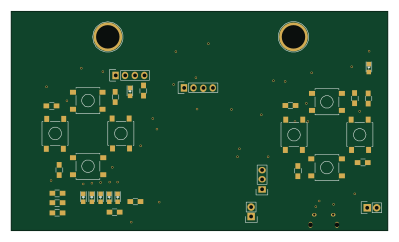 ESP8266
Paper badges
99.6 × 57.9 mm66 parts2LNo license0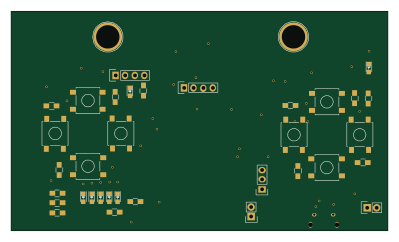 ESP8266
Badge bsides v0.7
99.6 × 57.9 mm66 parts2LNo license0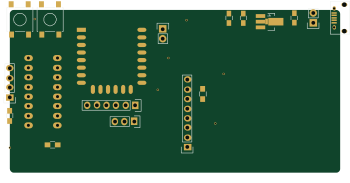 ESP8266
Badge dc24-with lcd all smd and breakout
87.3 × 43 mm32 parts2LNo license0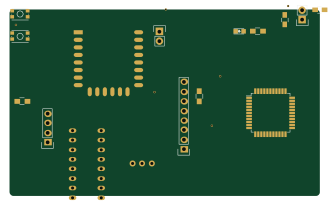 ESP8266
Badge dc24-with lcd
82.2 × 49.4 mm31 parts2LNo license0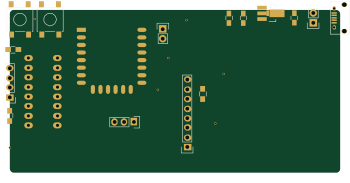 ESP8266
Badge dc24-with lcd all smd
87.3 × 43 mm31 parts2LNo license0
Similar boards
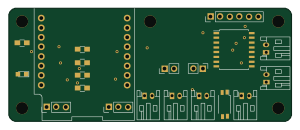 ESP8266
ESP8266ControllerCircuit
stuartpittaway
75 × 30 mm20 parts2LCC-BY-NC-4.01.1k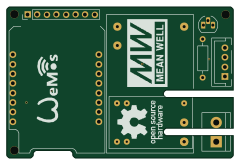 ESP8266
HASwitchPlate
aderusha
60 × 40 mm8 parts2LMIT738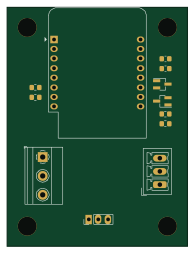 ESP8266
RatGDO-OpenSource-D1Mini-ESP8266
Kaldek
47.8 × 63.3 mm12 parts2LMIT506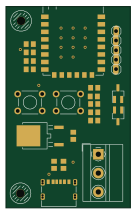 ESP8266
Goatgdo
32.9 × 53.3 mm23 parts2LMIT506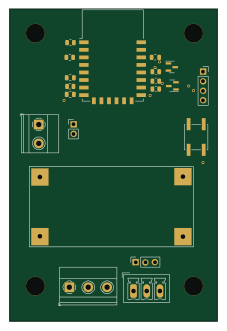 ESP8266
RatGDO-OpenSource-Bare-ESP8266
55 × 82.7 mm20 parts2LMIT506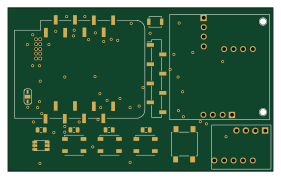 ESP8266
Iaq board
nkitanov
70.1 × 43.2 mm17 parts2LNo license398