
ESP32-USB-C-Development-Board

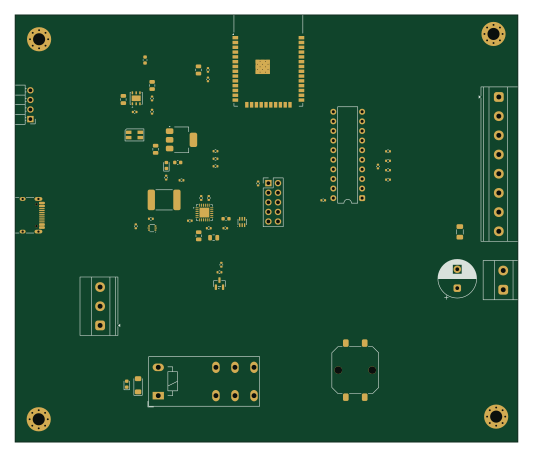
About the ESP32-USB-C-Development-Board
ESP32-USB-C-Development-Board is an open source ESP32 PCB design by hooria17webset, published on GitHub. It is a 4-layer board measuring 133 × 113 mm, with 57 components from 31 distinct parts.
Its main chip is the ESP32-WROOM-32D, from the ESP32 family. Other key parts include the USBLC6-2P6, CP2104, Si7021-A20, 74HC245 and LM1117MP-3.3. By type, the board carries 19 resistors, 15 capacitors, 6 ICs, 6 connectors, 4 diodes and 2 transistors.
It belongs with the iot & wireless, dev boards & breakouts and usb & debug tools designs in this gallery.
From the project
A compact ESP32 development board featuring a USB-C port for power and programming, designed for IoT and embedded projects.
A compact, custom-designed ESP32 development board featuring a USB-C port for power delivery and programming. Built for makers, hobbyists, and engineers working on IoT, wireless, and embedded applications. Features
- Microcontroller: ESP32 (dual-core Xtensa LX6, up to 240 MHz) - Connectivity: Wi-Fi 802.11 b/g/n + Bluetooth 4.2 / BLE - USB Interface: USB-C port for power and serial programming - Flash Memory: 4MB (expandable depending on variant) - GPIO: Multiple digital I/O, ADC, DAC, SPI, I2C, UART, PWM - Power Supply:5V via USB-C or external 3.3V regulated input - Onboard LED:Status…
Main components on the ESP32-USB-C-Development-Board
ESP32-USB-C-Development-Board bill of materials (BOM)
57 components, 31 distinct parts.
| Qty | Part | Footprint | Refs |
|---|---|---|---|
| 1 | ESP32-WROOM-32D | ESP32-WROOM-32D | U1 |
| 1 | USBLC6-2P6 | SOT-666 | U2 |
| 1 | CP2104 | QFN-24-1EP_4x4mm_P0.5mm_EP2.6x2.6mm | U3 |
| 1 | Si7021-A20 | DFN-6-1EP_3x3mm_P1mm_EP1.5x2.4mm | U4 |
| 1 | 74HC245 | DIP-20_W7.62mm | U5 |
| 1 | LM1117MP-3.3 | SOT-223-3_TabPin2 | U6 |
| 1 | UMH3N | SOT-363_SC-70-6 | Q1 |
| 1 | BC817 | SOT-23 | Q2 |
| 1 | USB_C_Receptacle_USB2.0_16P | USB_C_Receptacle_HRO_TYPE-C-31-M-12 | J1 |
| 1 | Conn_01x04_Pin | PinHeader_1x04_P2.54mm_Horizontal | J2 |
| 1 | Screw_Terminal_01x03 | TerminalBlock_Phoenix_MKDS-1,5-3-5.08_1x03_P5.08mm_Horizontal | J3 |
| 1 | Screw_Terminal_01x08 | TerminalBlock_Phoenix_MKDS-1,5-8-5.08_1x08_P5.08mm_Horizontal | J4 |
| 1 | Screw_Terminal_01x02 | TerminalBlock_Phoenix_MKDS-1,5-2-5.08_1x02_P5.08mm_Horizontal | J5 |
| 1 | Conn_02x05_Odd_Even | PinHeader_2x05_P2.54mm_Vertical | J6 |
| 1 | Fuse | Fuse_1206_3216Metric | F1 |
| 1 | 1A | Fuse_2920_7451Metric | F2 |
| 1 | RT314A05 | Relay_SPDT_Schrack-RT1-16A-FormC_RM5mm | K1 |
| 1 | SW_SPST | SW_Push_1P1T_NO_CK_PTS125Sx85PSMTR | SW1 |
| 1 | LL4148 | D_MiniMELF | D1 |
| 2 | LED | LED_0603_1608Metric | D2, D4 |
Show 11 more
| Qty | Part | Footprint | Refs |
|---|---|---|---|
| 1 | LED_RBGA | LED_RGB_Wuerth-PLCC4_3.2x2.8mm_150141M173100 | D3 |
| 1 | FB | L_0603_1608Metric | FB1 |
| 1 | 1000u/25V | CP_Radial_D10.0mm_P5.00mm | C1 |
| 6 | 22u | C_0805_2012Metric | C7, C10, C13, C14, C16, C20 |
| 7 | 100n | C_0402_1005Metric | C8, C11, C15, C17, C18, C19, C21 |
| 1 | 4u7 | C_0603_1608Metric | C9 |
| 4 | 5k | R_0402_1005Metric | R1, R2, R4, R5 |
| 4 | 10k | R_0402_1005Metric | R3, R7, R14, R19 |
| 5 | 1k | R_0402_1005Metric | R6, R8, R9, R10, R13 |
| 2 | 4k7 | R_0402_1005Metric | R11, R12 |
| 4 | 22R | R_0402_1005Metric | R15, R16, R17, R18 |
ESP32-USB-C-Development-Board design files
The KiCad project lives in the hooria17webset/ESP32-USB-C-Development-Board repository on GitHub; these links point at the commit this page was built from.
- Layoutdefault.kicad_pcb
- Schematicdefault.kicad_sch
ESP32-USB-C-Development-Board: common questions
What microcontroller does the ESP32-USB-C-Development-Board use?
The ESP32-USB-C-Development-Board is built around the ESP32-WROOM-32D, from the ESP32 family.
How big is the ESP32-USB-C-Development-Board?
The ESP32-USB-C-Development-Board measures 133 × 113 mm, has 4 copper layers and is 1.604 mm thick.
How many components are on the ESP32-USB-C-Development-Board?
57 components, from 31 distinct parts. The full bill of materials is listed on this page.
Where can I download the ESP32-USB-C-Development-Board design files?
From the hooria17webset/ESP32-USB-C-Development-Board repository on GitHub, which has the KiCad layout and the schematic; the links under Design files point to each one.
Can I use the ESP32-USB-C-Development-Board design in my own project?
The repository has no license, so all rights stay with hooria17webset. Use it as a reference, and ask the author before reusing the design.
Can I test firmware for the ESP32-USB-C-Development-Board without the hardware?
Yes. HardLabs builds a simulation of the board from its netlist and BOM, so you can run and debug ESP32 firmware against it before you order a PCB.
Similar boards
 ESP32
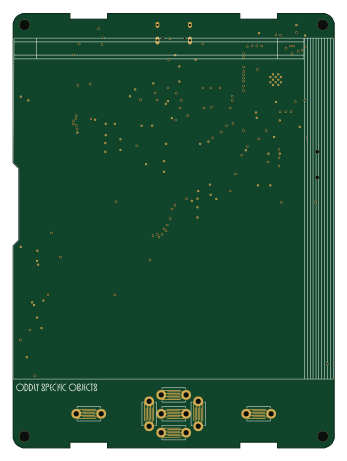
ESP32Open Book Abridged Edition
joeycastillo
85 × 115 mm65 parts2LCC-BY-SA-4.08.1k ESP32
ESP32Badge
atopile
56.3 × 39 mm239 parts4LMIT4.0k ESP32
ESP32Esp32 minimal
36.2 × 26.8 mm20 parts2LMIT4.0k ESP32
ESP32Racer
StuckAtPrototype
36 × 50.2 mm70 parts4LApache-2.03.8k ESP32
ESP32Controller
29 × 74 mm58 parts4LApache-2.03.8k ESP32
ESP32Bitaxe
skot
56.5 × 99.8 mm86 parts4LCERN-OHL-S-2.01.4k