DishyPi1

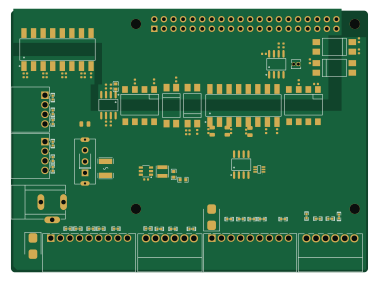
About the DishyPi1 PCB
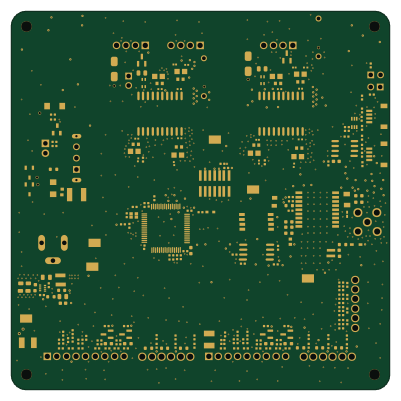
DishyPi1 is an open source PCB design by jrseti, published on GitHub under the MIT license. It is a 4-layer board measuring 94.6 × 69.3 mm, with 102 components from 38 distinct parts.
Other key parts include the CAT24C256WI-GT3, LTV-847S, LTV-827S-TA1, LTV-817S-TA1 and LTC4311ISC6#TRPBF. By type, the board carries 35 resistors, 29 diodes, 13 ICs, 13 capacitors, 7 connectors and 1 fuse.
From the project
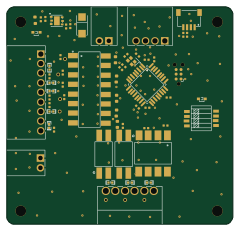
Various printed circuit board projects
The hardware part of the Dishy1Pi project is a Raspberry Pi Hat board which interfaces the Raspberry Pi GPIO pins with the satellite dish motor controllers, encoders, and various sensors. An important aspect of this board is that the Raspberry Pi is optically isolated from the hardware connected to the satellite dish.
Although this project is tailored to controlling a satellite dish, it can also be used for controlling other motor control systems that require isolation and encoder feedback.
Main components on the DishyPi1
DishyPi1 bill of materials (BOM)
102 components, 38 distinct parts.
| Qty | Part | Footprint | Refs |
|---|---|---|---|
| 1 | CAT24C256WI-GT3 | SOIC-8_L4.9-W3.9-P1.27-LS6.0-BL | U1 |
| 2 | LTV-847S | SMD-16_L20.0-W6.5-P2.54-LS10.2-BL | U2, U9 |
| 2 | LTV-827S-TA1 | LTV827S-TA1 | U3, U10 |
| 4 | LTV-817S-TA1 | LTV817S | U4, U5, U11, U12 |
| 1 | LTC4311ISC6#TRPBF | SC-70-6_L2.2-W1.3-P0.65-LS2.2-BL | U6 |
| 1 | ISO1540DR | SOIC-8_L4.9-W3.9-P1.27-LS6.0-BL | U7 |
| 1 | LM75BIMX-5/NOPB | SOIC-8_L4.9-W3.9-P1.27-LS6.0-BL | U8 |
| 1 | TPS561201DDCR | SOT-23-6_L2.9-W1.6-P0.95-LS2.8-BR | U13 |
| 2 | KF2EDGR-2.54-9P | CONN-TH_9P-P2.54_KF2EDGR-2.54-9P | CN2, CN6 |
| 2 | KF2EDGR-2.54-6P | CONN-TH_KF2EDGR-2.54-6P | CN3, CN7 |
| 2 | KF2EDGR-2.54-4P | CONN-TH_4P-P2.54_KF2EDGR-2.54-4P | CN4, CN5 |
| 1 | Conn_02x20_Odd_Even | PinSocket_2x20_P2.54mm_Vertical | J1 |
| 1 | DC-005-2.5A-2.0 | CONN-TH_DC-005-2.5A-2.0 | DC1 |
| 1 | 1812L110/33MR | F1812 | F1 |
| 1 | 1.27MM/1*2P | HDR-TH_2P-P1.27-V-M | H1 |
| 1 | SS-12F49-G050 | SW-TH_SS-12F45-GXXX | SW2 |
| 24 | TPESD0402G05V | D0402-BI | D4, D5, D6, D7, D8, D9, D10, D11 +16 |
| 1 | SS34 | SMA_L4.3-W2.6-LS5.2-RD | D29 |
| 1 | SMBJ18A_C78412 | SMB_L4.6-W3.6-LS5.3-RD | D30 |
| 1 | LED | LED_1206_3216Metric | D32 |
Show 18 more
| Qty | Part | Footprint | Refs |
|---|---|---|---|
| 2 | SMBJ16A hongjiacheng | D_SMB | D33, D34 |
| 1 | 4.7uH | IND-SMD_L3.0-W3.0-1 | L1 |
| 6 | 100nF Samsung Electro-Mechanics | C_0402 | C3, C5, C6, C7, C8, C11 |
| 1 | 100pF FH(Guangdong Fenghua Advanced Tech) | C_0402 | C4 |
| 1 | 47uF YAGEO | C1206 | C9 |
| 1 | 100nF Samsung Electro-Mechanics | C0603 | C10 |
| 3 | 10uF Samsung Electro-Mechanics | C_0805 | C12, C13, C14 |
| 1 | 100nF YAGEO | C_0805 | C15 |
| 2 | 3.9kΩ UNI-ROYAL(Uniroyal Elec) | R_0402 | R2, R3 |
| 12 | 1kΩ UNI-ROYAL(Uniroyal Elec) | R_0402 | R4, R6, R8, R12, R13, R14, R21, R23 +4 |
| 6 | 10kΩ UNI-ROYAL(Uniroyal Elec) | R_0402 | R5, R7, R9, R22, R24, R26 |
| 2 | 220Ω UNI-ROYAL(Uniroyal Elec) | R_0402 | R10, R27 |
| 4 | 22kΩ UNI-ROYAL(Uniroyal Elec) | R_0402 | R11, R16, R28, R33 |
| 2 | 470Ω UNI-ROYAL(Uniroyal Elec) | R_0402 | R15, R32 |
| 4 | 4.7kΩ UNI-ROYAL(Uniroyal Elec) | R_0402 | R17, R18, R19, R20 |
| 1 | 54.9k UNI-ROYAL(Uniroyal Elec) | R0603 | R34 |
| 1 | 10k UNI-ROYAL(Uniroyal Elec) | R0603 | R35 |
| 1 | 2.2kΩ UNI-ROYAL(Uniroyal Elec) | R_0402 | R36 |
DishyPi1 design files
The KiCad project lives in the jrseti/pcbs repository on GitHub; these links point at the commit this page was built from.
- Layoutdishy1pi/DishyPi1.kicad_pcb
- Schematicdishy1pi/DishyPi1.kicad_sch
DishyPi1: common questions
How big is the DishyPi1 PCB?
The DishyPi1 measures 94.6 × 69.3 mm, has 4 copper layers and is 1.6 mm thick.
How many components are on the DishyPi1?
102 components, from 38 distinct parts. The full bill of materials is listed on this page.
Where can I download the DishyPi1 design files?
From the jrseti/pcbs repository on GitHub, which has the KiCad layout and the schematic; the links under Design files point to each one.
Can I use the DishyPi1 design in my own project?
Yes, under the terms of its MIT license, which jrseti chose for the repository.